 0xsch1zo/nullgate
Library that eases the use of indirect syscalls. Quite interesting AV/EDR bypass as PoC.

This project implements a comfortable and modern way to use the NTAPI functions using indirect syscalls, coupled with the FreshyCalls method with a little twist for dynamic syscall number retrieval. It also uses a technique that I haven't seen being mentioned to bypass windows defender's memory scanning. The project implements a classic PoC process injector using the library. Convenient functions for encryption are also available.
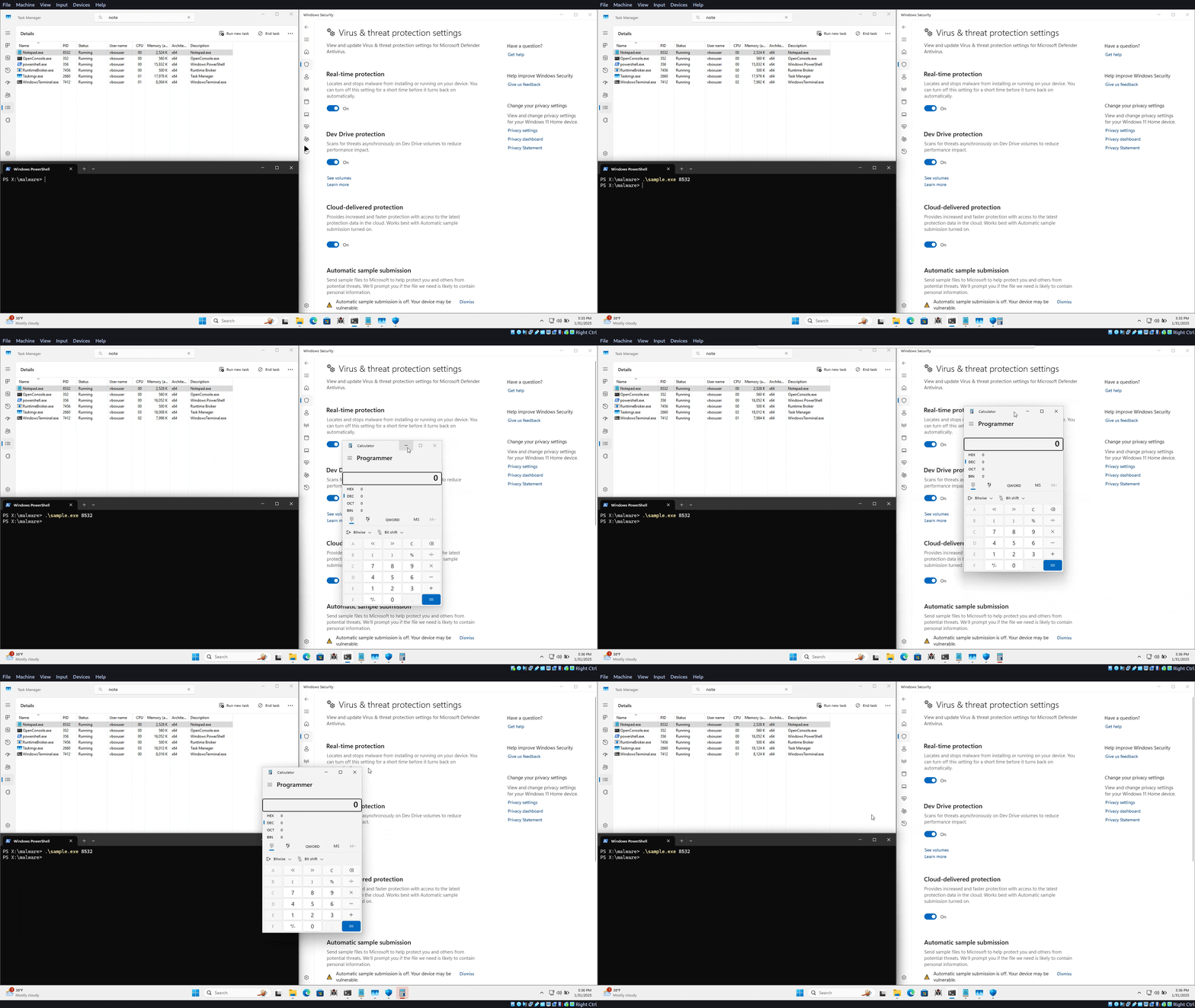
To build the sample use -DNULLGATE_BUILD_SAMPLE=ON.
If you built nullgate directly it will be accessible at <build_dir>/sample.exe, if you built it as a dependency at <build_dir>/_deps/nullgate-build/sample.exe.
On windows because the build destinations are weird, it will probably be at the same base directories of locations of samples but probably nested a bunch more.
It takes a PID that you want to inject shellcode into as an argument.
[!WARNING] If you are using linux you need to have the mingw cross-compiler installed. On Arch for example you can do
pacman -S mingw-w64-gcc. Then use the-DNULLGATE_CROSSCOMPILE=ONoption to set mingw as the default compiler.
[!TIP] It is also recommended to strip the resulting binary to decrease the possibility of detection
git clone https://github.com/0xsch1zo/NullGate
cd NullGate
cmake . -B build -DNULLGATE_BUILD_SAMPLE=ON
cmake --build build/
It can be built using the -DNULLGATE_DEPRECATED_HASHER flag.
CMake FetchContent is supported. Here is an example of a simple CMakeLists.txt:
cmake_minimum_required(VERSION 3.25)

include(FetchContent)

FetchContent_Declare(nullgate
    GIT_REPOSITORY https://github.com/0xsch1zo/NullGate
    GIT_TAG 1.2.0
)

FetchContent_MakeAvailable(nullgate)

project(test)

add_executable(test
    main.cpp
)

target_link_libraries(test
    PRIVATE nullgate
)
The linking is done statically so you don't have to worry about symbols being visible.
[!NOTE] The following examples will use
namespace ng = nullgate
The usage is pretty straight forward, here is a snippet demonstrating the main functionality:
ng::syscalls syscalls;
typedef NTSTATUS NTAPI NtAllocateVirtualMemory(
_In_ HANDLE ProcessHandle,
_Inout_ _At_(*BaseAddress,
_Readable_bytes_(*RegionSize) _Writable_bytes_(*RegionSize)
_Post_readable_byte_size_(*RegionSize)) PVOID *BaseAddress,
_In_ ULONG_PTR ZeroBits, _Inout_ PSIZE_T RegionSize,
_In_ ULONG AllocationType, _In_ ULONG PageProtection);
NTSTATUS status = syscalls.SCall<NtAllocateVirtualMemory>(
ng::obfuscation::fnv1Const("NtAllocateVirtualMemory"), processHandle,
&buf, 0, ®ionSize, MEM_RESERVE | MEM_COMMIT, PAGE_EXECUTE_READWRITE);
There's builtin type-safety. You just need to provide the definition of the nt function that you want to call! You can easily get that from ntdoc. This is the recommended way to use the lib.
For people who don't like c++ templating black magic or something the previous interface is still available:
NTSTATUS status = syscalls.Call(ng::obfuscation::fnv1Const("NtAllocateVirtualMemory"),
processHandle, (PVOID)&buf, (ULONG_PTR)0, ®ionSize,
(ULONG)(MEM_RESERVE | MEM_COMMIT), (ULONG)PAGE_EXECUTE_READWRITE);
Using this interface you need to cast the arguments to the right type, not doing this may cause problems.
constexpr uint64_t hash = ng::obfuscation::fnv1Const("NtAllocateVirtualMemory");
The previously demonstrated fnv1Const method brings the joys of modern C++ to the maldev world. It is a consteval function, so it is guaranteed that it will get evaluated at compile time, replacing the readable function name with a fnv1 hash.
There is also a runtime equivalent called fnv1Runtime but of course it doesn't add the benefit of having our function names obfuscated. It is used by the implementation to check which function inside of ntdll to get the syscall number of.
There are three routines for xor "encryption":
constexpr ng::obfuscation::ConstData xored = ng::obfuscation::xorConst("some string");
std::cout << xored.string();
Possible output:
<Y:-E&X0
This routine similarly to the fnv1Const function, is evaluated at compiler time, so "some string" will never appear in the binary, because the string will be stored in its encrypted form.
But hey we need to actually make use of that data! ConstData is a thin wrapper around raw bytes that is of constant size.
It has two methods raw() and string().
raw() returns an std::vector<unsigned char> and string as the name suggests returns an std::string.
[!NOTE] If you need to construct
ConstDatadirectly with a string literal usestd::to_arrayto construct an intermediate array passed down toConstData. Please note however that with this approachConstDatawill be storing the additional null character of the literal.
Of course we need a way to decrypt this and use it, which is the next function we will cover.
xorRuntime is the second routine that is available.
As the name suggests it is the runtime equivalent of xorConst.
Please note that it doesn't have to only be used for decryption it works both ways, although using it for encryption doesn't have the benefits of obfuscating the string at compile time.
ng::obfuscation::ConstData xored = ng::obfuscation::xorConst("some string");
ng::obfuscation::ConstData data = ng::obfuscation::xorRuntime(xored);
assert(data.string() == "some string");

std::string dynamicString = "some data of dynamic size";
auto dynamicData = ng::obfuscation::DynamicData(dynamicString);
auto xoredDynamic = ng::obfuscation::xorRuntime(dynamicData);
auto unxoredDynamic = ng::obfuscation::xorRuntime(xoredDynamic);
assert(unxoredDynamic.string() == dynamicString);
DynamicData has the same methods as ConstData with some added constructors for interoperability, and as the name suggests can be of size not known at compile time.
xorRuntime accepts both DynamicData and ConstData.
While we could always decrypt at runtime by first calling xorConst and passing the result to xorRuntime that's kind of tedious
Here comes the solution to this problem, the cherry on top which is xorRuntimeDecrypted it is a handy function for string literals that don't need to be operated on while they're in the encrypted state.
It encrypts the string literal at compile time and then decrypts it at runtime all in one call. Isn't it cool!.
ng::obfuscation::ConstData text = ng::obfuscation::xorRuntimeDecrypted<"some string">();
assert(data.string() == "some string");
Now someone might say everything is great but where is the key? In nullgate 1.2 the key gets randomly generated per each fresh build made!(meaning the cmake command is run) This reduces the chance of getting signatured even more.
The core of the issue is that when we call NtCreateRemoteThreadEx or NtCreateProcess, a memory scan gets triggered and our signatured as hell msfvenom payload gets detected.
