 0xblackash/cve-2026-8932
CVE-2026-8932





The oldest security vulnerability ever fixed in libcurl—remaining unnoticed for over 25 years.
CVE-2026-8932 is a security vulnerability in libcurl where the library may incorrectly reuse an existing TLS connection after mutual TLS (mTLS) client authentication settings have changed.
Because certain private key-related options were not included in libcurl's connection matching logic, an existing authenticated connection could be reused even when a different client certificate configuration should have forced a new TLS handshake.
Note: The standalone curl command-line tool is not affected. Only applications embedding libcurl are vulnerable.
| Property | Value |
|---|---|
| CVE | CVE-2026-8932 |
| Component | libcurl |
| Type | Incomplete Connection Matching |
| CWE | CWE-305 (Authentication Bypass) |
| Severity | Low |
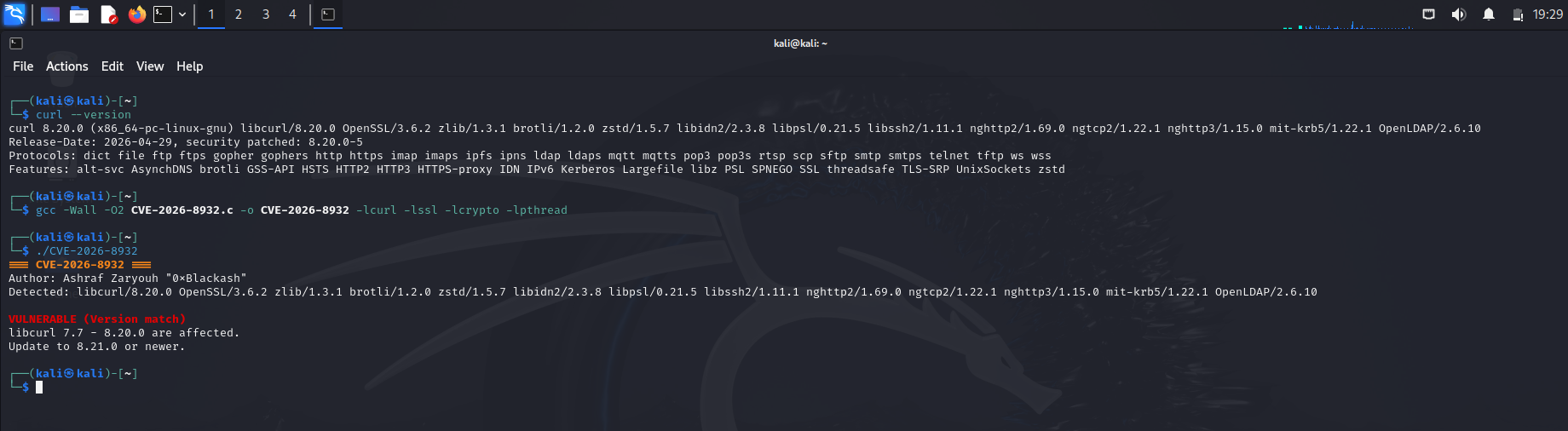
| Affected Versions | 7.7 – 8.20.0 |
| Fixed Version | 8.21.0 |
When libcurl evaluates whether an existing TLS connection can be reused, several SSL parameters are compared.
However, some mTLS private key configuration options were omitted from this comparison.
As a result:
Possible consequences include:
Although exploitation requires specific application behavior, environments relying heavily on mutual TLS authentication should update immediately.
| Version | Status |
|---|---|
| 7.7 | ❌ Vulnerable |
| 7.x | ❌ Vulnerable |
| 8.0.x | ❌ Vulnerable |
| 8.20.0 | ❌ Vulnerable |
| 8.21.0+ | ✅ Fixed |
Application
      │
      ▼
Creates TLS connection
      │
      ▼
Authenticates with Client Certificate A
      │
      ▼
Application switches to Certificate B
      │
      ▼
libcurl incorrectly reuses old TLS connection
      │
      ▼
Certificate A remains in use
      │
      ▼
Authentication mismatch
Unlike memory corruption vulnerabilities, this issue affects the logic governing TLS connection reuse.
Applications expecting a new authenticated session after changing client credentials may unknowingly continue using an old session, potentially violating authentication boundaries.
This vulnerability is notable because it:
Stay patched • Stay secure • Happy hacking responsibly

