 0xblackash/cve-2026-6471
Non-destructive PostgreSQL vulnerability checker for CVE-2026-6471. Audits server version and REPLICATION privileges to identify exposure to logical decoding authorization flaw, with remediation guidance.


A defensive, non-destructive vulnerability checker for CVE-2026-6471
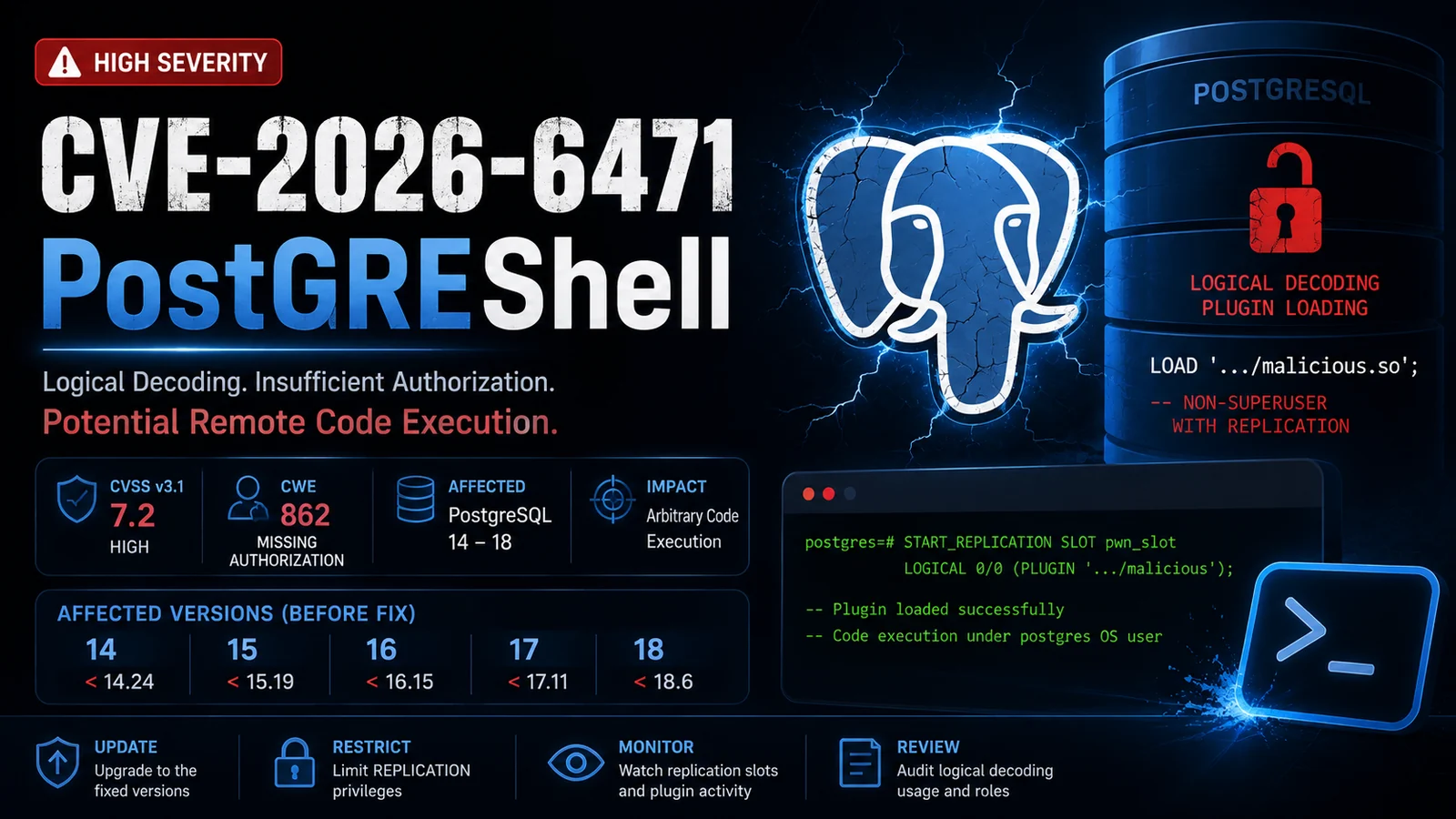
CVE-2026-6471 is a PostgreSQL authorization vulnerability involving the logical decoding subsystem.
The vulnerability can allow a PostgreSQL role possessing the REPLICATION privilege, but lacking superuser privileges, to cause the PostgreSQL server to load an attacker-controlled library accessible to the PostgreSQL operating-system account.
Successful exploitation can result in arbitrary code execution with the privileges of the PostgreSQL server process.
This repository provides a safe detection PoC designed for authorized security assessments.
⚠️ No malicious shared library is loaded and no operating-system command is executed by the checker.
| Property | Value |
|---|---|
| CVE | CVE-2026-6471 |
| Product | PostgreSQL |
| Component | Logical Decoding |
| CWE | CWE-862 — Missing Authorization |
| CVSS v3.1 | 7.2 High |
| Attack Vector | Network |
| Attack Complexity | Low |
| Privileges Required | High |
| User Interaction | None |
| Confidentiality | High |
| Integrity | High |
| Availability | High |
CVSS:3.1/AV:N/AC:L/PR:H/UI:N/S:U/C:H/I:H/A:H
Under the vulnerable conditions, an attacker who already possesses a PostgreSQL account with the required replication capability may potentially cross the database-to-operating-system privilege boundary.
┌──────────────────────┐
│   PostgreSQL User    │
│  REPLICATION = YES   │
└──────────┬───────────┘
           │
           ▼
┌──────────────────────┐
│   Logical Decoding   │
└──────────┬───────────┘
           │
           ▼
┌──────────────────────┐
│ Missing Authorization│
│      Validation      │
└──────────┬───────────┘
           │
           ▼
┌──────────────────────┐
│   Library Loading    │
└──────────┬───────────┘
           │
           ▼
┌──────────────────────┐
│ PostgreSQL OS User   │
└──────────────────────┘
The actual impact depends heavily on the privileges and filesystem permissions of the PostgreSQL operating-system account.
The PostgreSQL project's security advisory identifies the following affected branches:
| Branch | Affected | Fixed |
|---|---|---|
| PostgreSQL 14 | < 14.24 | 14.24 |
| PostgreSQL 15 | < 15.19 | 15.19 |
| PostgreSQL 16 | < 16.15 | 16.15 |
| PostgreSQL 17 | < 17.11 | 17.11 |
| PostgreSQL 18 | < 18.6 | 18.6 |
Upgrade to the latest security release available for your PostgreSQL branch.
This project intentionally performs non-destructive checks only.
The checker should verify:
REPLICATIONSELECT
version() AS postgres_version,
current_user AS current_user,
rolsuper AS is_superuser,
rolreplication AS has_replication
FROM pg_roles
WHERE rolname = current_user;
Example output:
postgres_version : PostgreSQL 17.x
current_user     : security_audit
is_superuser     : f
has_replication  : t
A vulnerable version combined with REPLICATION privileges should be treated as requiring remediation.
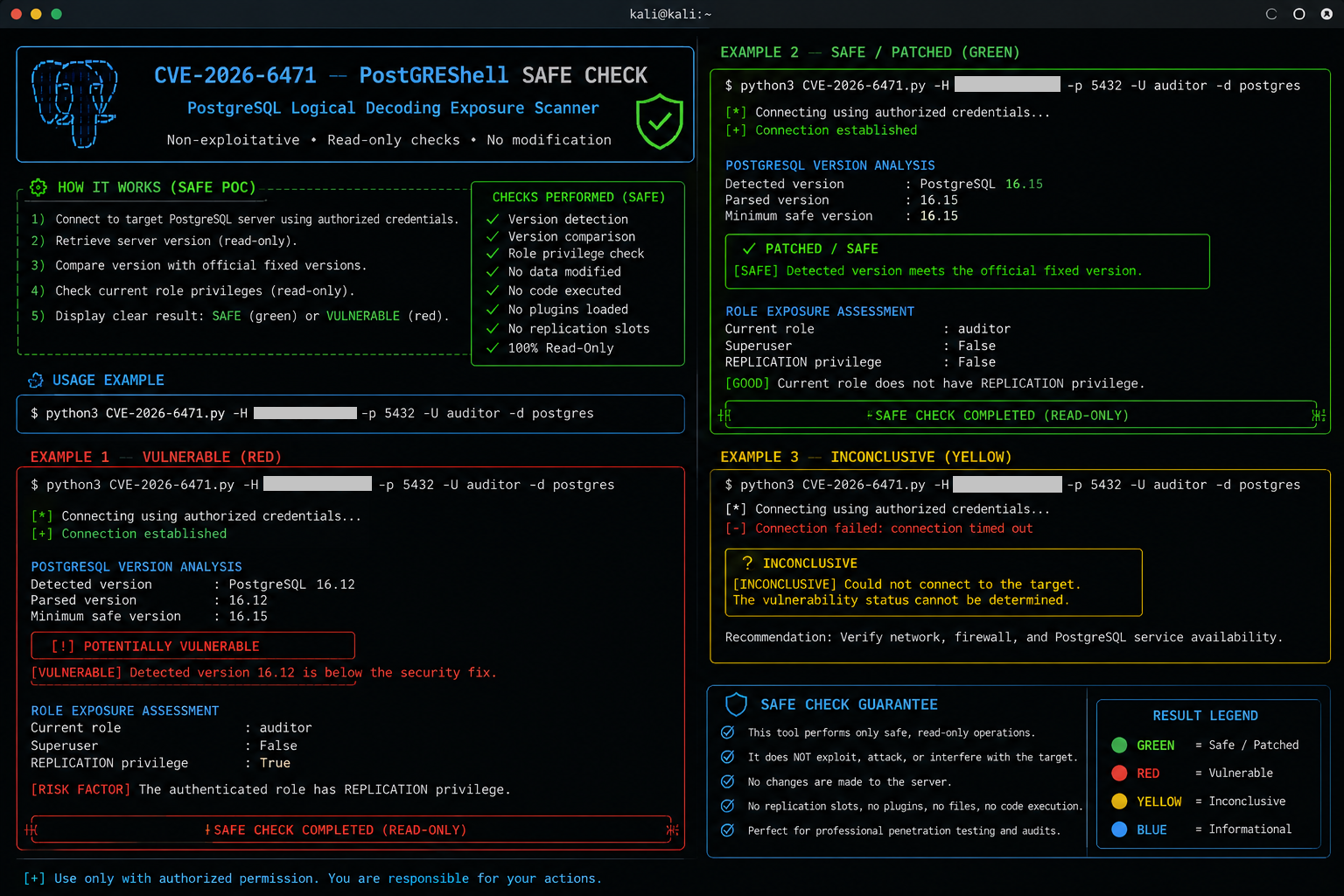
The PoC follows this workflow:
              ┌───────────────┐
              │ PostgreSQL    │
              │ Connection    │
              └───────┬───────┘
                      │
                      ▼
             ┌─────────────────┐
             │ Get Server      │
             │ Version         │
             └────────┬────────┘
                      │
                      ▼
             ┌─────────────────┐
             │ Check Current   │
             │ Role            │
             └────────┬────────┘
                      │
                      ▼
             ┌─────────────────┐
             │ Check           │
             │ REPLICATION     │
             └────────┬────────┘
                      │
                      ▼
             ┌─────────────────┐
             │ Compare Against │
             │ Fixed Releases  │
             └────────┬────────┘
                      │
              ┌───────┴────────┐
              ▼                ▼
        Potentially          Not
        Vulnerable         Affected
❌ Load an attacker-controlled .so
❌ Execute arbitrary SQL payloads
❌ Execute operating-system commands
❌ Spawn a reverse shell
❌ Modify PostgreSQL configuration
❌ Modify filesystem contents
❌ Create persistence
❌ Exploit production systems
This makes the checker suitable for controlled vulnerability assessment and inventory workflows.
Clone the repository:
git clone https://github.com/<YOUR-USERNAME>/CVE-2026-6471.git
cd CVE-2026-6471
Install the required Python dependency:
python3 -m pip install psycopg2-binary
Run the checker:
python3 CVE-2026-6471.py
Example:
╔════════════════════════════════════════════════════╗
║             CVE-2026-6471 SAFE CHECK               ║
║       PostgreSQL Logical Decoding Audit            ║
╚════════════════════════════════════════════════════╝

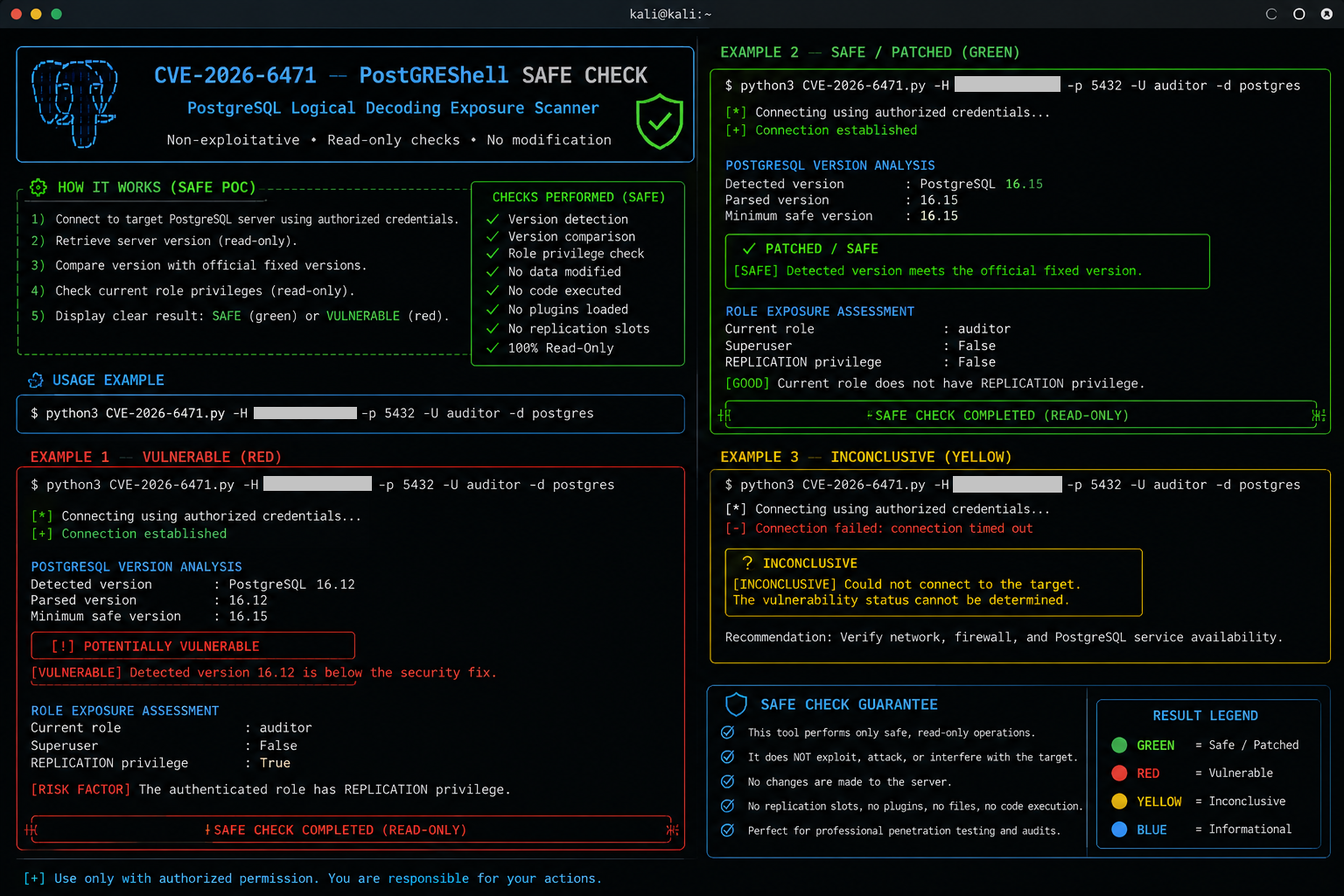
[+] Connecting to PostgreSQL...
[+] Server version : PostgreSQL 17.x
[+] Current role   : security_audit
[+] Superuser      : False
[+] Replication    : True

[!] PostgreSQL version requires security update
[!] REPLICATION privilege detected

[!] POTENTIALLY VULNERABLE
[!] Upgrade PostgreSQL to a fixed release.
Administrators can inspect replication-enabled roles with:
SELECT
    rolname,
    rolsuper,
    rolreplication
FROM pg_roles
WHERE rolreplication = true;
Review every returned account.
If an account does not require replication privileges, remove unnecessary privileges according to your operational requirements.
Install the appropriate fixed release:
14.24+
15.19+
16.15+
17.11+
18.6+
Prefer the latest available PostgreSQL security release rather than stopping at the minimum fixed version.
Identify accounts with replication capability:
SELECT
    rolname,
    rolreplication
FROM pg_roles
WHERE rolreplication = true;
Remove unnecessary replication privileges:
ALTER ROLE <role_name> NOREPLICATION;
Only perform privilege changes after confirming that the role is not required for legitimate replication infrastructure.
Pay particular attention to:
SUPERUSER
REPLICATION
LOGIN
CREATEDB
CREATEROLE
Use least privilege wherever possible.
A simplified conceptual implementation:
if postgres_version_is_affected:
    if role_has_replication:
        if not role_is_superuser:
            report("POTENTIALLY VULNERABLE")
        else:
            report("AFFECTED VERSION - SUPERUSER CONTEXT")
    else:
        report("AFFECTED VERSION - REPLICATION NOT PRESENT")
else:
    report("NOT AFFECTED")
The purpose of the checker is exposure identification, not exploitation.
| Result | Meaning |
|---|---|
| 🟢 NOT AFFECTED | PostgreSQL is running a fixed version |
| 🟡 UPDATE REQUIRED | Version is within an affected branch |
| 🟠 REPLICATION DETECTED | Current role has replication capability |
| 🔴 POTENTIALLY VULNERABLE | Affected version + relevant privilege |
| ⚪ INSUFFICIENT ACCESS | Scanner cannot inspect required role information |
REPLICATION roles. INTERNET
│
▼
┌─────────────┐
│ Firewall │
└──────┬──────┘
│
▼
┌─────────────┐
│ PostgreSQL │
│ Server │
└──────┬──────┘
│
┌─────────┴─────────┐
▼ ▼
Least Privilege Monitoring
│ │
▼ ▼
Role Controls SIEM / Alerts
Restrict PostgreSQL network exposure and avoid exposing database services directly to untrusted networks.
Recommended testing setup:
┌───────────────────────────────────┐
│        Isolated Lab Network       │
│                                   │
│  ┌────────────┐   ┌────────────┐  │
│  │ Scanner    │──▶│ PostgreSQL │  │
│  │  Machine   │   │ Test Host  │  │
│  └────────────┘   └────────────┘  │
│                                   │
│       No Production Systems       │
└───────────────────────────────────┘
Use a disposable PostgreSQL installation or dedicated lab environment when validating security tooling.
This project is intended strictly for defensive security research, vulnerability assessment, and authorized testing.
The included methodology is designed to identify potentially vulnerable PostgreSQL installations without weaponizing the vulnerability.
Do not use this project against systems that you do not own or have explicit authorization to assess.
The author is not responsible for misuse, damage, data loss, service interruption, or unauthorized access resulting from this project.
Cybersecurity Research • Vulnerability Analysis • Defensive Tooling
Research → Verify → Document → Remediate
Contributions are welcome.
When submitting improvements:
If this project helped your security research, consider giving it a ⭐