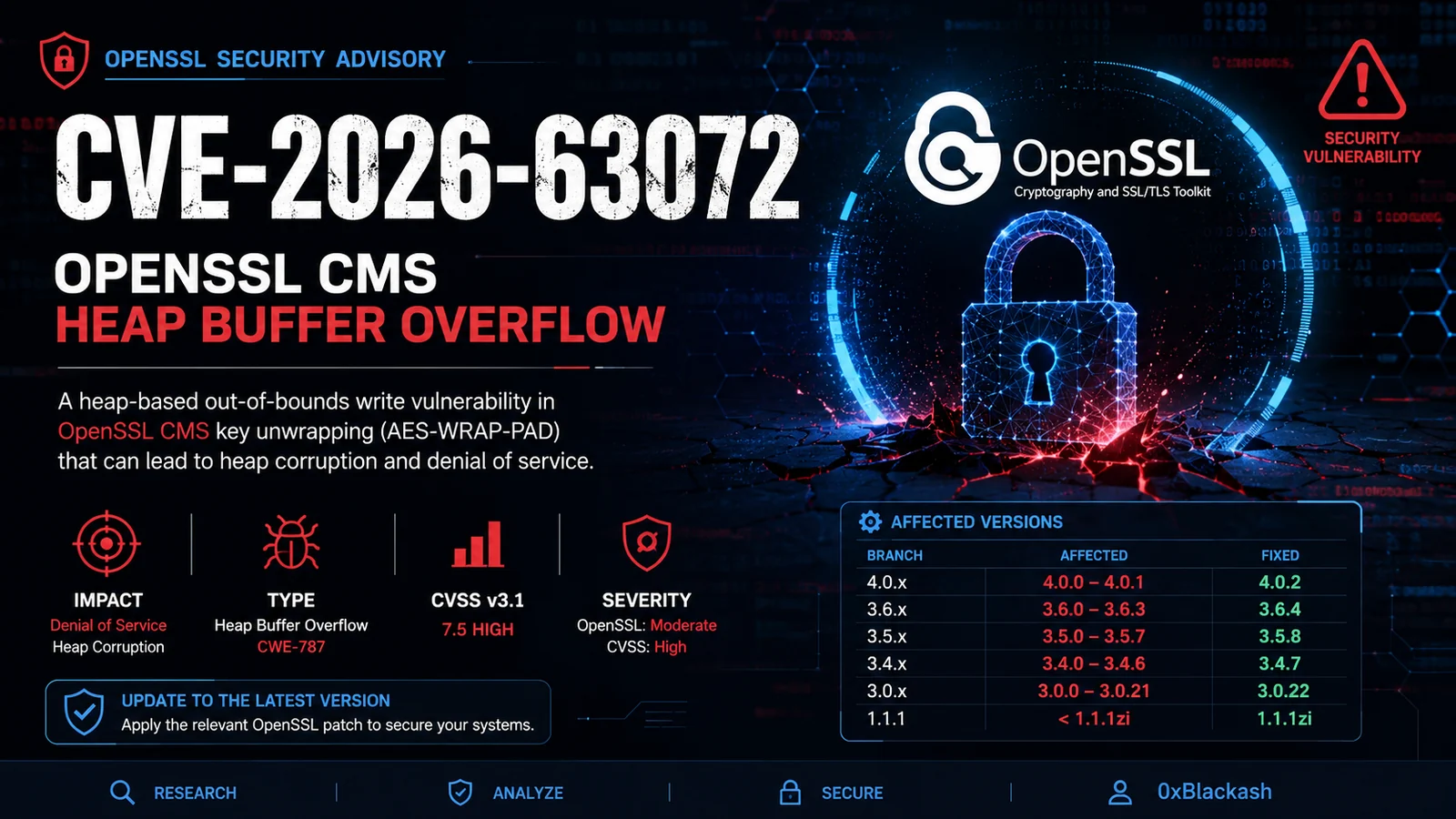
 0xblackash/cve-2026-63072
Technical analysis of CVE-2026-63072, a heap buffer overflow in OpenSSL CMS key unwrapping, covering root cause, affected versions, detection, and mitigation.

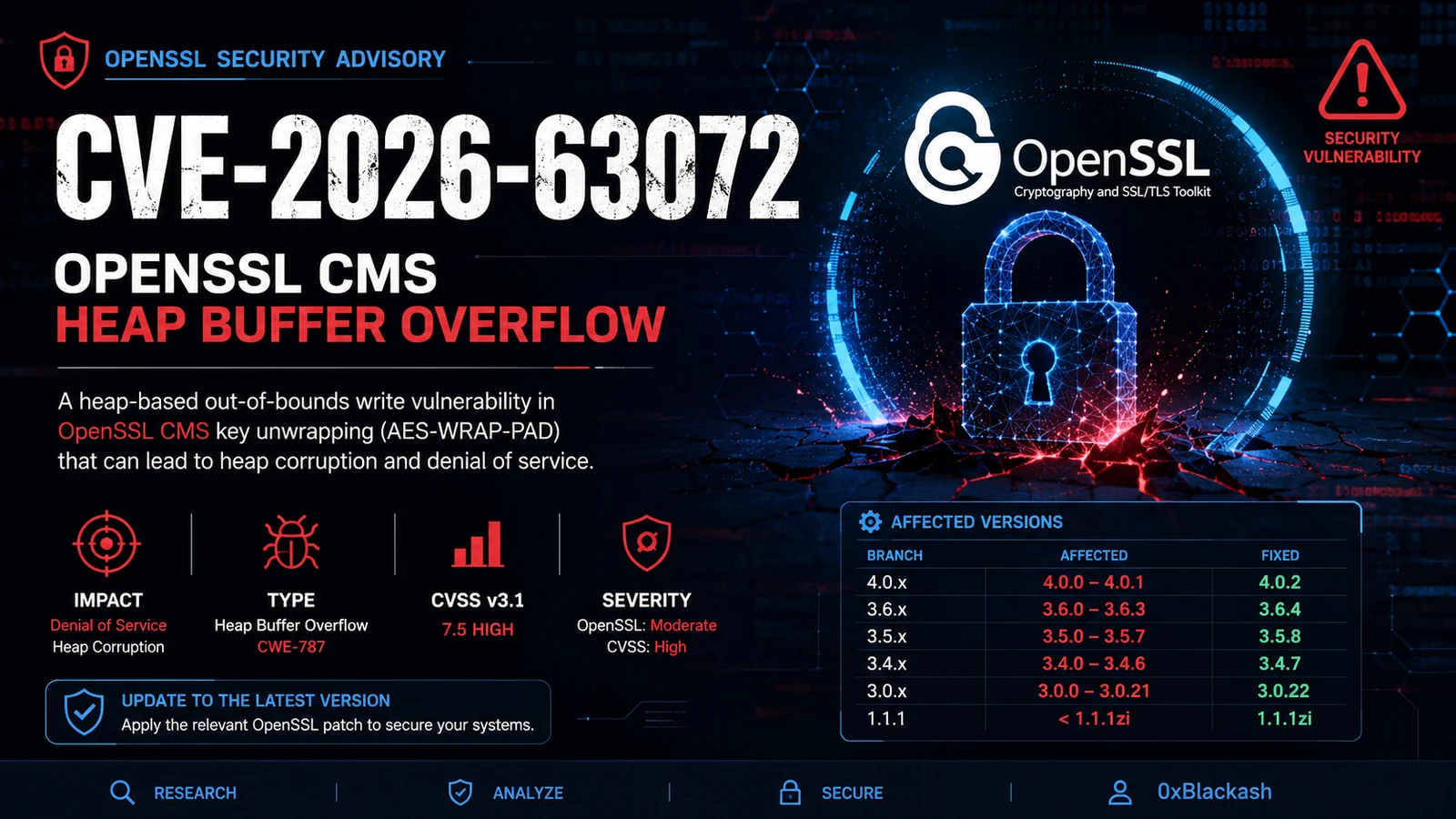
A technical analysis of CVE-2026-63072, a heap-based out-of-bounds write affecting OpenSSL's CMS key-unwrapping functionality.
CVE-2026-63072 is a heap-based buffer overflow vulnerability in OpenSSL's CMS (Cryptographic Message Syntax) implementation.
The vulnerability can be triggered when processing a specially crafted CMS message using the affected AES-WRAP-PAD key-unwrapping path.
Successful exploitation can result in an 8-byte out-of-bounds heap write, potentially causing:
Current assessment: Publicly documented impact is primarily Denial of Service / heap corruption. Remote Code Execution has not been established by the available public information.
| Field | Details |
|---|---|
| 🆔 CVE | CVE-2026-63072 |
| 🏢 Vendor | OpenSSL |
| 📦 Component | CMS |
| 🐛 Vulnerability | Heap Buffer Overflow |
| 🔢 CWE | CWE-787 |
| ⚠️ CVSS v3.1 | 7.5 — High |
| 🔥 OpenSSL Severity | Moderate |
| 🎯 Primary Impact | Denial of Service |
| 🔐 Attack Vector | Network |
| 👤 Privileges Required | None |
| 🧑💻 User Interaction | None |
The vulnerability exists in the CMS key-unwrapping process.
Under specific conditions involving AES-WRAP-PAD, the implementation can incorrectly determine the required buffer size for the unwrapped key.
The subsequent unwrap operation can write beyond the allocated heap buffer:
CMS message
     │
     ▼
CMS_decrypt()
     │
     ▼
CMS key unwrapping
     │
     ▼
AES-WRAP-PAD
     │
     ▼
Incorrect buffer sizing
     │
     ▼
Out-of-bounds write
     │
     ▼
💥 Heap corruption / DoS
The documented behavior involves an approximately 8-byte heap overwrite.
| OpenSSL Branch | Affected Versions | Fixed Version |
|---|---|---|
| 4.0.x | 4.0.0 – 4.0.1 | 4.0.2 |
| 3.6.x | 3.6.0 – 3.6.3 | 3.6.4 |
| 3.5.x | 3.5.0 – 3.5.7 | 3.5.8 |
| 3.4.x | 3.4.0 – 3.4.6 | 3.4.7 |
| 3.0.x | 3.0.0 – 3.0.21 | 3.0.22 |
| 1.1.1 | Before 1.1.1zi | 1.1.1zi |
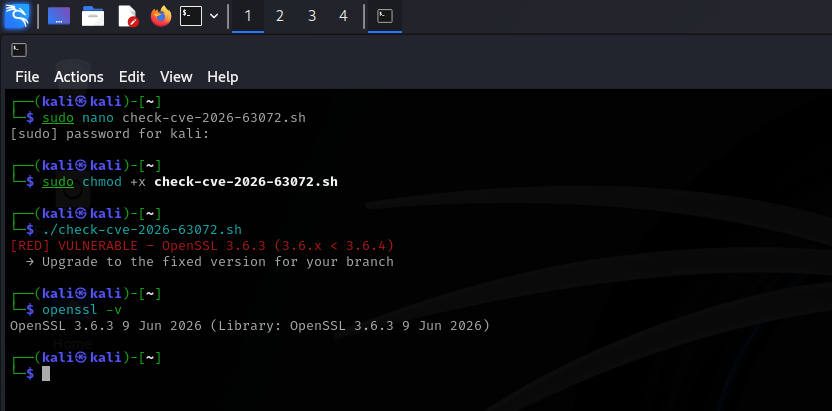
🔎 Recommendation: Upgrade affected OpenSSL installations to the corresponding fixed release.
The underlying issue is related to a mismatch between:
Conceptually:
Expected allocation
        │
        ▼
   ┌───────────┐
   │   Buffer  │
   └───────────┘
        │
        │  AES unwrap writes
        ▼
   ┌───────────────┐
   │ Buffer + 8 B  │  ← Out-of-bounds
   └───────────────┘
This can corrupt adjacent heap memory and terminate the affected process.
Example environment for defensive analysis:
# Identify installed OpenSSL version
openssl version -a

# Check linked libraries
ldd /path/to/application | grep -i ssl
For laboratory testing, use an isolated environment and a vulnerable OpenSSL build.
openssl version
Compare the installed version against the affected releases listed above.
Install the vendor-provided patched package or upgrade to the appropriate fixed OpenSSL release.
After updating OpenSSL, restart applications and services that dynamically link against the vulnerable library.
openssl version -a
Confirm that the running environment uses the patched version.
| Impact | Status |
|---|---|
| 💥 Crash | ✅ Possible |
| 🧠 Heap Corruption | ✅ Possible |
| 🚫 Denial of Service | ✅ Primary documented impact |
| 🔓 Information Disclosure | ⚠️ Not established |
| 🖥️ Remote Code Execution | ❓ Not established |
Identify affected version
          │
          ▼
Map dependent applications
          │
          ▼
Analyze CMS processing
          │
          ▼
Review AES-WRAP-PAD path
          │
          ▼
Validate behavior in isolated lab
          │
          ▼
Apply vendor patch
          │
          ▼
Verify remediation
This repository is intended for authorized security research, vulnerability analysis, and defensive testing.
Do not test vulnerable software against systems that you do not own or have explicit authorization to assess.
CVE-2026-63072CVE-2026-630720xBlackash
Cybersecurity Research • Vulnerability Analysis • Network Security
⭐ If this research was useful, consider starring the repository.
