 0xblackash/cve-2026-53359
CVE-2026-53359

Januscape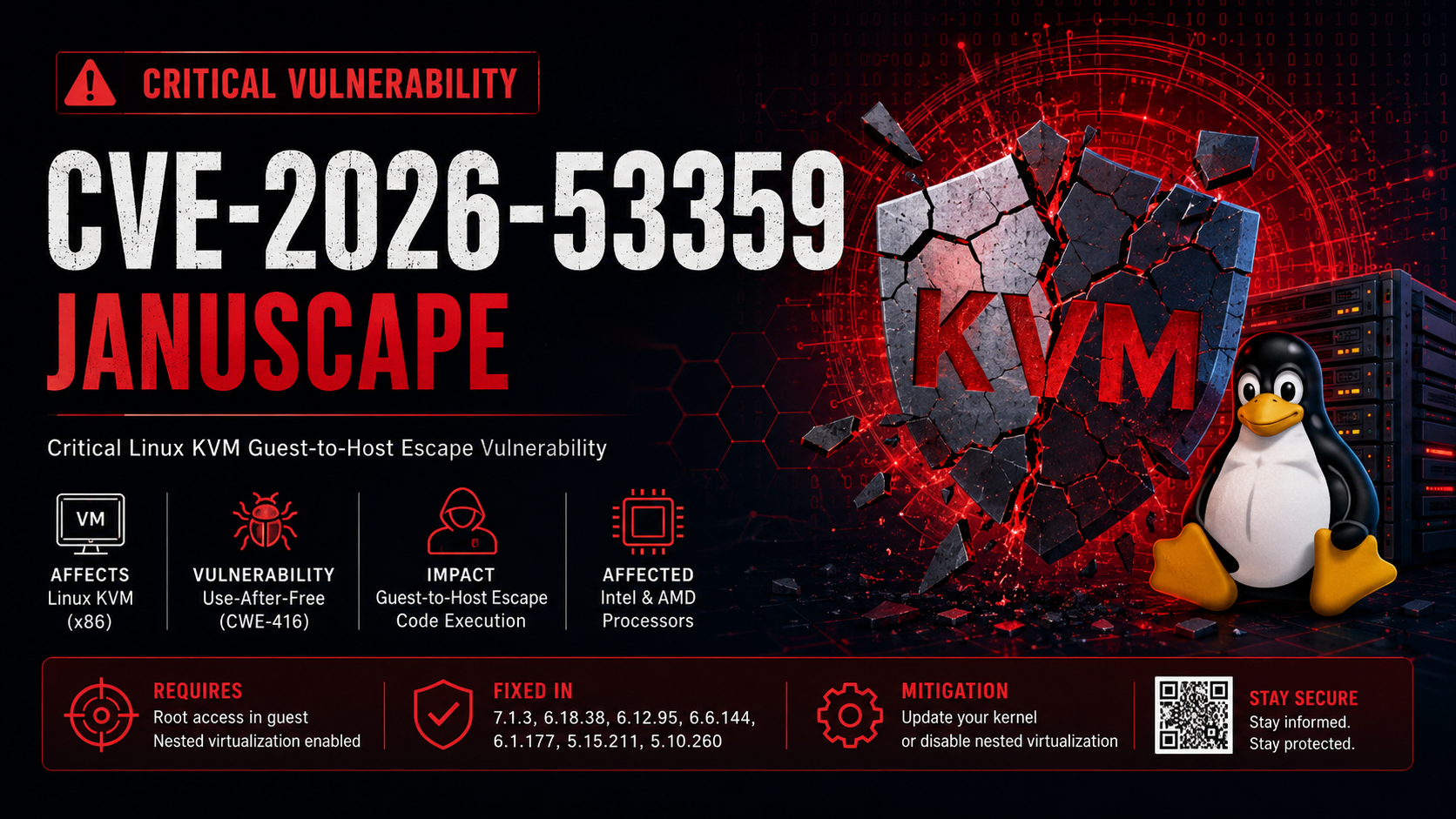




Januscape is a Linux Kernel KVM vulnerability caused by a Use-After-Free (UAF) condition in the x86 Shadow MMU. Under vulnerable configurations, a malicious guest can corrupt host memory, leading to host crashes and potentially breaking VM isolation.
| Field | Value |
|---|---|
| CVE | CVE-2026-53359 |
| Nickname | Januscape |
| Component | Linux Kernel KVM (x86 Shadow MMU) |
| Bug Class | Use-After-Free |
| Attack Vector | Guest VM |
| Impact | Host Kernel Memory Corruption |
| Affected Platforms | Intel VT-x & AMD-V |
| Disclosure | July 2026 |
The vulnerability exists within KVM's legacy shadow paging implementation.
An earlier security fix validated the Guest Frame Number (GFN) but failed to verify the shadow page role before reusing an existing kvm_mmu_page.
This allows incompatible shadow pages to be reused, leaving stale reverse-mapping (rmap) entries after memory has already been freed.
Subsequent MMU operations may dereference freed memory, resulting in a Use-After-Free condition that can corrupt the host kernel.
Guest modifies page mapping
        │
        ▼
Shadow page reused
without validating role
        │
        ▼
Stale rmap entry remains
        │
        ▼
Shadow page freed
        │
        ▼
Later MMU operation
dereferences freed memory
        │
        ▼
Use-After-Free
[  123.456789] BUG: unable to handle page fault for address: ffff8881xxxxxxxx
[  123.456789] #PF: supervisor read access in kernel mode
[  123.456789] #PF: error_code(0x0000) - not-present page
[  123.456789] CPU: 3 PID: 1234 Comm: poc_3 Tainted: G           OE
[  123.456789] RIP: 0010:kvm_mmu_page_get_gfn+0xXX/0xXX [kvm]
...
[  123.456789] Call Trace:
[  123.456789]  pte_list_remove+0xXX/0xXX [kvm]
[  123.456789]  kvm_mmu_zap_all_fast+0xXX/0xXX [kvm]
[  123.456789]  kvm_mmu_notifier_invalidate_range+0xXX/0xXX [kvm]
...
[  123.456789] Kernel panic - not syncing: Fatal exception
[  123.456789] ---[ end Kernel panic - not syncing: Fatal exception ]---
The official kernel fix addresses the shadow page reuse logic by ensuring page roles are validated before reuse.
Potentially affected environments include:
The vulnerable path is primarily associated with shadow paging, which can be exercised when nested virtualization is used.
Current public information indicates:
Administrators should:
dmesg, journalctl).This repository is intended solely for cybersecurity education, defensive research, incident response, and vulnerability awareness.
No offensive tooling or exploit code is included.

