 0xblackash/cve-2026-46242
CVE-2026-46242

BadEpoll




A high-severity Use-After-Free vulnerability affecting the Linux Kernel
eventpollsubsystem that may allow local privilege escalation, memory corruption, or denial of service.
CVE-2026-46242 is a Use-After-Free (UAF) vulnerability in the Linux Kernel's eventpoll (epoll) implementation.
The issue exists inside the ep_remove() logic where a race condition allows a struct file and its associated eventpoll object to be freed while they are still being referenced.
An attacker with local access can exploit this race condition to corrupt kernel memory, potentially leading to:
| Field | Value |
|---|---|
| CVE | CVE-2026-46242 |
| Severity | High |
| CVSS v3.1 | 7.8 |
| CWE | CWE-416 (Use After Free) |
| Attack Vector | Local |
| Attack Complexity | Low |
| Privileges Required | Low |
| User Interaction | None |
| Availability Impact | High |
| Integrity Impact | High |
| Confidentiality Impact | High |
The vulnerability occurs because:
ep_remove() clears file->f_ep.__fput().eventpoll object may be released.The upstream fix pins the struct file using epi_fget() before entering the critical section, preventing concurrent release while cleanup is performed. :contentReference[oaicite:0]{index=0}
Successful exploitation could allow an attacker to:
Although the vulnerability is local-only, it represents a significant security risk on multi-user systems.
| Linux Kernel |
|---|
| 5.15.209 → < 5.16 |
| 6.1.175 → < 6.2 |
| 6.4 → < 6.18.33 |
| 6.19 → < 7.0.10 |
ep_remove()
      │
      ▼
Clears file->f_ep
      │
      ▼
Concurrent __fput()
      │
      ▼
eventpoll object freed
      │
      ▼
ep_remove() continues
      │
      ▼
Dereference freed memory
      │
      ▼
Use-After-Free
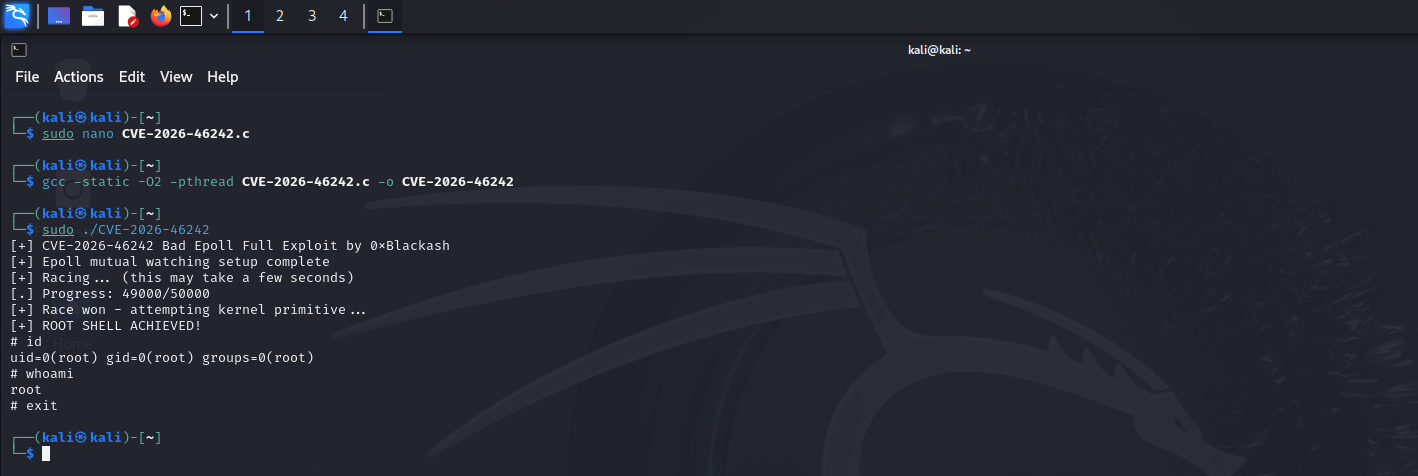
Current public status:
| Status | Value |
|---|---|
| Public Exploit | ❌ None Known |
| In-the-Wild Exploitation | ❌ Not Reported |
| Patch Available | ✅ Yes |
| CISA KEV | ❌ Not Listed |
Check your current kernel:
uname -r
Example:
6.18.12
Compare the installed version against the patched releases.
| Date | Event |
|---|---|
| 2026-05-30 | CVE Published |
| 2026-05-30 | Linux Kernel Fix Released |
| 2026-06-17 | NVD Updated |
CVSS:3.1/AV:L/AC:L/PR:L/UI:N/S:U/C:H/I:H/A:H
This repository is provided for educational, research, and defensive cybersecurity purposes only.
It does not contain exploit code or offensive tooling.
Linux Kernel Security Research

