 0xblackash/cve-2026-43503
CVE-2026-43503





A Local Privilege Escalation vulnerability caused by improper propagation of the
SKBFL_SHARED_FRAG flag inside the Linux networking stack.
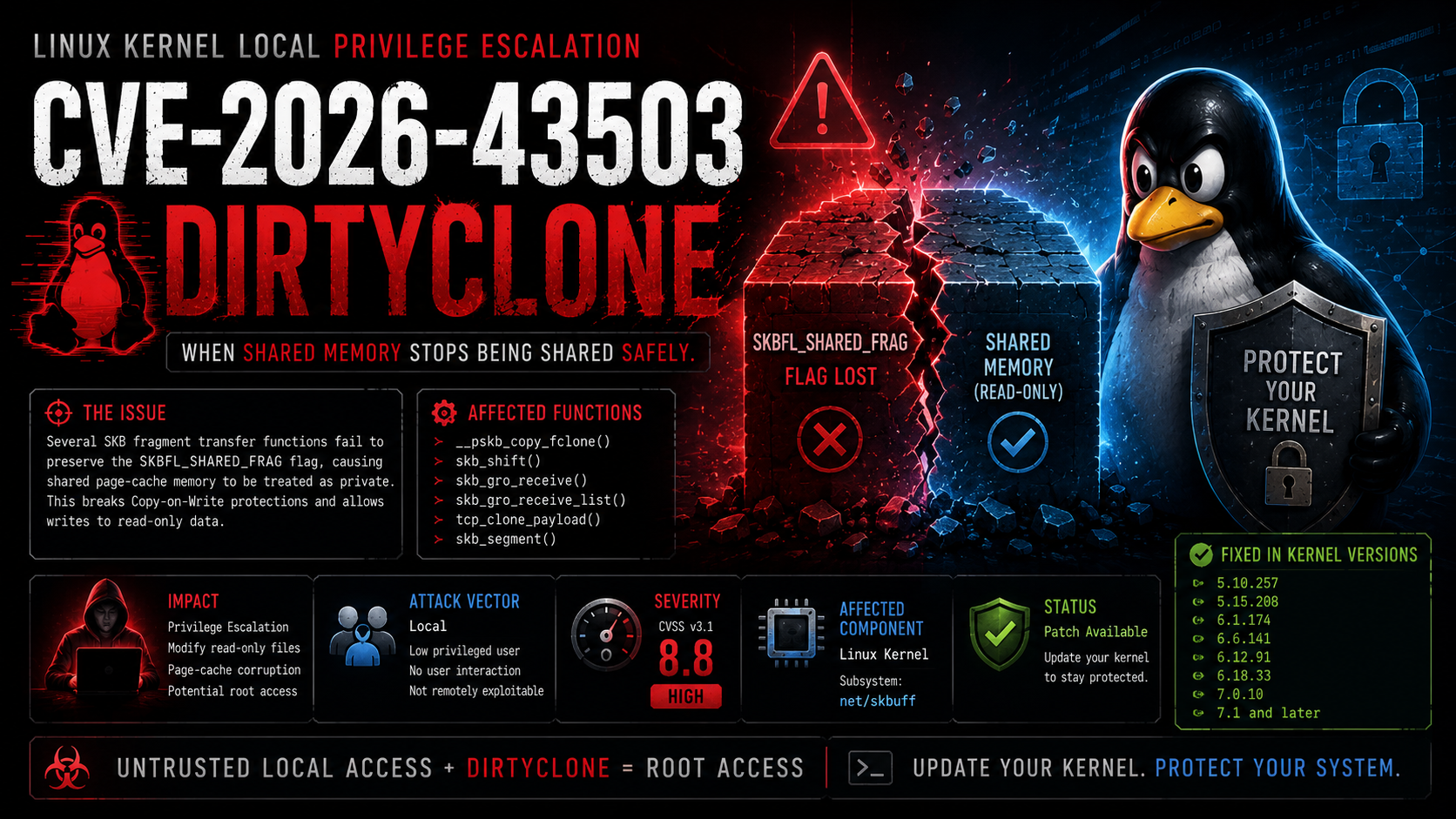
CVE-2026-43503, nicknamed DirtyClone, is a High Severity Local Privilege Escalation (LPE) vulnerability affecting the Linux kernel networking subsystem.
The vulnerability exists because several Socket Buffer (SKB) fragment-copy routines fail to preserve the SKBFL_SHARED_FRAG flag when cloning or transferring packet fragments.
As a result, memory that should remain protected by Copy-on-Write (CoW) semantics may become writable unexpectedly, allowing a local attacker to modify read-only page-cache data under specific conditions.
The name DirtyClone reflects two key characteristics:
Similar to previous Linux memory corruption vulnerabilities, the issue stems from incorrect handling of shared memory metadata rather than a traditional buffer overflow.
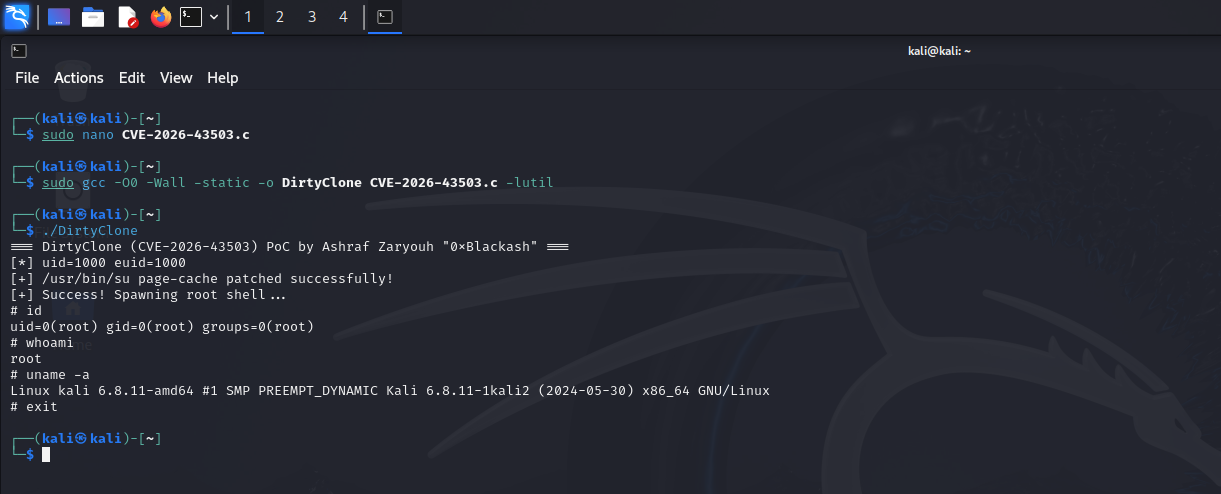
Successful exploitation may allow an attacker to:
Several networking helper functions clone or move packet fragments without copying the:
SKBFL_SHARED_FRAG
flag.
Consequently, the destination socket buffer incorrectly assumes ownership of memory that is actually shared.
This breaks the kernel's assumptions about page ownership and write protection.
__pskb_copy_fclone()

skb_shift()

skb_gro_receive()

skb_gro_receive_list()

tcp_clone_payload()

skb_segment()
Each of these routines may propagate fragment references without preserving the shared-fragment state.
Local User
     │
     ▼
Create crafted networking workload
     │
     ▼
SKB Fragment Cloning
     │
     ▼
SKBFL_SHARED_FRAG Lost
     │
     ▼
Shared Memory Appears Private
     │
     ▼
Write Into Read-Only Page Cache
     │
     ▼
Privilege Escalation
| Property | Value |
|---|---|
| CVE | CVE-2026-43503 |
| Nickname | DirtyClone |
| Severity | High |
| CVSS v3.1 | 8.8 |
| Attack Vector | Local |
| Complexity | Low |
| Privileges Required | Low |
| User Interaction | None |
| Scope | Changed |
| Impact | Privilege Escalation |
Linux Kernel

Subsystem:
net/skbuff
| Stable Branch | Fixed Version |
|---|---|
| 5.10 | 5.10.257 |
| 5.15 | 5.15.208 |
| 6.1 | 6.1.174 |
| 6.6 | 6.6.141 |
| 6.12 | 6.12.91 |
| 6.18 | 6.18.33 |
| 7.0 | 7.0.10 |
| 7.1+ | Fixed |
Indicators may include:
| Category | Description |
|---|---|
| CWE | Improper State Management |
| Vulnerability Type | Local Privilege Escalation |
| Exploitation | Local authenticated attacker |
| Requires Reboot | After kernel update |
| Remote Exploitable | ❌ No |
DirtyClone is not a network remote exploit—it is a local privilege escalation vulnerability caused by incorrect handling of shared socket-buffer fragments. Losing the
SKBFL_SHARED_FRAGflag allows writes to memory that should remain protected, undermining Linux's Copy-on-Write guarantees and enabling privilege escalation under the right conditions.
Kernel privilege escalation vulnerabilities continue to demonstrate how subtle memory-management mistakes can have major security consequences.
If this repository was useful, consider ⭐ starring it to support cybersecurity research and vulnerability documentation.

