
Skip to content
KitploitKITPLOIT
ToolsBlog
Submit
ToolsBlog
Submit

Hacking, PenTest, and Cybersecurity Tools for Your Security Arsenal!

Kitploit is a directory of hacking, cybersecurity, and pentesting tools. Discover the latest project updates to find vulnerabilities, analyze systems, automate testing, and strengthen your security.

··Feeds·Contact·Privacy·© 2026 Kitploit

Tool Directory

Categories

View all categories
Loading categories
CVE-2026-43494 — CVE-2026-43494 | Kitploit
Tools/GitHubGitHub/0xblackash/cve-2026-43494
Privilege EscalationVulnerability AnalysisExploitationCTFLearning & EducationBinary Exploitation
GitHub0xblackash/cve-2026-43494

CVE-2026-43494

CVE-2026-43494

View Repository
2213 months agoNot yet reviewed

Most Popular

View all →

Discover the most used tools by our community.

Explore all tools

Browse our collection of tools

View all tools →
Share

🛠️ PinTheft — CVE-2026-43494

ChatGPT Image May 23, 2026, 09_07_08 AM

Local Privilege Escalation in Linux Kernel via RDS + io_uring Page Cache Overwrite

Linux Exploit Architecture


📌 Overview

PinTheft is a sophisticated local root exploit for CVE-2026-43494, a reference-counting bug in the Linux kernel's Reliable Datagram Sockets (RDS) subsystem.

By combining a double-free in RDS zero-copy path with io_uring's fixed buffers, the exploit achieves reliable page cache overwrite of SUID-root binaries, resulting in local privilege escalation to root.

A small accounting error in an obscure networking path becomes a reliable LPE when mixed with modern io_uring features.


🧪 Vulnerability Details

  • Component: net/rds
  • Trigger: Failure path in rds_message_zcopy_from_user() → incorrect op_nents handling
  • Root Cause: Double put_page() after failed iov_iter_get_pages2()
  • Impact: Unprivileged local user → root

CVSS Score: ~7.8 (High)


🎯 Exploit Technique ("PinTheft")

  1. Pin target page using io_uring REGISTER_BUFFERS (+1024 FOLL_PIN references)
  2. Clone buffers to second ring + hold with daemon (prevents unpin on close)
  3. Steal all 1024 pins using repeated failing RDS zero-copy sendmsg
  4. munmap() → clean free to PCP (LIFO)
  5. Trigger page cache reclaim of a readable SUID binary
  6. Overwrite the reclaimed page using IORING_OP_READ_FIXED via dangling struct page*
  7. Execute the modified SUID binary → root shell

Bypasses:

  • CONFIG_INIT_ON_ALLOC_DEFAULT_ON
  • bad_page() checks
  • io_uring unpin on ring destruction

📋 Requirements

  • Kernel with CONFIG_RDS and CONFIG_RDS_TCP enabled
  • io_uring enabled (kernel.io_uring_disabled=0)
  • Kernel ≥ 6.13 (for optimal io_uring features)
  • At least one readable SUID-root binary on the system
  • x86_64 architecture

Not vulnerable by default on most distros (RDS is rarely enabled).


🚀 Usage

root@kitploit:~
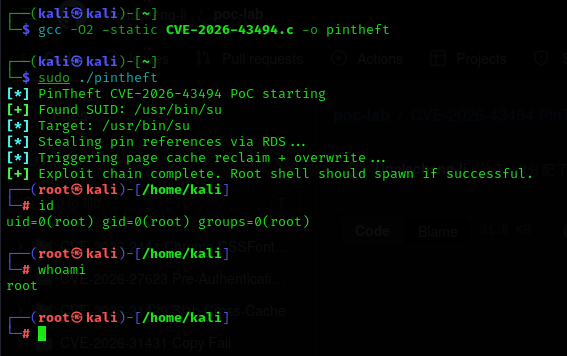
# 1. Clone & Compile
git clone https://github.com/0xBlackash/CVE-2026-43494.git
cd CVE-2026-43494
gcc -O2 -static CVE-2026-43494.c -o pintheft

# 2. Run
sudo ./pintheft
CVE-2026-43494

📁 Files

  • CVE-2026-43494.c — Full exploit source (PinTheft)
  • README.md — This document
  • backup/ — Automatic backups of overwritten SUID binaries

🛡️ Mitigation

root@kitploit:~
# Disable RDS
echo "install rds /bin/false" | sudo tee /etc/modprobe.d/disable-rds.conf
echo "install rds_tcp /bin/false" | sudo tee -a /etc/modprobe.d/disable-rds.conf
sudo modprobe -r rds_tcp rds

# Disable io_uring (if unused)
echo "kernel.io_uring_disabled=2" | sudo tee -a /etc/sysctl.conf
sudo sysctl -p

Update your kernel as soon as patches are available.


🔍 Verification

root@kitploit:~
# Check if vulnerable
modprobe -n rds_tcp && echo "RDS: Vulnerable"
cat /proc/sys/kernel/io_uring_disabled
uname -r

⚠️ Disclaimer

  • This exploit is for educational and authorized testing only.
  • Misuse may destabilize the system or cause data loss.
  • Always test in isolated virtual machines.

📜 Credits

  • Discovery & PoC: Ashraf Zaryouh "0xBlackash"
  • CVE Assignment: MITRE
  • Public Disclosure: May 23, 2026

Made with ❤️ for the security research community

Stay curious. Stay safe.

Download Tool