 0xblackash/cve-2026-41089
CVE-2026-41089

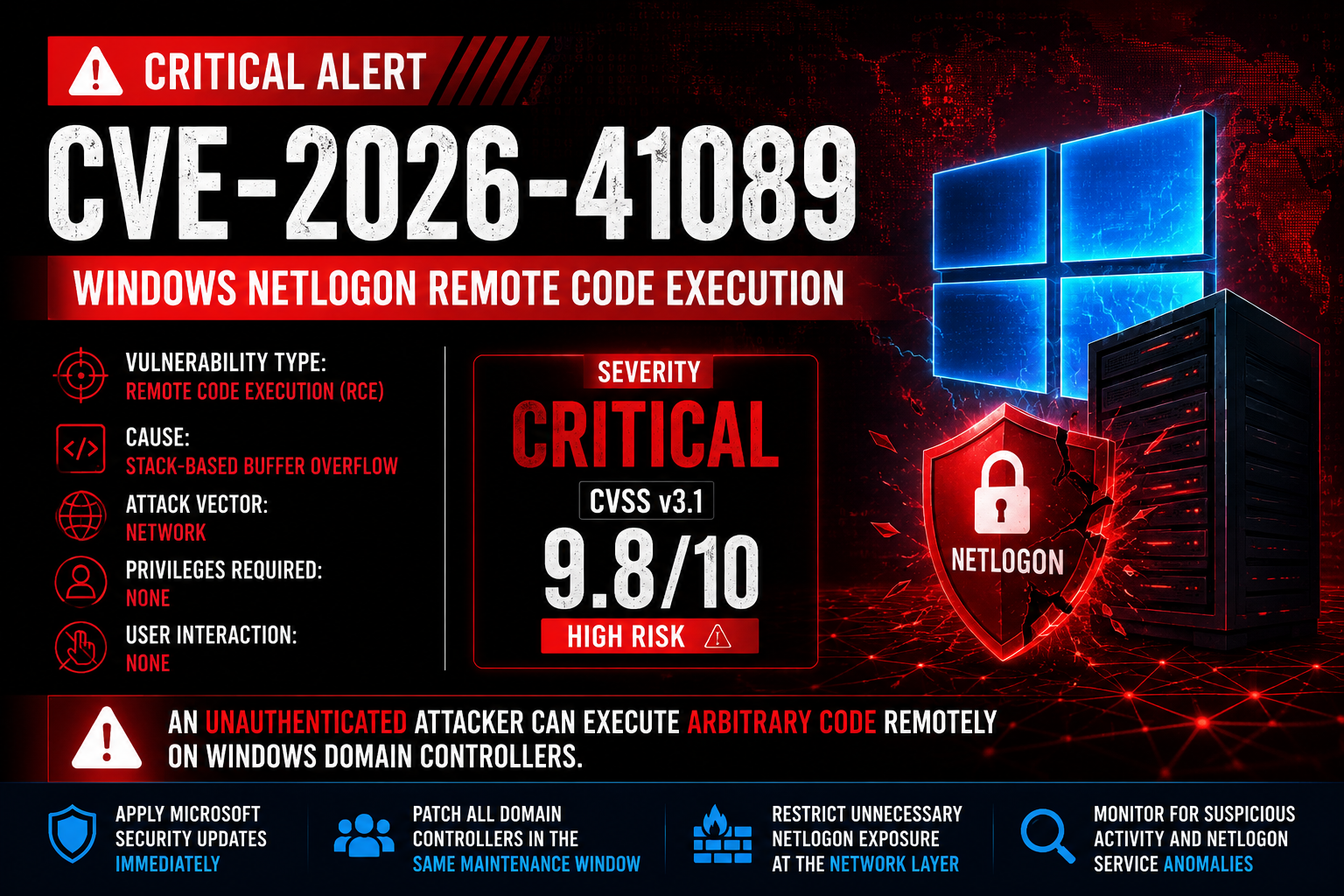





⚠️ A critical Windows Netlogon vulnerability allowing unauthenticated remote code execution on domain controllers.
CVE-2026-41089 is a critical vulnerability affecting the Windows Netlogon service.
The flaw originates from a stack-based buffer overflow, enabling a remote attacker to execute arbitrary code by sending specially crafted requests to a vulnerable domain controller.
| Field | Value |
|---|---|
| CVE | CVE-2026-41089 |
| Severity | Critical |
| CVSS v3.1 | 9.8 |
| CWE | CWE-121 |
| Component | Windows Netlogon |
| Attack Vector | Network |
| Privileges Required | None |
| User Interaction | None |
| Scope | Changed |
| Impact | Remote Code Execution |
# Connectivity test (short username, no overflow)
python3 CVE-2026-41089.py 10.0.50.21 corp.local

# Default overflow attempt
python3 CVE-2026-41089.py 10.0.50.21 corp.local -l 130

# Larger payload, longer timeout for slow networks
python3 CVE-2026-41089.py 10.0.50.21 corp.local -l 200 -t 10
Attacker
    │
    ▼
Crafted Netlogon Request
    │
    ▼
Stack Buffer Overflow
    │
    ▼
Memory Corruption
    │
    ▼
Arbitrary Code Execution
    │
    ▼
Domain Controller Compromise
An attacker located on the network:
Netlogon is one of the most critical services in Active Directory environments.
Successful exploitation could allow:
| Category | Rating |
|---|---|
| Exploit Complexity | Low |
| Attack Complexity | Low |
| Authentication | Not Required |
| User Interaction | None |
| Confidentiality Impact | High |
| Integrity Impact | High |
| Availability Impact | High |
Unexpected Netlogon crashes
Netlogon service restarts
Authentication anomalies
Suspicious domain controller traffic
Unexpected privilege escalation
Repeated Netlogon requests

Unexpected service crashes

Abnormal Domain Controller behavior

Unknown processes spawned by lsass.exe

Unusual authentication activity

Lateral movement patterns
CVSS 9.8/10

████████████████████ 100%

CRITICAL
Potentially affected:
CVE-2026-41089 is a critical Windows Netlogon Remote Code Execution vulnerability that allows unauthenticated attackers to execute arbitrary code remotely against vulnerable domain controllers. Due to its low attack complexity and high impact, organizations should prioritize patching and monitoring efforts immediately.
CVE-2026-41089
Made with ❤️ for the Cybersecurity Community

