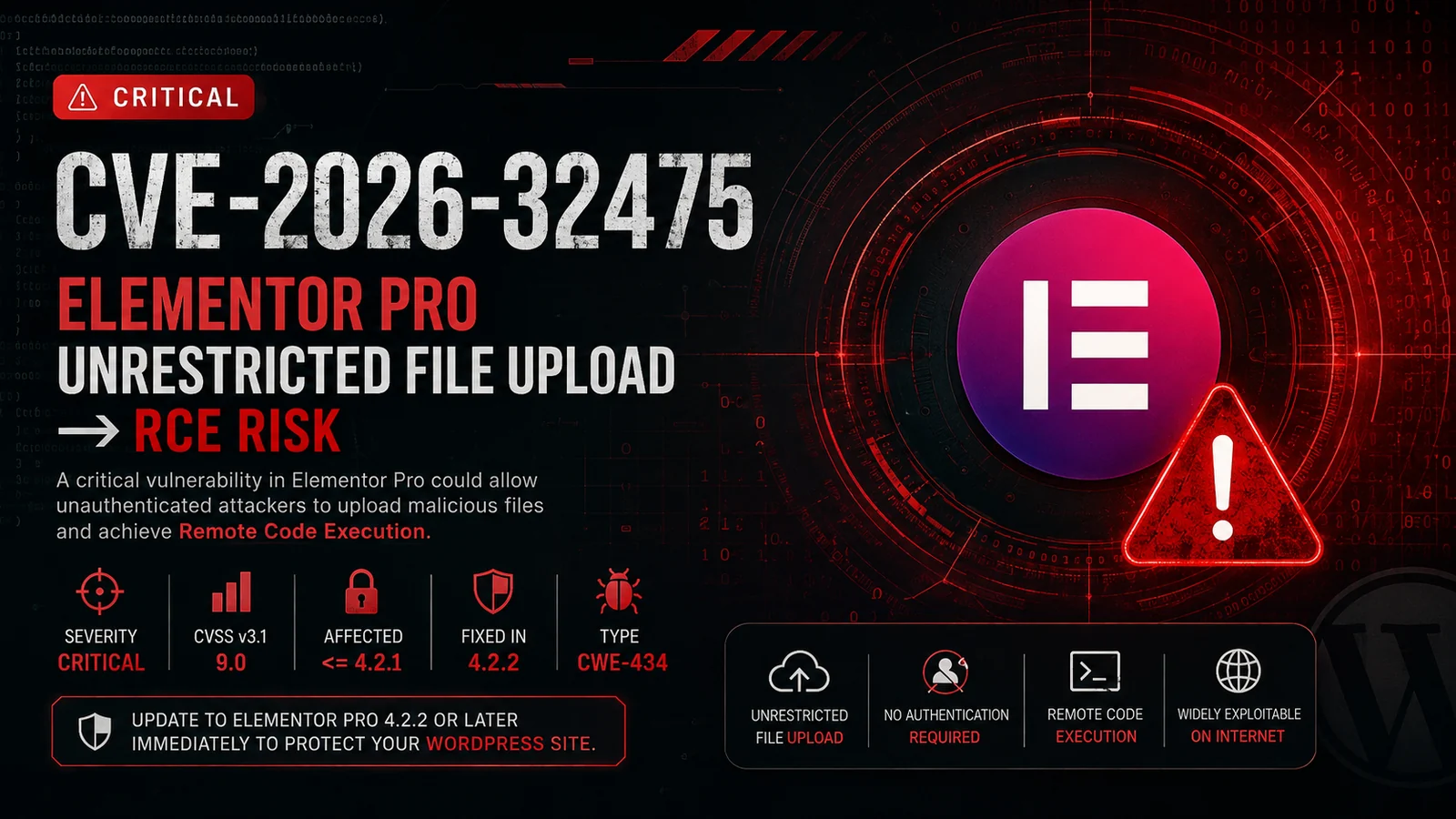
 0xblackash/cve-2026-32475
Technical analysis and detection guidance for critical unrestricted file upload in Elementor Pro (CVE-2026-32475) leading to remote code execution.

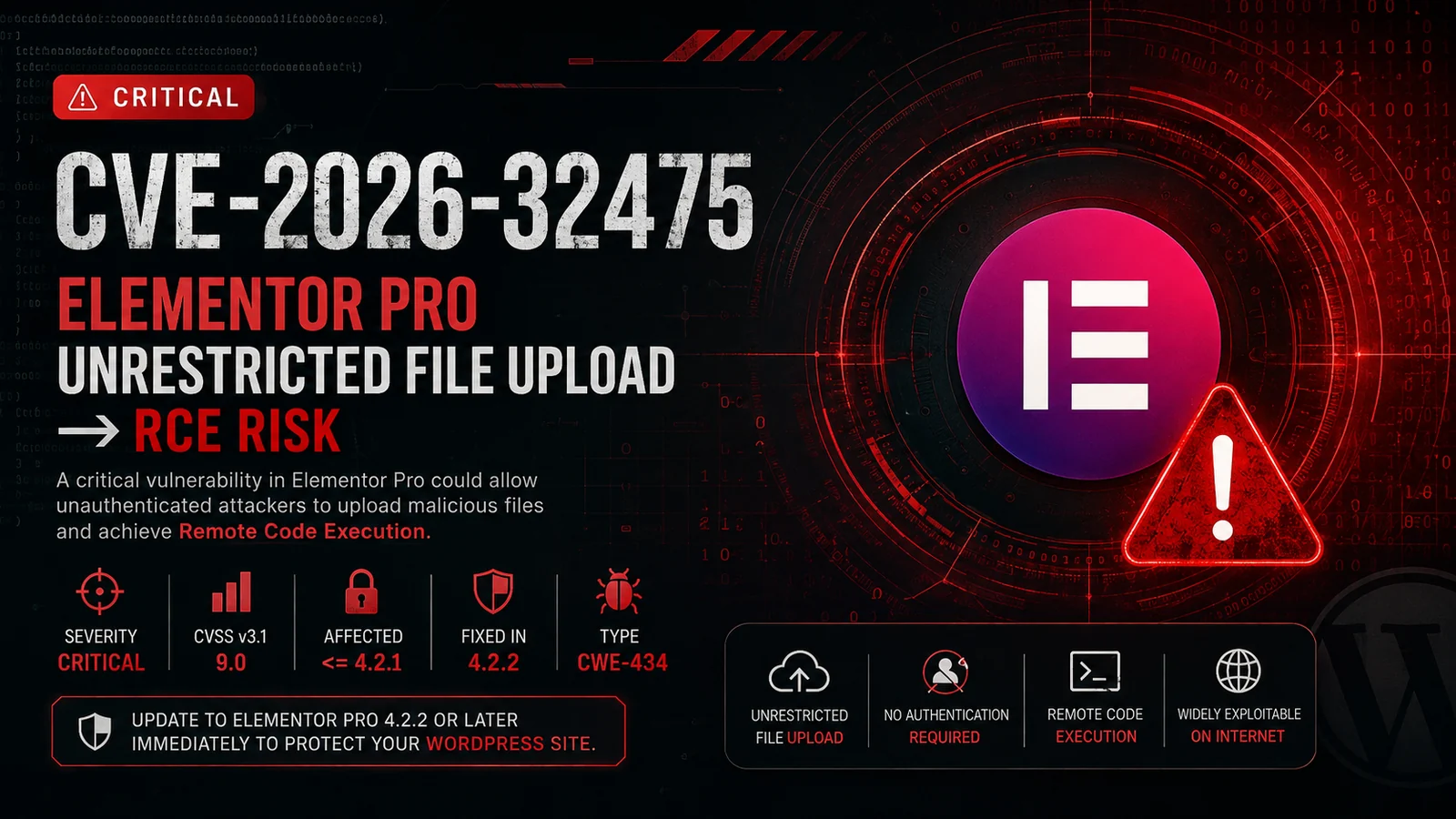



Critical Unrestricted File Upload vulnerability in Elementor Pro
Potentially leading to Remote Code Execution (RCE)
CVE-2026-32475 is a critical security vulnerability affecting Elementor Pro, a widely deployed WordPress page-builder plugin.
The vulnerability involves insufficient restrictions around file uploads, allowing an attacker to potentially upload a dangerous file type that can subsequently be processed by the server.
Under vulnerable configurations, successful exploitation may lead to Remote Code Execution (RCE) with the privileges of the underlying WordPress/PHP process.
Security Notice: This documentation describes the vulnerability and its impact for defensive research and authorized security testing. No weaponized exploit payload is included.
| Property | Details |
|---|---|
| CVE | CVE-2026-32475 |
| Product | Elementor Pro |
| Platform | WordPress |
| Vulnerability Type | Unrestricted Upload of File with Dangerous Type |
| CWE | CWE-434 |
| Severity | 🔴 Critical |
| CVSS | 9.0 |
| Affected Versions | <= 4.2.1 |
| Fixed Version | 4.2.2 |
| Potential Impact | Remote Code Execution |
The vulnerability is related to the way Elementor Pro validates and subsequently processes uploaded files.
A discrepancy between the validation stage and the file-processing stage can allow specially crafted multipart upload data to bypass expected restrictions.
Conceptually:
          HTTP Multipart Upload
                    │
                    ▼
          ┌───────────────────┐
          │ Upload Validation │
          └─────────┬─────────┘
                    │
             Validation Bypass
                    │
                    ▼
          ┌───────────────────┐
          │ File Processing   │
          └─────────┬─────────┘
                    │
                    ▼
          Dangerous File Type
                    │
                    ▼
             Server Execution
                    │
                    ▼
                  RCE
The security issue therefore results from inconsistent assumptions between what the validation layer considers safe and what the processing layer ultimately handles.
Successful exploitation against a vulnerable installation could potentially allow an attacker to:
The actual impact depends heavily on the privileges of the WordPress/PHP process and the server configuration.
The vulnerability is associated with the file-upload functionality exposed by Elementor Pro.
A simplified attack chain can be represented as:
Attacker
   │
   │ Crafted HTTP request
   ▼
WordPress
   │
   ▼
Elementor Pro
   │
   ├── Upload validation
   │
   ├── File processing
   │
   ▼
Filesystem
   │
   ▼
Potentially executable content
   │
   ▼
Remote Code Execution
⚠️ Exploitation should only be performed against systems you own or have explicit authorization to test.
The primary remediation is to upgrade:
Elementor Pro 4.2.1
        ↓
Elementor Pro 4.2.2+
From the WordPress administration interface:
Dashboard
   └── Plugins
        └── Elementor Pro
             └── Version
For potentially exposed installations, investigate:
Web server access logs
PHP logs
WordPress logs
File modification timestamps
Authentication logs
WAF events
Look for unusual multipart upload requests and unexpected files appearing in WordPress-controlled directories.
Security teams can monitor for:
POST requests
      │
      ├── multipart/form-data
      │
      ├── unusual filename parameters
      │
      ├── unexpected extensions
      │
      └── suspicious upload destinations
Additional indicators may include:
For authorized testing, a safe assessment should focus on determining whether the target is running an affected version rather than deploying executable payloads.
Example inventory check:
Target
  │
  ▼
WordPress detected
  │
  ▼
Elementor Pro detected
  │
  ▼
Version identified
  │
  ├── <= 4.2.1 → ⚠️ Potentially vulnerable
  │
  └── >= 4.2.2 → ✅ Patched
| Risk | Rating |
|---|---|
| Confidentiality | 🔴 High |
| Integrity | 🔴 High |
| Availability | 🟠 High |
| Exploitability | 🔴 High |
| Overall Severity | 🔴 Critical |
For organizations running WordPress:
CVE-2026-32475CWE-434 — Unrestricted Upload of File with Dangerous Type4.2.2This repository is intended for defensive security research, vulnerability analysis, education, and authorized penetration testing.
Do not use vulnerability research or testing techniques against systems without explicit authorization.
The author is not responsible for misuse of the information contained in this documentation.
Security Research • Vulnerability Analysis • Defensive Engineering
