
Skip to content
KitploitKITPLOIT
ToolsBlog
Submit
ToolsBlog
Submit

Hacking, PenTest, and Cybersecurity Tools for Your Security Arsenal!

Kitploit is a directory of hacking, cybersecurity, and pentesting tools. Discover the latest project updates to find vulnerabilities, analyze systems, automate testing, and strengthen your security.

··Feeds·Contact·Privacy·© 2026 Kitploit

Tool Directory

Categories

View all categories
Loading categories
CVE-2026-21858 — CVE-2026-21858 | Kitploit
Tools/GitHubGitHub/0xblackash/cve-2026-21858
ReconnaissanceVulnerability AnalysisExploitationWeb Application ExploitationInformation GatheringPenetration Testing
GitHub0xblackash/cve-2026-21858

CVE-2026-21858

CVE-2026-21858

View Repository
146 months agoNot yet reviewed

Most Popular

View all →

Discover the most used tools by our community.

Explore all tools

Browse our collection of tools

View all tools →
Share

🚨 CVE-2026-21858 — “Ni8mare”

G-ELe0qa4AA62WN

Severity CVSS Attack Vector Auth Required

A critical unauthenticated remote code execution vulnerability in an open-source workflow automation platform.


📖 Table of Contents

  • Overview
  • Technical Details
  • Severity & CVSS
  • Affected Versions
  • Impact
  • Exploitation
  • Detection
  • Remediation
  • Mitigation
  • Summary

🔎 Overview

CVE-2026-21858, nicknamed “Ni8mare,” is a critical vulnerability discovered in n8n — a popular platform for building automation workflows (e.g., automating API calls, integrations, SaaS connectors).

It allows unauthenticated remote attackers to interact with improperly validated webhook/form endpoints and gain unauthorized access to files and internal server resources.

A successful exploit can lead to full remote code execution (RCE) and complete instance takeover.


🧠 Technical Details

  • Root Cause: Improper input validation and Content-Type confusion in webhook/form handling logic.
  • Attackers can send crafted HTTP requests that trick the system into exposing file contents or triggering unsafe workflows.
  • The flaw allows attackers to:
    • Read arbitrary files from the host
    • Expose sensitive credentials and tokens
    • Forge admin session tokens
    • Abuse workflow nodes (e.g., Execute Command) to run arbitrary OS commands
    • Fully compromise the server instance

📊 Severity & CVSS

This represents the maximum possible severity for a remote code execution flaw.


📦 Affected Versions

The vulnerability impacts the open-source n8n platform:

= 1.65.0 and < 1.121.0

id="vsurvey1"

All self-hosted instances running versions prior to 1.121.0 are vulnerable.


🔥 Impact

An attacker exploiting this vulnerability can:

  • 🔓 Read arbitrary system files
  • 🔑 Expose database credentials, API keys, tokens
  • 🔐 Forge authentication sessions
  • 🛠 Execute arbitrary system commands
  • 💥 Fully compromise the host machine
  • ↔ Pivot into connected systems and integrations

Instances exposed on the public internet are particularly at risk.
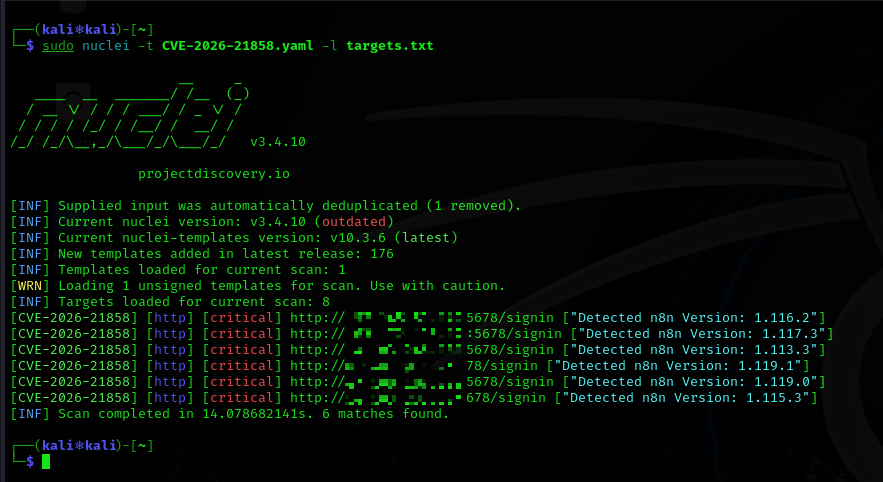

🧨 Exploitation

cve-2026-21858

This vulnerability is:

  • Remote: No network restrictions needed beyond access to webhook/form endpoints
  • Unauthenticated: No login or credentials required
  • Low complexity: Easy for attackers to craft exploit requests

Evidence from internet scanning suggests tens of thousands of potentially exposed instances remain reachable online.


🔍 Detection

Watch for:

  • Unexpected HTTP requests with unusual Content-Type headers
  • Access patterns to webhook/form endpoints from untrusted sources
  • Suspicious file access or node execution logs
  • Webserver logs showing abnormal workflow executions

🛠 Remediation

✅ Patch Immediately

Update n8n to version 1.121.0 or later — this release includes the fix for CVE-2026-21858.

  1. Stop your current n8n instance
  2. Upgrade to 1.121.0+
  3. Restart the service
  4. Validate there are no exposed unpatched nodes remaining

🧱 Temporary Mitigation (If Patch Delayed)

While updating, reduce exposure:

  • Restrict external access to webhook and form endpoints
  • Require authentication for all incoming requests
  • Use firewall rules to limit inbound traffic
  • Disable public webhooks until patched

🔐 Security Checklist

  • Run n8n ≥ 1.121.0
  • Restrict network access to trusted IPs
  • Rotate all stored secrets (API keys/tokens/credentials)
  • Review workflow definitions for unsafe content
  • Audit access logs for exploit attempts

📌 Summary


⚠️ Final Advisory

If you run n8n **anywhere — especially self-hosted, internet-facing instances — patch **to version 1.121.0 or higher immediately. The risk of full system compromise is high, and automated exploits are possible given the public details of this issue.


Download Tool
MetricDetails
CVSS Score (v3.1)10.0 — Critical
Attack VectorNetwork
Privileges RequiredNone
Authentication Required❌ None
User Interaction❌ None
Confidentiality ImpactHigh
Integrity ImpactHigh
Availability ImpactNone
FieldValue
CVE IDCVE-2026-21858
NicknameNi8mare
Productn8n Workflow Automation
SeverityCritical (CVSS 10.0)
TypeUnauthenticated Remote Code Execution
Auth RequiredNo
Fixed Version≥ 1.121.0