
Skip to content
KitploitKITPLOIT
ToolsBlog
Submit
ToolsBlog
Submit

Hacking, PenTest, and Cybersecurity Tools for Your Security Arsenal!

Kitploit is a directory of hacking, cybersecurity, and pentesting tools. Discover the latest project updates to find vulnerabilities, analyze systems, automate testing, and strengthen your security.

··Feeds·Contact·Privacy·© 2026 Kitploit

Tool Directory

Categories

View all categories
Loading categories
CVE-2026-15409 — CVE-2026-15409 | Kitploit
Tools/GitHubGitHub/0xblackash/cve-2026-15409
Vulnerability AnalysisWeb SecurityThreat IntelligencePapers & ResearchLearning & EducationCurated Resources
GitHub0xblackash/cve-2026-15409

CVE-2026-15409

CVE-2026-15409

View Repository
31 month agoNot yet reviewed

Most Popular

View all →

Discover the most used tools by our community.

Explore all tools

Browse our collection of tools

View all tools →
Share

🚨 CVE-2026-15409

Critical Unauthenticated SSRF in SonicWall SMA1000 Series

ChatGPT Image Jul 15, 2026, 05_55_53 PM

Critical Server-Side Request Forgery (SSRF) vulnerability affecting SonicWall SMA1000 Series appliances.

This repository documents the vulnerability, affected products, technical overview, impact, detection guidance, and remediation.


📖 Overview

CVE-2026-15409 is a critical unauthenticated Server-Side Request Forgery (SSRF) vulnerability in SonicWall SMA1000 Series appliances.

The flaw allows a remote attacker to force the appliance to perform unintended HTTP requests to internal or external resources. According to public advisories, the vulnerability has been exploited in real-world attacks and may be chained with additional vulnerabilities for further compromise.


✨ Highlights

  • 🔴 Critical Severity (CVSS 10.0)
  • 🌐 Remote exploitation
  • 🔓 No authentication required
  • ⚡ Server-Side Request Forgery (SSRF)
  • 🎯 Can be chained with additional vulnerabilities
  • 🛡️ Fixed by vendor updates

📊 Vulnerability Details


🎯 Affected Products

ProductStatus
SonicWall SMA1000 SeriesVulnerable
SMA6210Vulnerable
SMA7210Vulnerable
SMA8200vVulnerable

⚠️ Potential Impact

Successful exploitation may allow attackers to:

  • Access internal services
  • Reach cloud metadata endpoints
  • Interact with otherwise inaccessible hosts
  • Bypass network segmentation
  • Enable further attack chains
  • Increase attack surface for post-exploitation

🧠 Attack Flow

root@kitploit:~
Internet
      │
      ▼
Attacker
      │
      ▼
SonicWall SMA1000
      │
      ▼
Unexpected Internal HTTP Requests
      │
      ▼
Internal Services / Cloud Metadata / Management Interfaces
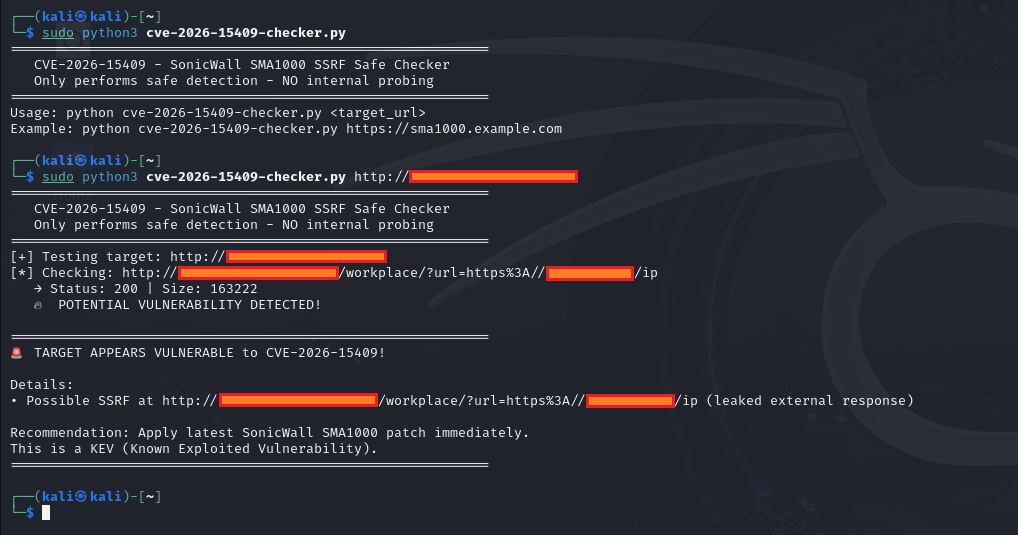
📸 Demo

cve-2026-15409

🔍 Detection

Security teams should monitor for:

  • Unusual outbound requests
  • Unexpected connections from SMA appliances
  • Requests targeting RFC1918 internal ranges
  • Access to cloud metadata endpoints
  • Abnormal HTTP activity
  • Suspicious administrative events

🛡️ Mitigation

  • Upgrade immediately to the patched firmware.
  • Restrict unnecessary outbound connectivity.
  • Monitor appliance logs.
  • Reset credentials if compromise is suspected.
  • Rotate MFA secrets if required.
  • Review indicators of compromise published by the vendor.

📂 Repository Structure

root@kitploit:~
.
├── README.md
├── assets
│   └── banner.png
├── docs
│   ├── overview.md
│   ├── timeline.md
│   └── mitigation.md
└── LICENSE

📈 Risk Matrix


📚 References

  • SonicWall Security Advisory
  • CISA Known Exploited Vulnerabilities (KEV)
  • NIST National Vulnerability Database (NVD)
  • MITRE CVE Program

⚖️ Disclaimer

This repository is intended solely for defensive security, research, and educational purposes. It does not include exploit code or instructions for unauthorized access. Users are responsible for complying with applicable laws and organizational policies.


⭐ Found this repository useful?

Consider giving it a Star ⭐ to support cybersecurity research.

Stay Secure • Patch Early • Monitor Continuously

Download Tool
FieldValue
CVE IDCVE-2026-15409
SeverityCritical
CVSS v3.110.0
Attack VectorNetwork
AuthenticationNone
User InteractionNot Required
TypeServer-Side Request Forgery (SSRF)
ImpactInternal resource access, attack chaining
Metric
Rating
Severity🔴 Critical
Exploitability⭐⭐⭐⭐⭐
AuthenticationNone
ComplexityLow
Public AwarenessHigh
Patch Available✅ Yes