
Skip to content
KitploitKITPLOIT
ToolsBlog
Submit
ToolsBlog
Submit

Hacking, PenTest, and Cybersecurity Tools for Your Security Arsenal!

Kitploit is a directory of hacking, cybersecurity, and pentesting tools. Discover the latest project updates to find vulnerabilities, analyze systems, automate testing, and strengthen your security.

··Feeds·Contact·Privacy·© 2026 Kitploit

Tool Directory

Categories

View all categories
Loading categories
CVE-2026-11499 — CVE-2026-11499 | Kitploit
Tools/GitHubGitHub/0xblackash/cve-2026-11499
Embedded Systems SecurityIoT SecurityVulnerability AnalysisExploitationHardware SecurityLearning & EducationBinary Exploitation
GitHub0xblackash/cve-2026-11499

CVE-2026-11499

CVE-2026-11499

View Repository
2123 months agoNot yet reviewed

Most Popular

View all →

Discover the most used tools by our community.

Explore all tools

Browse our collection of tools

View all tools →
Share

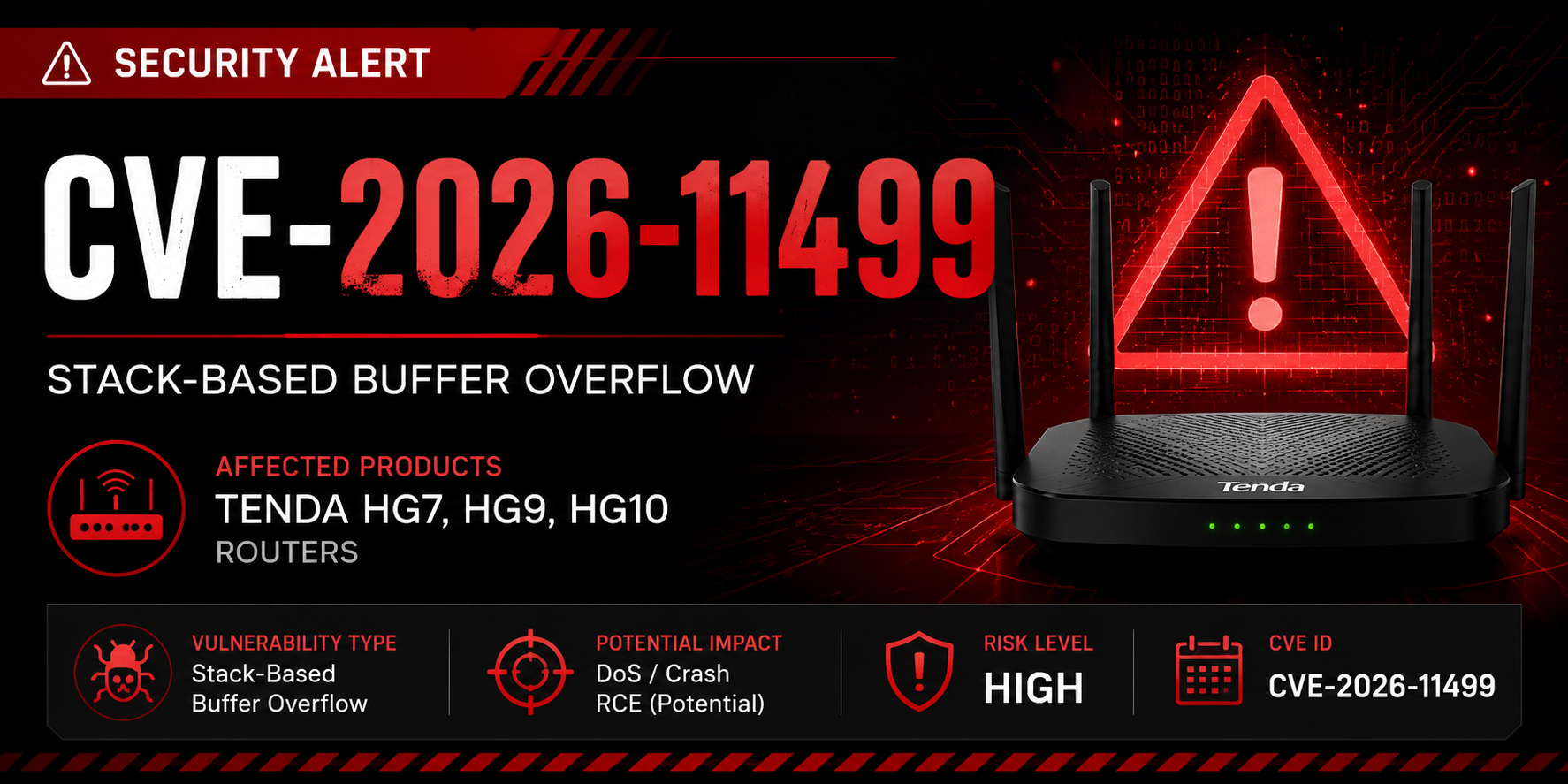
🚨 CVE-2026-11499

Stack-Based Buffer Overflow in Tenda HG7 / HG9 / HG10 Routers

ChatGPT Image Jun 8, 2026, 11_53_47 AM

Security CVE Severity Status


📖 Overview

CVE-2026-11499 is a reported stack-based buffer overflow vulnerability affecting several Tenda router models, including:

  • HG7
  • HG9
  • HG10

Successful exploitation may allow an attacker to trigger a crash, denial of service, or potentially achieve Remote Code Execution (RCE) depending on the vulnerable code path and deployment configuration.

⚠️ Technical details are currently limited and public disclosure appears to be ongoing.


🎯 Affected Products

VendorProductStatus
TendaHG7Vulnerable
TendaHG9Vulnerable
TendaHG10Vulnerable

🛠 Vulnerability Details


⚡ Potential Impact

An attacker may be able to:

  • Cause device crashes
  • Trigger denial of service conditions
  • Corrupt process memory
  • Execute arbitrary code
  • Gain unauthorized access to the device
root@kitploit:~
User Input
     │
     ▼
┌───────────────┐
│ Vulnerable    │
│ Function      │
└──────┬────────┘
       │
       ▼
 Buffer Overflow
       │
       ▼
 Memory Corruption
       │
       ▼
 Potential RCE

🔬 Technical Analysis

Vulnerability Class

The issue has been categorized as a:

root@kitploit:~
char buffer[256];
strcpy(buffer, attacker_input);

When input exceeds the allocated buffer size, adjacent memory may be overwritten.

Possible consequences include:

  • Application crashes
  • Stack corruption
  • Control-flow hijacking
  • Arbitrary code execution

🧪 Proof of Concept

🚫 No public PoC has been released at the time of writing.

When a PoC becomes available, testing should be performed only in authorized laboratory environments.


🛡 Mitigation

Immediate Actions

  • Update firmware once patches become available
  • Restrict administrative access
  • Disable remote management if unnecessary
  • Monitor router logs
  • Isolate vulnerable devices from untrusted networks

📅 Timeline

DateEvent
2026CVE Reserved
2026Public Disclosure
PendingVendor Advisory
PendingPatch Release

📚 References

  • MITRE CVE Program
  • NVD (National Vulnerability Database)
  • Tenda Security Advisories

⚠️ Disclaimer

This repository is intended for:

  • Security research
  • Vulnerability analysis
  • Educational purposes

Do not use this information against systems without explicit authorization.


🔥 Cybersecurity Research • Vulnerability Analysis • Responsible Disclosure

⭐ If you found this repository useful, consider starring it.

Download Tool
FieldValue
CVE IDCVE-2026-11499
TypeStack-Based Buffer Overflow
CWECWE-121
ImpactDoS / Potential RCE
Attack VectorUnknown
AuthenticationUnknown
SeverityHigh (Pending CVSS)