📖 Table of Contents
- Overview
- Technical Details
- Severity & CVSS
- Affected Versions
- Real-World Impact
- Exploitation Summary
- Detection Guidance
- Remediation
- Mitigation (Temporary)
- Security Checklist
- Summary
🔎 Overview
CVE-2025-14847, nicknamed “MongoBleed,” is a vulnerability in MongoDB Server’s network protocol handling.
It allows a remote, unauthenticated attacker to read uninitialized heap memory from a vulnerable MongoDB process.
This can expose sensitive information such as:
- 🔑 Credentials
- 🔐 Encryption keys
- 🎟 Session tokens
- 📦 Internal runtime data
🧠 Technical Details
🧩 Root Cause
The issue stems from:
- Mismatched length fields in zlib compressed protocol headers
- Improper validation during decompression handling
- Exposure of memory regions that were not properly initialized
When specially crafted compressed network traffic is processed, the server may return unintended memory contents.
🛑 Vulnerability Type
- Information Disclosure
- Heap Memory Exposure
- Improper Input Validation
📊 Severity & CVSS
| Metric | Value |
|---|
| CVSS v3.1 | 7.5 (High) |
| CVSS v4.0 | 8.7 (High) |
| Attack Vector | Network |
| Authentication Required | ❌ No |
| User Interaction | ❌ None |
| Exploited in Wild | ✅ Yes |
The vulnerability has been added to the :contentReference[oaicite:1]{index=1} (CISA) Known Exploited Vulnerabilities (KEV) catalog.
📦 Affected Versions
The following MongoDB release lines are affected:
3.6.x (all versions)
4.0.x (all versions)
4.2.x (all versions)
4.4.0 – 4.4.29
5.0.0 – 5.0.31
6.0.0 – 6.0.26
7.0.0 – 7.0.26
8.0.0 – 8.0.16
8.2.0 – 8.2.2
🛠 Fixed Versions
Upgrade to one of the following patched releases:
4.4.30
5.0.32
6.0.27
7.0.28
8.0.17
8.2.3
🌍 Real-World Impact
- Thousands of exposed MongoDB instances observed online
- Active exploitation confirmed
- High risk for internet-facing deployments
- Cloud-hosted and self-managed instances both affected
Because exploitation requires no authentication, publicly accessible MongoDB servers are at immediate risk.
🧨 Exploitation Summary
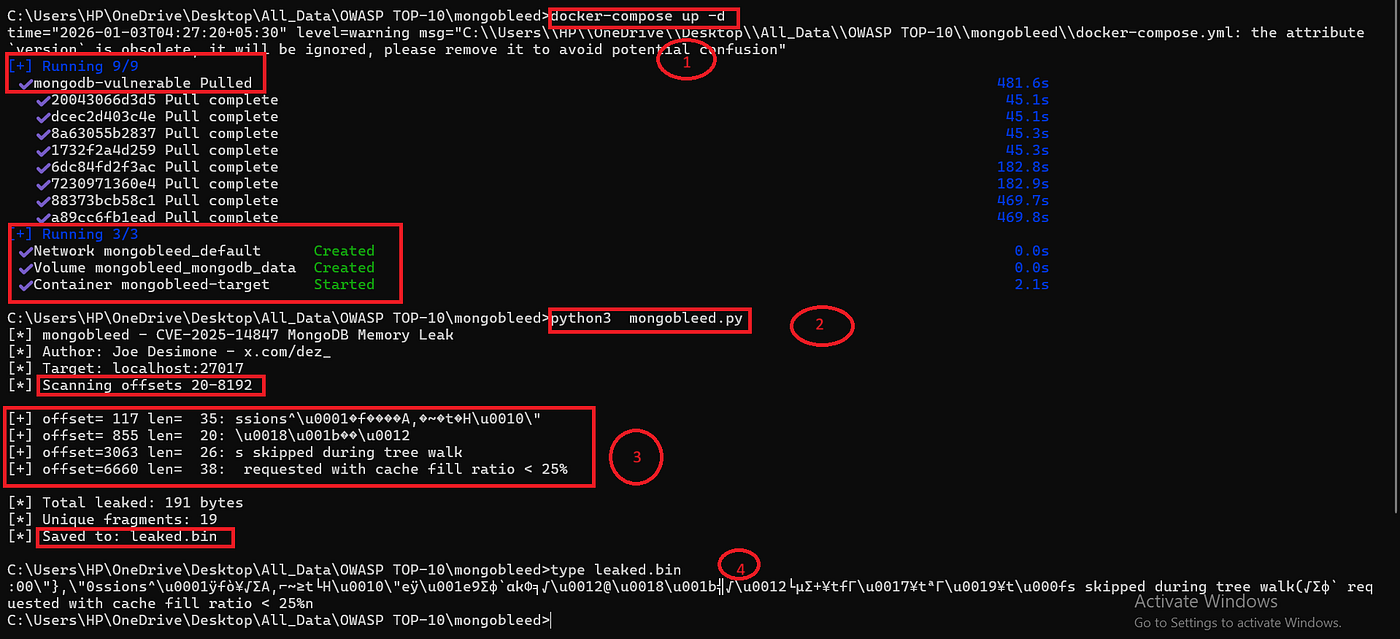
Attacker Capabilities
- Send crafted compressed protocol packets
- Trigger improper decompression handling
- Extract chunks of process memory
Potential Consequences
- Credential harvesting
- Privilege escalation
- Data exfiltration
- Follow-on attacks against backend infrastructure
🔍 Detection Guidance
Monitor for:
- Unusual compressed protocol traffic
- Abnormal zlib negotiation activity
- Unexpected outbound traffic from database hosts
- Repeated anomalous connections on port
27017
Consider:
- Network intrusion detection signatures
- Memory integrity monitoring
- External exposure scans
- Upgrade to a fixed MongoDB version
- Restart all database nodes after upgrade
- Review logs for suspicious activity
- Rotate credentials if compromise is suspected
🧱 Temporary Mitigation (If Patch Delayed)
- Disable zlib compression if not required
- Switch to alternative compressors (e.g., snappy)
- Restrict network access to trusted IP ranges
- Ensure MongoDB is not publicly exposed
🧾 Security Checklist
📌 Summary
| Field | Value |
|---|
| CVE ID | CVE-2025-14847 |
| Nickname | MongoBleed |
| Type | Memory Disclosure |
| Severity | High |
| Authentication Required | No |
| Exploited in Wild | Yes |
| Affected Software | MongoDB Server |
⚠️ Final Advisory
If you operate MongoDB Server, especially internet-facing deployments:
Patch immediately.
Unauthenticated memory exposure vulnerabilities can lead to serious downstream compromise even without direct code execution.

 0xblackash/cve-2025-14847