yakit v1.4.8-0731
All-in-one penetration testing platform with MITM proxy, web fuzzer, reverse connection handler, and plugin system for automated security testing and exploitation.

YAKIT-A Cyber Security ALL-IN-ONE Platform based on Yak language







Whitepaper • Official documentation • Issue feedback • Official website • Community • Architecture
Introduction
Security integration is a reform of security operations and management for enterprises in the new normal. It is also a top priority for enterprises in the new normal.
Based on the concept of security integration, the Yaklang.io team has developed Yaklang, a vertical language in the security field. For some products/tools that cannot be natively integrated into the Yak platform, Yaklang can be used to rewrite their "high-quality substitutes." For ecologically complete and widely recognized products, Yaklang can directly compile and integrate them, making necessary modifications to the source code for better compatibility with the Yaklang language. For security practitioners who do not want to write code, Yakit provides a suitable GUI for all capabilities in Yaklang. As the versions evolve, the GUI will become more mature.
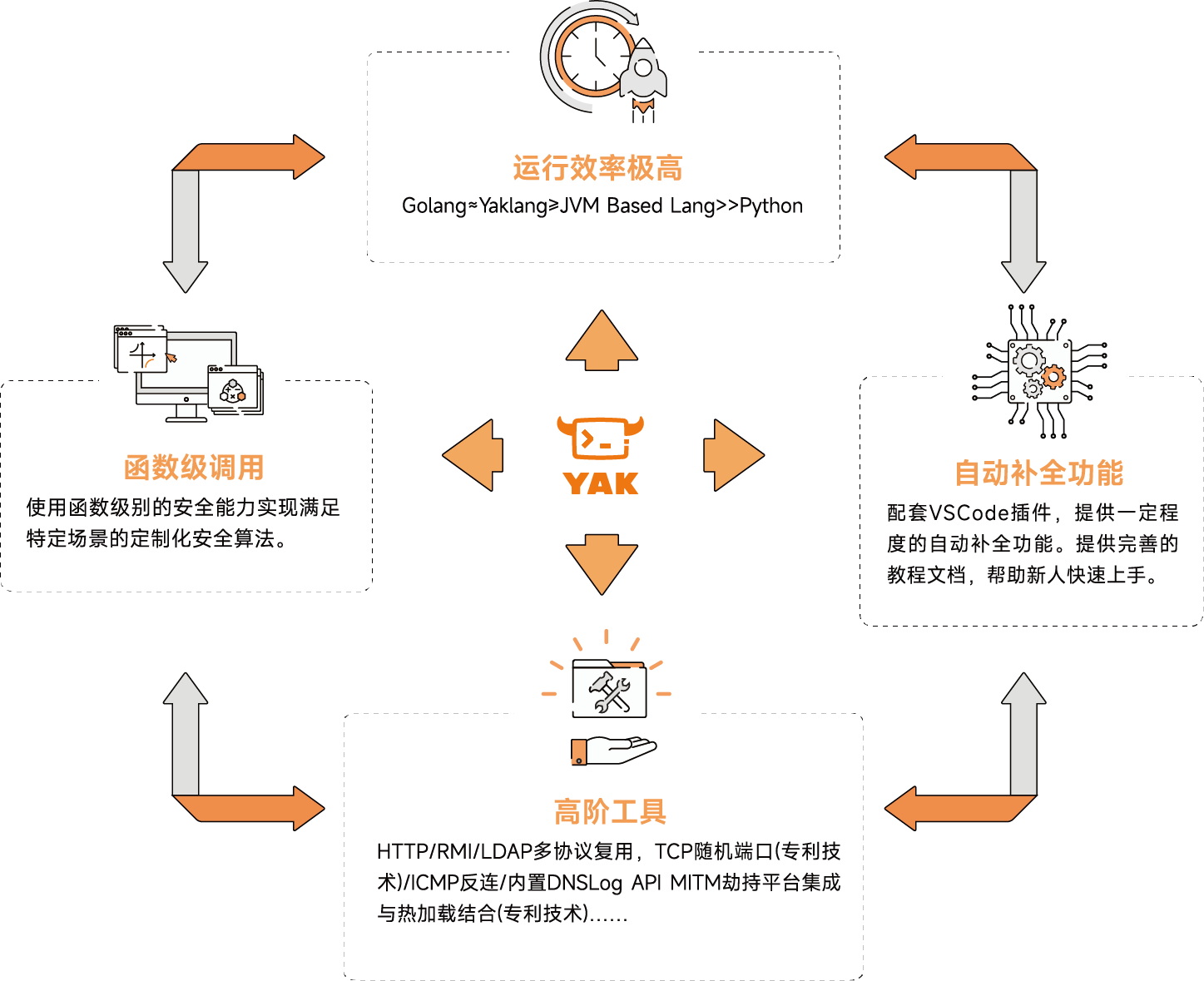
In order to make Yaklang's security capabilities more relevant to practical use, we have developed a gRPC server for Yak and built a client called Yakit using this server.
Architecture
Core technologies: CDSL
CDSL, which stands for CyberSecurity Domain Specific Language, is a specialized programming language in the field of cybersecurity. We have developed a stack virtual machine to handle the runtime state of this Turing-complete language. Our aim is to integrate security capabilities and achieve a unified underlying platform through the use of CDSL.
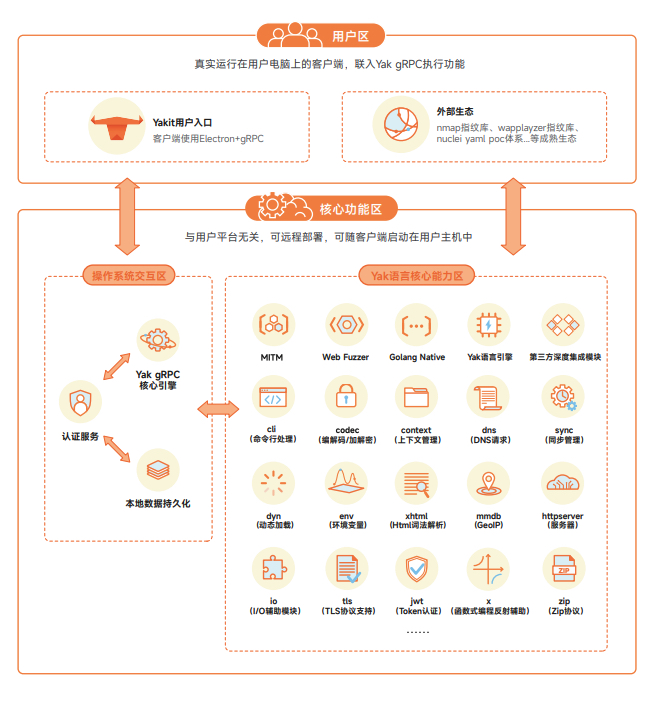
To make our self-developed CDSL language more aligned with practical usage scenarios, we have created a gRPC server for Yaklang. Using this gRPC server as a foundation, we have built the Yakit client.
In practice, Yakit's graphical user interface (GUI) allows users to control the capabilities of the engine. The gRPC server of Yakit enables convenient and efficient deployment options. It is platform-agnostic, providing users with the flexibility to choose between remote deployment or running it directly on their local machines.
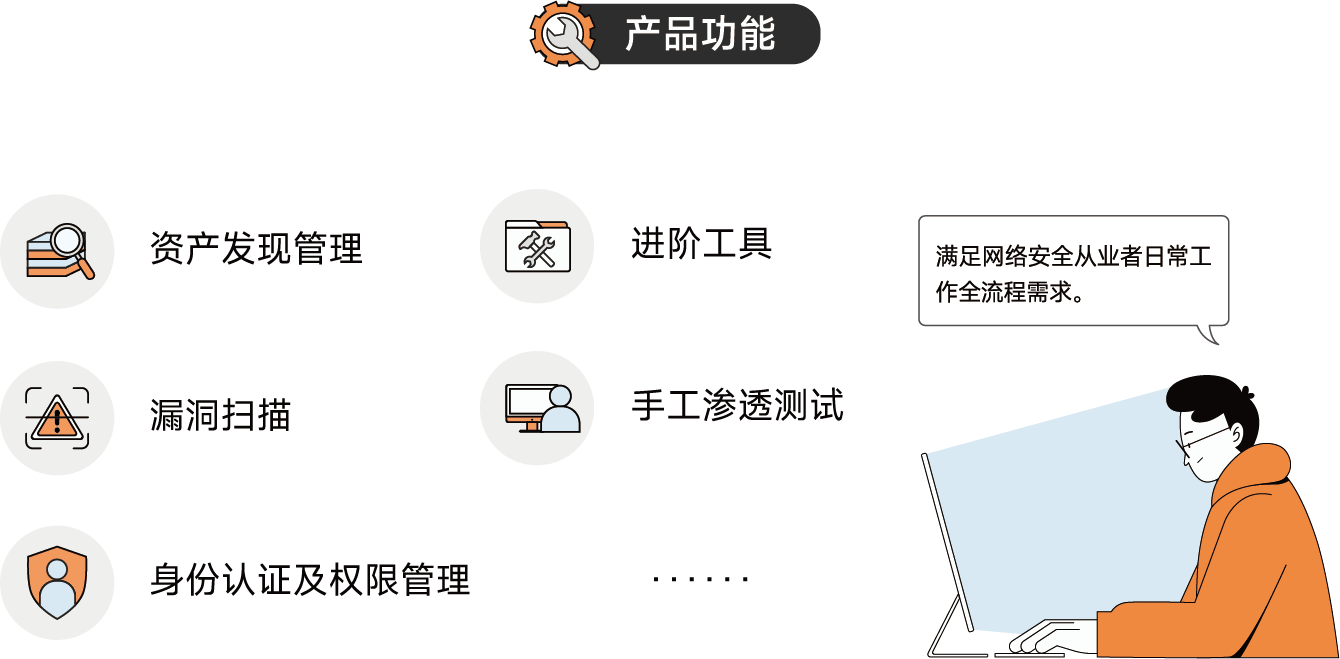
- It can completely replace BurpSuite as a MITM interception platform.
- It provides a unique and user-friendly GUI for difficult-to-replicate MITM passive scanning.
- It allows embedding Yaklang scripts for dynamic debugging of traffic and executing code on the fly.
- It is the world's first visual Web Fuzzer, a powerful tool for conducting comprehensive web vulnerability testing.
- Yakit Plugin Store: A marketplace where users can find and install various Yakit plugins.
- It enables the execution of custom Yaklang scripts or plugins at any step of penetration testing. ... ...
Overview of Security Capabilities:
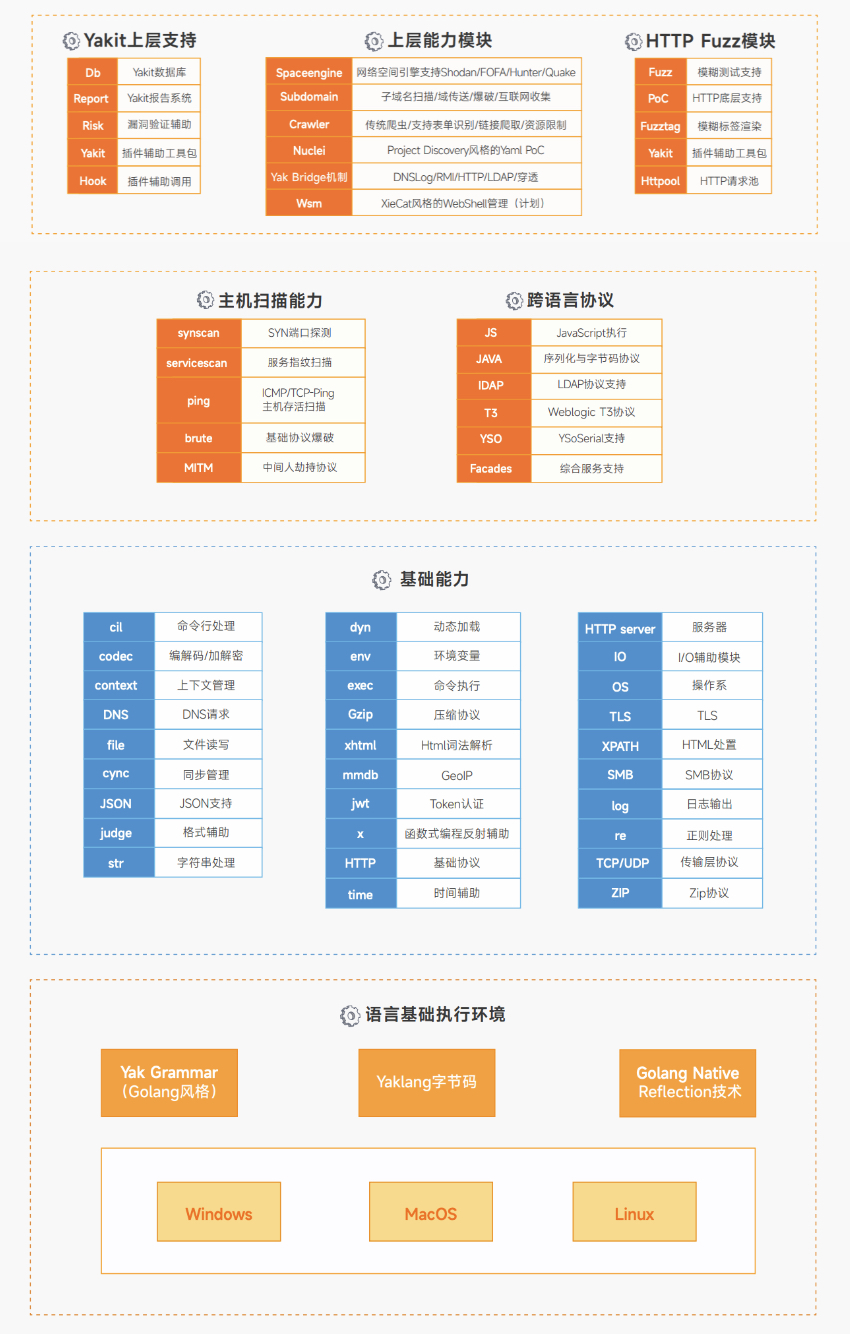
Specialized Technologies
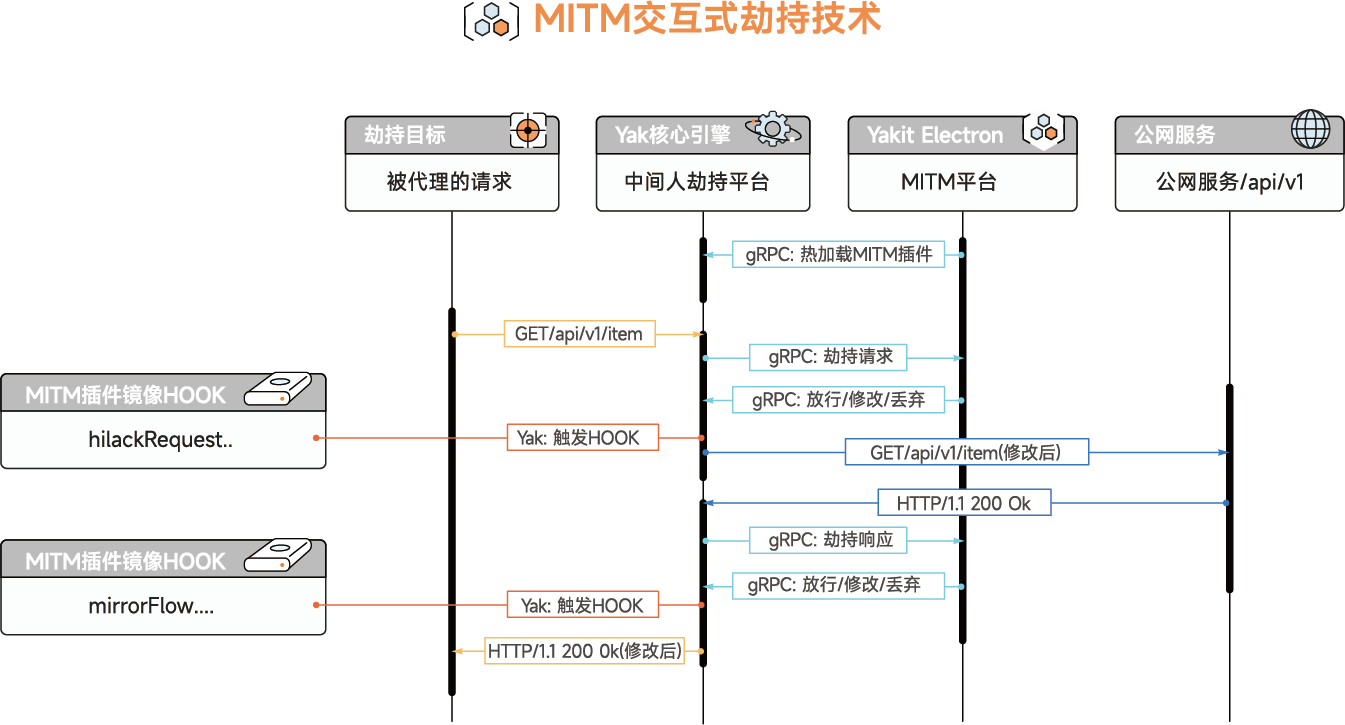
MITM Interactive Hijacking.
The MITM (Man-in-the-Middle) Console in Yakit can fully replace BurpSuite and perform all operations, including downloading and installing certificates, hijacking requests and responses, and editing intercepted packets. It provides a smooth workflow that involves hijacking, history tracking, and using tools like Repeater and Intruder. Users can intercept data, view historical data in the history section, select packets for further analysis, and send them to the Web Fuzzer for Repeater or Intruder operations. In addition to these typical use cases, the MITM module in Yakit offers more flexible features such as plugin-based passive scanning, hot reloading, packet substitution, and tagging.
The underlying principle of Yakit's MITM module is to start an HTTP proxy that automatically forwards traffic. When a user initiates a manual hijack, the automatic forwarding is stopped, and the request is blocked and popped out of the stack. The module then performs tasks such as Gzip decoding, chunk processing, and decoding to make the request human-readable, which is then displayed to the user. Users can view, modify, or replay requests as needed. During replay, the Yakit engine repairs the user-constructed HTTP request to ensure its validity. Yak's engine has a custom-built HTTP library, allowing users to customize malformed requests and responses, which can be useful in exploiting vulnerabilities in specific scenarios.
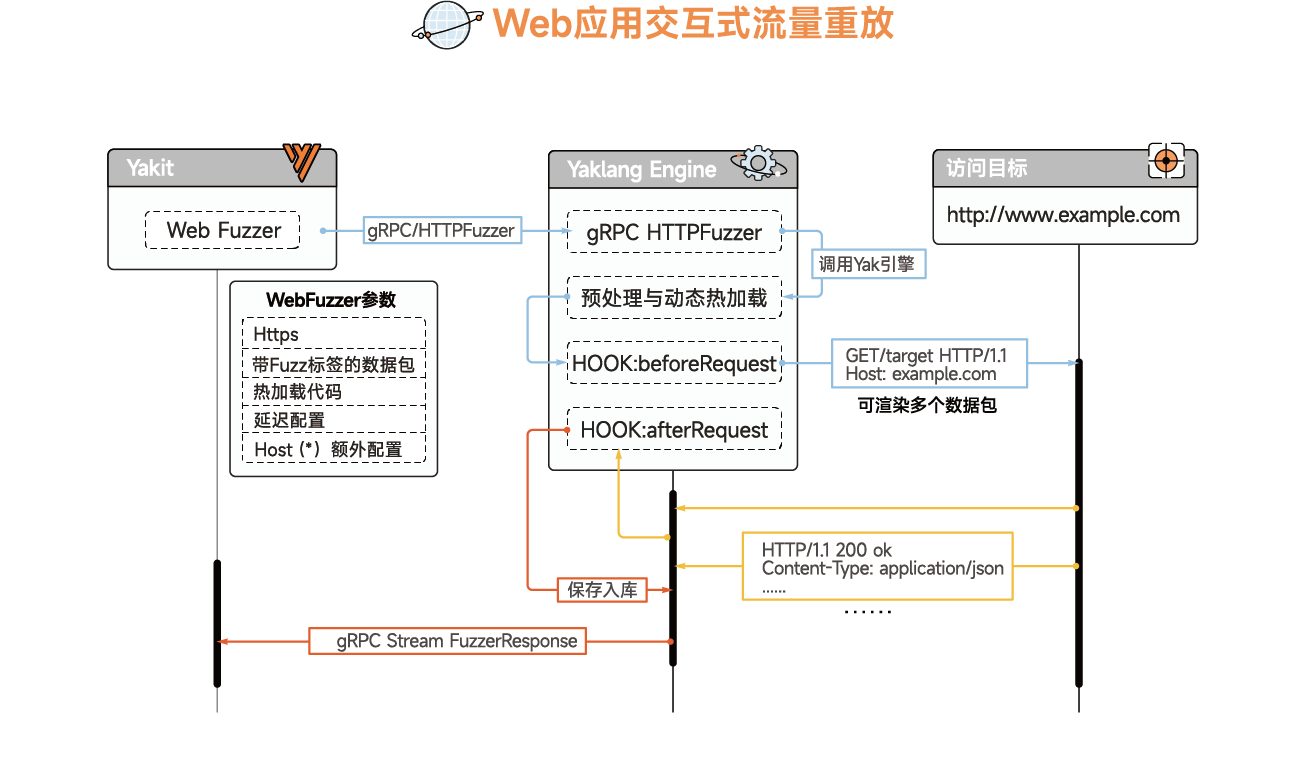
Web Application Interactive Traffic Replay and Fuzz Testing.
The Web Fuzzer module supports user-defined HTTP raw request sending. To make it user-friendly and intuitive, Yakit's backend performs several tasks. It ensures that the necessary information for data transmission and parsing in the HTTP raw request is repaired and completed. For example, Yakit fixes CRLF, completes the Content-Type, handles chunked transfer encoding, adds the missing boundary, corrects the Content-Length, and so on. This allows users to focus on the data-related information without worrying about the underlying intricacies of the HTTP protocol.