
opennhp v1.0.1
A lightweight, cryptography-powered, open-source toolkit built to enforce Zero Trust security for infrastructure, applications, and data in the AI-driven world.


Make the Internet Invisible to Attackers





OpenNHP hides your servers, ports, and domains from the public internet. Nothing answers until a client proves who it is with a single encrypted packet, so scanners, bots, and AI-driven attackers find nothing to attack.
OpenNHP is a lightweight, cryptography-powered, open-source toolkit implementing Zero Trust security for infrastructure, applications, and data. It is the reference implementation of the Cloud Security Alliance (CSA) Network-infrastructure Hiding Protocol (NHP) specification, and features two core protocols:
- Network-infrastructure Hiding Protocol (NHP): Conceals server ports, IP addresses, and domain names to protect applications and infrastructure from unauthorized access.
- Data-content Hiding Protocol (DHP): Ensures data security and privacy via encryption and confidential computing, making data "usable but not visible."
Website · Vision · Live Demo · Documentation · Discord
Why OpenNHP
The modern internet is a dark forest. Attackers — increasingly backed by LLMs that scan, fingerprint, and exploit at machine speed via Autonomous Vulnerability Exploitation — treat every reachable service as a target. Gartner projects AI-driven cyberattacks will rise rapidly. Traditional defenses authenticate users after the network lets them in, leaving exposed ports, IPs, and domains as a permanent attack surface.
In the AI era, VISIBILITY = VULNERABILITY.
OpenNHP inverts that model: invisible until trusted. Every port, IP, and hostname sits behind a default-deny gate. Access is granted only after a cryptographically signed knock is authenticated and authorized out-of-band. Attackers can't exploit what they can't discover.
The third-generation network hiding protocol
NHP is the next step in a line of "hide the service first" designs:
| Generation | Protocol | Limitations |
|---|---|---|
| 1 | Port Knocking | Plaintext, replay-prone |
| 2 | Single Packet Authorization (SPA) | Shared secrets, one-way, typically hides ports only, typically C/C++ |
| 3 | NHP | Modern crypto, bi-directional with status, hides domain + IP + ports, stateless and horizontally scalable, memory-safe Go |
NHP slots in alongside existing IAM, DNS, FIDO, and Zero Trust policy engines rather than replacing them — it extends your stack instead of forking it.
Architecture
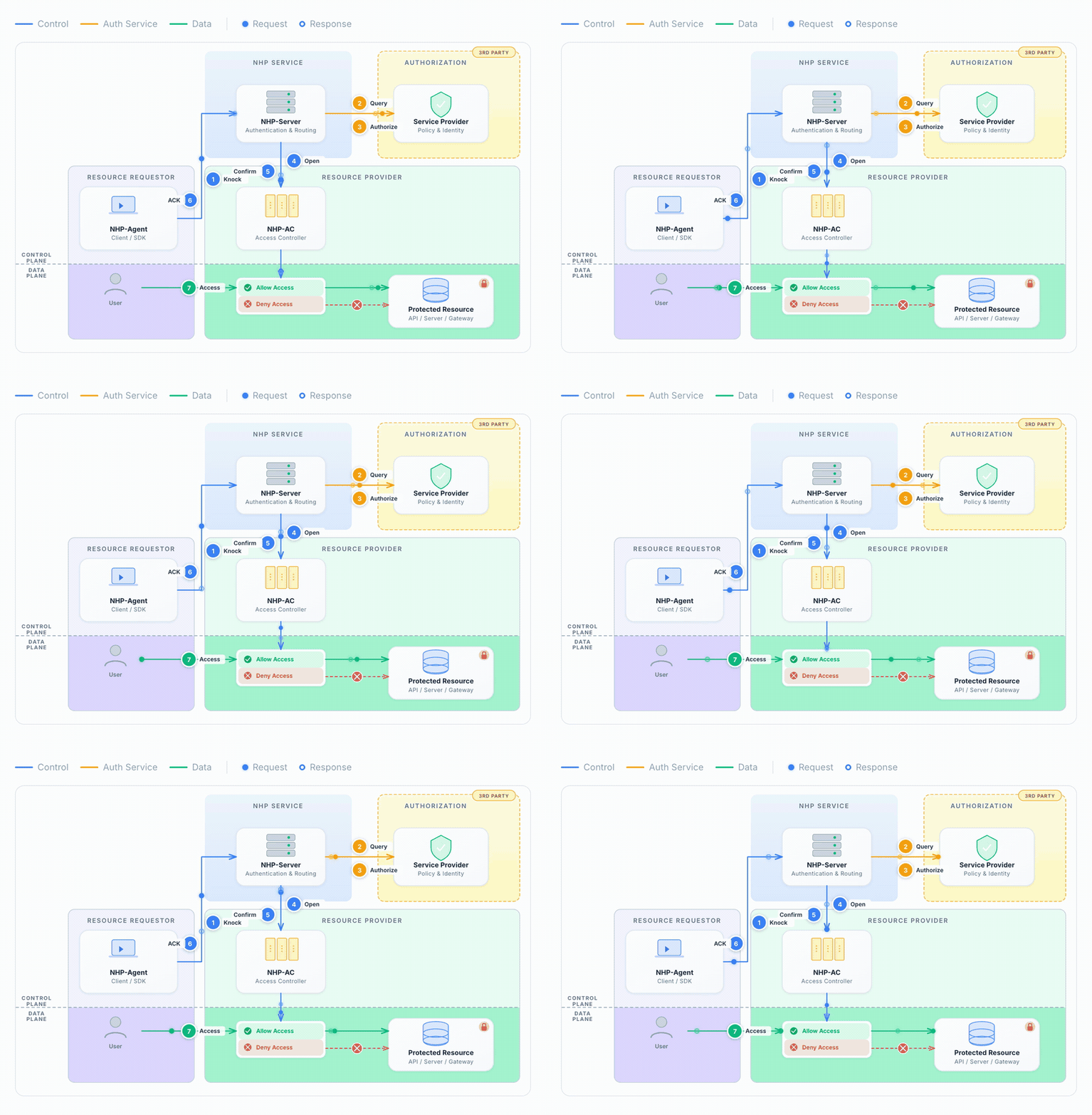
OpenNHP follows a modular design with three core components, inspired by the NIST Zero Trust Architecture:
| Core Component | Role |
|---|---|
| NHP-Agent | Client that sends encrypted knock requests to gain access |
| NHP-Server | Authenticates and authorizes requests; runs separately and is architecturally decoupled from the protected host |
| NHP-AC | Access controller that manages firewall rules on the protected server |
| Addon Component | Role |
|---|---|
| NHP-Relay | HTTP-to-UDP bridge enabling browser-based agents to send NHP knocks via HTTPS |
| NHP-KGC | Key Generation Center for Identity-Based Cryptography (IBC) |
Protocol flow
Registration (once per device). The agent generates its own key pair, then enrolls the public key:
- Agent requests a one-time password (
NHP_OTP); the Server's auth plugin delivers it to the user (e.g. by email). - Agent sends the OTP and its public key (
NHP_REG); the Server binds the key to the user and replies (NHP_RAK).
The private key never leaves the device.
Knock (every access).
- Agent sends an encrypted knock (
NHP_KNK) to the Server. - Server validates the knock and sends an operation request (
NHP_AOP) to the AC. - AC opens the firewall and replies (
NHP_ART) to the Server. - Server returns an acknowledgment (
NHP_ACK) with access info to the Agent. - Agent reaches the protected resource through the AC.
Browser agents, which cannot send raw UDP, reach the Server through NHP-Relay over HTTPS; the relay forwards each packet inside an authenticated NHP_RLY envelope.
Cryptography
OpenNHP ships with two interchangeable cipher suites:
CIPHER_SCHEME_CURVE— Curve25519 + AES-256-GCM + BLAKE2sCIPHER_SCHEME_GMSM— SM2 + SM4-GCM + SM3
Both are driven by the Noise Protocol Framework. An Identity-Based Cryptography (IBC) mode is available via the Key Generation Center (KGC).
For protocol details, deployment models, and cryptographic design, see the documentation.