Back to updates
UpdatedJul 21, 2026

Awesome-MoAI-Security — Updated!

Curated reading list and taxonomy of attack and defense research for mobile on-device AI systems, covering adversarial, backdoor, model stealing, and energy-latency attacks alongside obfuscation, TEE, and watermarking defenses.

Share

Awesome Mobile On-Device AI Security

SoK: Attack and Defense Landscape of Mobile On-device AI Systems

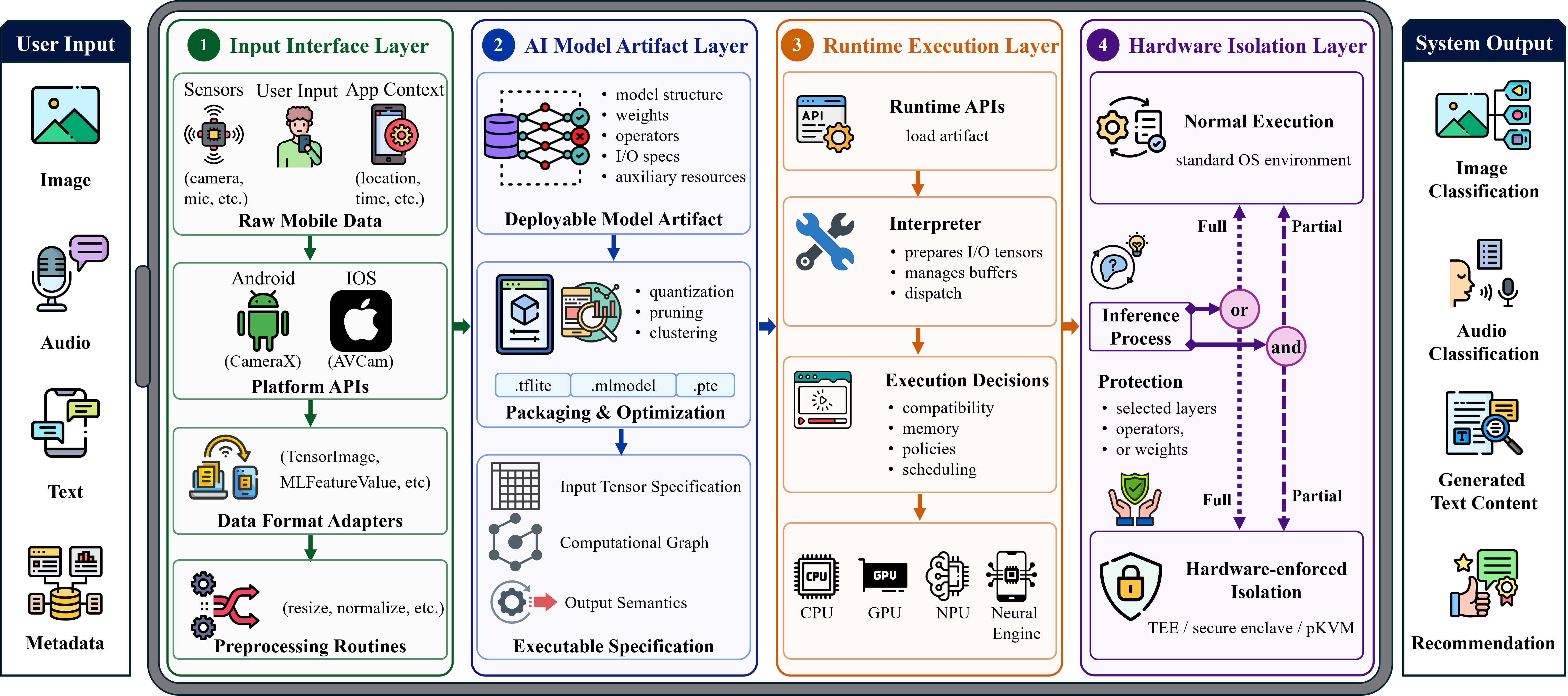
Mobile on-device AI systems execute AI models locally through ML frameworks such as LiteRT/TFLite, Core ML, ExecuTorch, ONNX, and hardware-backed accelerators. This repo tracks the security research needed to understand and protect such systems, as the local storage of on-device models introduces new security risks.

Overview of a Mobile On-Device AI system
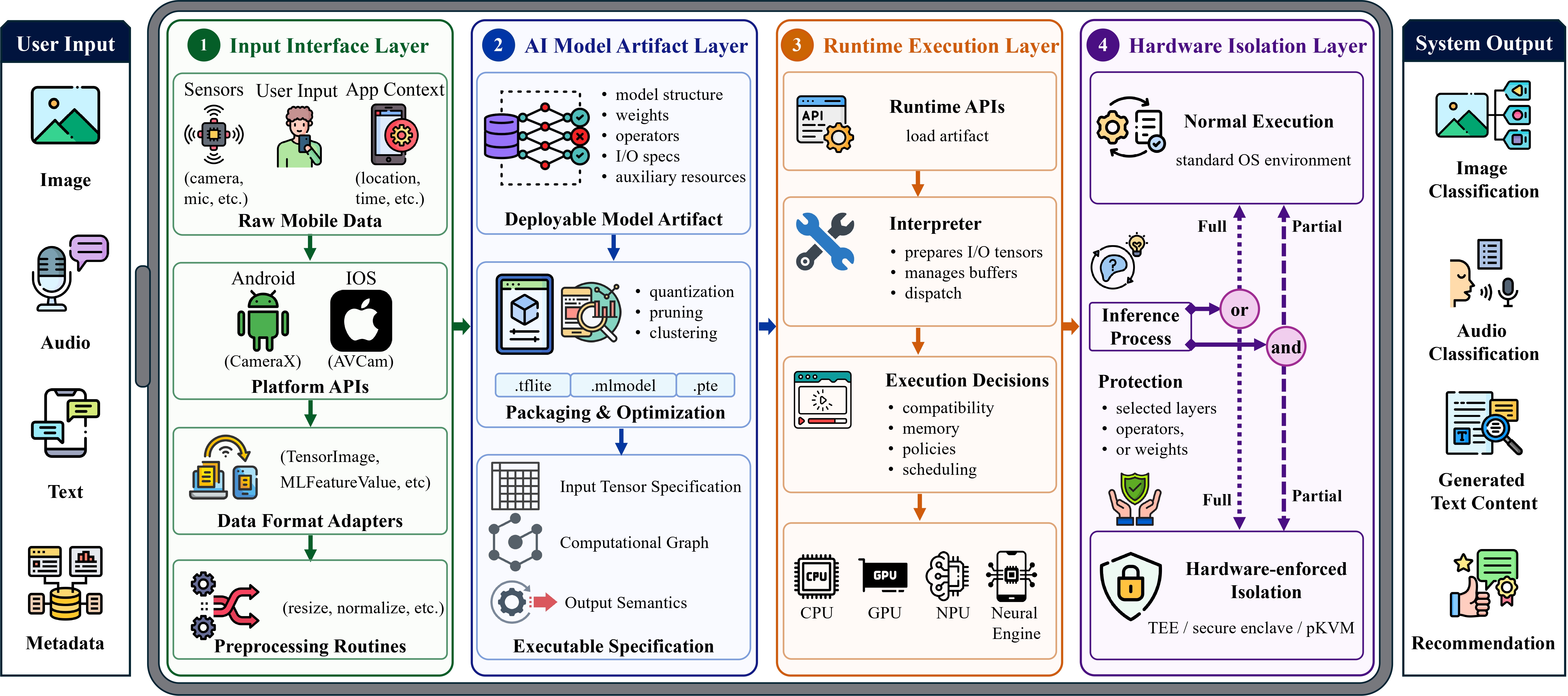
Overview of a Mobile On-Device AI system

Contents

Reading roadmap

New to MoAI security? Start here:

  1. Understand the ecosystem. Read empirical studies on deep learning apps and on-device models in Android/iOS apps.
  2. Learn the core risk. Study model extraction and model protection papers, because local model residency is the central security shift in MoAI systems.
  3. Understand the attack surfaces. Study how MoAI attacks arise across input interfaces, model artifacts, runtime execution, and hardware-backed environments.
  4. Connect defenses to the surfaces. Examine how MoAI defenses protect these surfaces across pre-deployment, runtime execution, and post-deployment phases.
  5. Look forward. Explore new security challenges in on-device training, on-device GenAI, and agentic MoAI systems.

A minimal first-week reading path for newcomers to MOAI security.


 A First Look at Deep Learning Apps on Smartphones
 A First Look at On-device Models in iOS Apps


 Mind Your Weight(s): A Large-scale Study on Insufficient ML Model Protection in Mobile Apps


 Robustness of On-device Models: Adversarial Attack to Deep Learning Models on Android Apps
 DeepPayload: Black-box Backdoor Attack on Deep Learning Models through Neural Payload Injection
 Typhon Unleashed: Practical Adversarial Weight Attacks Against On-Device Deep Learning Models
 Energy-Latency Attacks to On-Device Neural Networks via Sponge Poisoning


 ModelObfuscator: Obfuscating Model Information to Protect Deployed ML-based Systems
 ShadowNet: A Secure and Efficient On-device Model Inference System
 THEMIS: Towards Practical IP Protection for Post-Deployment On-Device DL Models

Taxonomy at a glance

MoAI security pillarWhat it protectsRepresentative attacksRepresentative defenses
User-governed input integrityThe end-to-end integrity of user inputs, from mobile data acquisition to model-input handoffAdversarial Attacks, Backdoor Attacks, Energy-latency Attacks-
Device-resident model securityDeployed model artifacts and all post-deployment forms in which models are stored, loaded, transformed, or materialized on devicesAdversarial Attacks, Backdoor Attacks, Adversarial Weight Attacks, Model Stealing Attacks, Energy-latency AttacksModel Obfuscation, Model Authorization, TEE, Model Watermarking
Device-native environment confinementSensitive inference computation and runtime states across the mobile OS, AI runtime, memory subsystem, and hardware-backed execution environmentsModel Stealing Attacks, Energy-latency AttacksModel Obfuscation, TEE

Cross-pillar Security Analysis

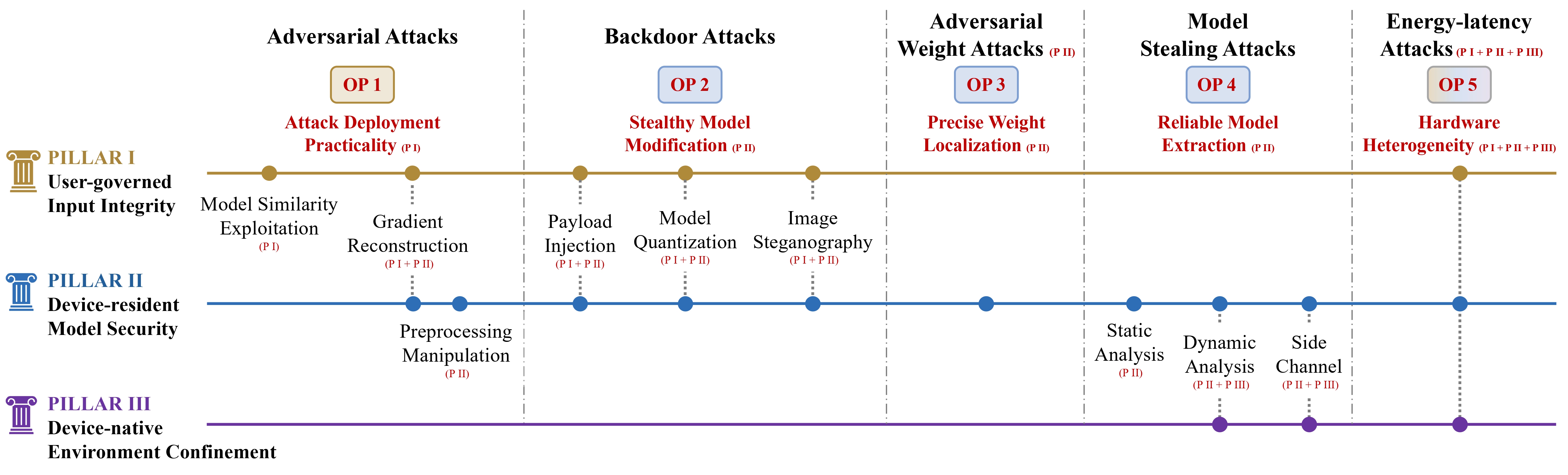
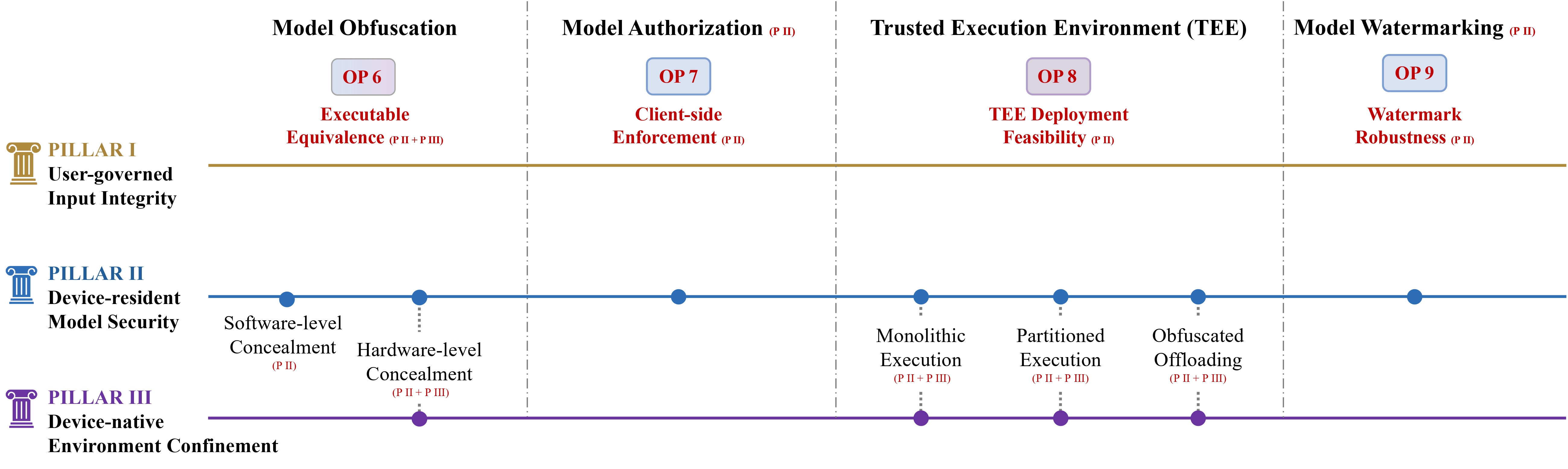
Cross-pillar security analysis of attacks and open problems in MoAI systems. Cross-pillar security analysis of defenses and open problems in MoAI systems.

Attacks on MoAI systems

Model Similarity Exploitation

Gradient Reconstruction

Preprocessing Manipulation

Payload Injection

Model Quantization

Image Steganography

Static Analysis

Dynamic Analysis

Side Channel

Defenses for MoAI systems

Software-level Concealment

Hardware-level Concealment

Monolithic Execution

Partitioned Execution

Obfuscated Offloading

Open problems

The following open problems summarize the main research gaps identified in our SoK. We keep the descriptions here high-level for readers using this repository. More technical discussions can be found in the paper.

  1. Attack Deployment Practicality.
    Adversarial attacks against on-device models remain hard to realize after deployment because they often require control over model inputs, insertion of adversarial perturbations, or app repackaging to modify preprocessing code. These steps can be impractical or detectable in real end-user deployments.

  2. Stealthy Model Modification.
    Backdoor attacks need to find post-deployment entry points beyond standard training-time poisoning because on-device models are typically read-only and inference-only. The key challenge is to introduce hidden malicious behavior without producing observable changes in model artifacts.

  3. Precise Weight Localization.
    Adversarial weight attacks expose a parameter-level integrity risk, but practical deployment depends on locating behavior-critical weights in the large parameter search space. This is difficult because attackers often lack gradient guidance and need to preserve benign utility while modifying only selected parameters.

  4. Reliable Model Extraction.
    Local model storage does not make model stealing straightforward. Practical extraction still depends on reliable model identification, decryption, and reconstruction in the presence of customized encryption algorithms, nonstandard AI frameworks, and runtime-specific loading behavior.

  5. Hardware Heterogeneity.
    Energy-latency attacks depend on how poisoned activation patterns interact with device-specific execution behavior. They may amplify latency and energy consumption on sparsity-sensitive accelerators, but fail to transfer to hardware without sparsity-dependent execution.

  1. Executable Equivalence.
    Model obfuscation still needs to preserve the original prediction function during authorized inference. This executable equivalence can expose recoverable runtime states, transformed weights, operator semantics, or structural traces that enable semantic, structural, or parameter recovery.

  2. Client-side Enforcement.
    Model authorization binds correct inference to credentials, integrity checks, and packed-weight recovery. However, these checks need to execute inside the mobile stack, making enforcement dependent on client-side code that can be reverse engineered, repackaged, hooked, or instrumented after deployment.

  3. TEE Deployment Feasibility.
    TEE defenses require coordinated support across model formats, AI frameworks, operator libraries, delegates, accelerators, and CPU/GPU/NPU isolation interfaces. Current mobile ecosystems still lack widely adopted, developer-transparent TEE-backed inference stacks.

  4. Watermark Robustness.
    Model watermarking enables post-deployment ownership verification, but stolen models may be redeployed through framework conversion, encryption, or app-level input-output mediation. These transformations can preserve benign inference while disrupting trigger responses, confidence patterns, or output semantics used for verification.

Emerging directions

Beyond the nine open problems above, our SoK highlights three emerging directions where MOAI security is likely to expand next. These directions move MoAI security research toward systematic evaluation while extending its scope to the emerging attack surfaces introduced by on-device training and agentic MoAI systems. We summarize them here at a high level. The companion paper provides more detailed motivation, threat surfaces, and research challenges.

Existing MoAI security studies evaluate attacks and defenses using self-collected datasets, method-specific metrics, and different threat models, and are typically limited to a single platform (Android or iOS). This makes evaluation results difficult to compare and overlooks platform-specific differences. Future work should establish unified benchmarks that standardize datasets, metrics, and threat models and support cross-platform evaluation for systematic, comparable, and reproducible assessment of MoAI security.

Current MoAI security research mainly focuses on deployed models that are read-only and inference-only. On-device training changes this assumption by allowing models to be updated locally, which exposes gradients, parameter updates, and user data during the training process. This opens new questions around local fine-tuning, update integrity, training-data exposure, personalization poisoning, and defenses for training-time states on end-user devices.

MoAI systems are evolving from passive local inference toward agentic workflows that connect models with sensors, private user data, app contexts, OS services, and cross-app interfaces. This shifts the security focus from protecting model artifacts alone to governing context-to-action chains. Future work should study provenance for mobile context, separation of trusted user intent from untrusted environmental content, task-scoped permissions for tool and API use, confirmation and rollback for sensitive actions, and auditing of agent plans, memory, and actions.

Categories