Back to updates
New releaseAug 5, 2026

kin v0.5.3

The system of record for AI-written software. A persistent graph of entities, relationships, changes, and provenance, so humans and AI agents see what a change touches before it merges. Beside Git today.

Share

Kin, a graph-native code repository for people and AI agents

AI changed who writes code.
Kin changes what they build on.

A graph-native code repository for people and AI agents.

License: Apache-2.0 Latest release kinlab.ai

AI writes a change in seconds. Working out what it touches has not gotten any faster.

Every agent reads a repository the way a person would. Search, open files, follow callers, build the picture, throw it away when the session ends. The next one starts over. The reviewer starts over again. Most AI tools rebuild context for each task. Kin keeps a durable semantic record across tasks, agents, and changes.

Git shows which lines changed. Kin shows what the change affects.

Kin makes the graph the repository. Entities, relationships, exact source, and change history are what you commit, branch, and merge, and files stay a projection so ordinary tools keep working.

Agents stop rebuilding context and start editing code. Reviewers see what a change touches before it merges.

Kin is a public alpha. It runs today as a local CLI, a daemon, an MCP server for agents, a review surface, and a graph-backed filesystem projection. It is pre-1.0, so expect rough edges and breaking changes. See the latest stable release and what is real today and what is alpha before you put it in a critical workflow.

Point it at a repository you know and ask it something you already know the answer to. Or watch it run on Kin's own repositories at kinlab.ai/demo.

See it on a real repository

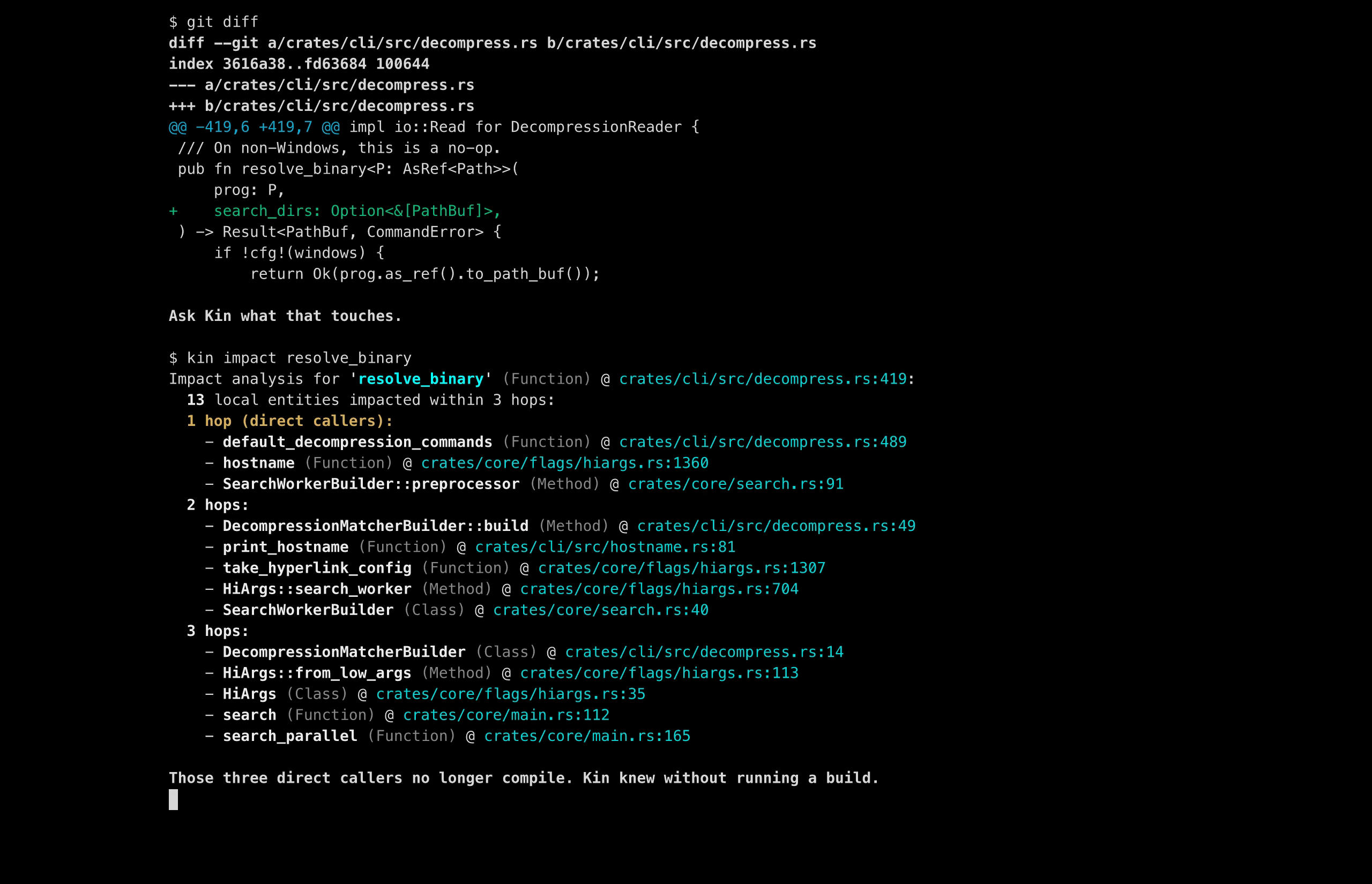
A one-line signature change in ripgrep looks harmless in the diff. Ask kin impact about it, before any compiler runs, and it names what the edit reaches. The callers of the changed signature come first, then everything those callers pull in behind them.

kin impact on ripgrep: a one-line signature edit, and Kin surfaces the entities it affects before a compiler runs

Recorded against a prepared graph at ripgrep commit e89fff89ac9af12e8d4ce9d5fd07beb408ca730f. A one-line signature edit, and Kin surfaces the entities it affects before a compiler runs. The graph was built beforehand. No compiler ran. The two commands are the ones in the quickstart below: kin init . to build the graph, then kin impact on the entity you changed. The raw run directory for this capture is not public yet, so treat it as a recipe you can re-run rather than a trace you can audit.

Kin surfaces what the change touches. Whether the change is correct stays with your compiler, tests, and review. The graph is built beforehand by kin init, and building it is the expensive part; after that, impact questions are answered from graph truth, not from re-reading the tree.

Quickstart

Install, admit your repository, check the graph, ask it something. Wire your agent last. The agent tools answer from the graph, so a client pointed at a repository with no graph gets a tool surface with nothing behind it.

Run the installer on its own and finish any setup prompts:

curl -fsSL https://get.kinlab.dev/install | sh

Once it finishes, reload your shell with this separate command:

exec "$SHELL" -l

At the new prompt, replace the path below with your repository's location and run this block:

cd /path/to/your/repository &&
kin init . &&
kin overview

kin overview prints what the graph now holds: entity counts by kind, by language, and the files carrying the most of them. If it prints counts, the graph is real and the commands below have something to answer from.

The rest of this section is the same path with the detail behind each step.

1. Install Kin

On macOS or Linux, run the installer on its own and finish any setup prompts:

curl -fsSL https://get.kinlab.dev/install | sh

Once it finishes, reload your shell with this separate command:

exec "$SHELL" -l

The installer resolves the latest stable release, verifies its published SHA-256 checksum, installs the managed binaries under ~/.kin, and launches setup. Running the explicit agent intent, which step 5 does once the graph exists, configures the built-in MCP server for detected supported clients. Use --intent local for CLI and filesystem use without MCP configuration, or --intent editor for the VS Code path.

npm, Homebrew, and a manual archive resolve that same public release channel:

npm install -g @kinlab/kin@latest
brew install firelock-ai/kin/kin

Each archive and its .sha256 file is published under https://github.com/firelock-ai/kin/releases/latest/download/, and the release page lists the asset names.

Confirm what you installed with kin --version, whichever path you took. The quickstart doc carries the operator detail: the asset matrix, what to do when a global npm install hits EACCES, how the Homebrew formula is regenerated from each release rather than hand-maintained, and kin setup uninstall when you want the integrations gone.

On Windows, run irm https://get.kinlab.dev/install.ps1 | iex in PowerShell. Native Windows x86_64 support is early. Repository admission works: kin init imports a Git repository and publishes graph authority, and graph, lexical, and daemon-backed queries answer natively. Transparent filesystem projection is not shipped on Windows, and the end-to-end install proof does not yet cover MCP or review workflows there, so WSL2 remains the recommended path for the full Kin experience. Read Platform and maturity below before choosing a Windows install path.

2. Admit your repository as graph truth

Replace the path below with your repository's location:

cd /path/to/your/repository && kin init .

In a detected Git repository, kin init atomically admits complete reachable history, refs, raw objects, the exact workspace tree, and admission policy into repository-v6 graph authority. A worktree with uncommitted edits, staged changes, or untracked files still admits: kin init admits the committed state and discloses what it did not admit. It never substitutes an exact-HEAD snapshot or raw-filesystem semantic rebuild. Supported repository-local remote URLs, refspecs, branch tracking, and push defaults are sealed into Kin's Git coexistence configuration; unsafe, ambiguous, or unsupported transfer settings fail closed before publication.

Admission also derives the semantic entity and relation layer for every supported entity-source file in that history, and kin init reports the durable, generation-bound counts it committed. kin status reports that repository authority view; kin graph status separately reports the daemon's mutable live query graph, which may include later derived enrichment. Query surfaces consume graph-owned enrichment when it exists and report its absence instead of hiding the gap behind raw file search.

kin init is the slow step and the one that earns the rest. It admits your Git history into the graph, and every answer after it comes from that graph rather than from re-reading the tree. Measured on a fresh Debian 12 container with 4 CPUs and 8 GiB against the release npm serves today, the installer took 4 seconds, kin init took 139 seconds on a 503-file repository with 1,983 commits, and the first kin locate answered in 6.7 seconds while the daemon cold-started, then in 71 milliseconds warm. Those are separately measured legs of one sitting, not one timed run, and a repository with deeper history takes longer.

Which files become entities

"Supported entity-source file" means a file one of Kin's language adapters claims. The adapter registry is the whole set, and every file in a repository resolves through it:

LanguageExtensions
TypeScript.ts, .tsx
JavaScript.js, .jsx, .mjs, .cjs
Python.py, .pyi
Go.go
Java.java
Rust.rs
C.c, .h
C++.cpp, .hpp, .cc, .cxx
C#.cs
Ruby.rb
PHP.php
Swift.swift
Kotlin.kt, .kts
HCL / Terraform.tf, .tfvars

A .h header is read as C++ when its contents say so, so a C++ project does not lose namespaces and templates to the C grammar.

Everything else is admitted as content and stays queryable as history and text, but is not parsed into entities and relations. That includes Markdown, HTML and CSS, SQL, YAML, JSON and TOML, shell scripts, Objective-C, Scala, Elixir, Dart, Lua, R, Zig, Haskell, and Nix. If your language is on that list, locate and refs will not find symbols in it.

3. Check the graph is ready

kin graph status
kin embed

kin graph status reports the daemon's live query graph and its coverage. Admission derives the semantic entities, not their vectors, so run kin embed to add local vector similarity over them and confirm coverage with kin graph status again.

One thing to expect on a small repository: kin init starts a background download of the roughly 523 MB embedding model, and a conversion that finishes in seconds can beat it. When that happens the first kin locate ranks on lexical and graph signals alone and says why on the line beneath its rows. If that line reports the model still downloading, run the query again once it lands. If it reports that none of it arrived, do not wait on it: kin embed fetches the rest.

4. Ask it something you already know the answer to

This is the honest way to judge it. Pick a helper you know the callers of, or a subsystem you could describe from memory, and see whether Kin agrees with you. A question about code you've never read tells you nothing about whether the answer is right.

kin locate "<something you already know is in this repository>"
kin refs ExactEntityName
kin trace ExactEntityName
kin impact ExactEntityName

Replace ExactEntityName with a symbol returned by locate. locate finds the entities relevant to an intent, refs shows graph-owned callers/importers and references, and trace returns the focal entity plus nearby semantic context. Once embeddings are complete, your configured AI agent can use the vector-backed semantic_locate tool; get_context_pack, find_references, and trace_data_flow expose the graph neighborhood directly.

impact walks the other way from refs and shows what sits downstream of the entity you are about to change. Replace the locate string with a behavior you could already point to in the source.

5. Wire your agent

Now that the graph exists, point your agent at it:

kin setup --intent agent

Use kin setup --intent editor for the VS Code path, or --intent local for CLI and filesystem use with no MCP configuration. Confirm the resulting machine-readable health checklist with kin setup status --json. Works with your agent has the per-client one-liners and the standard MCP entry.

Why I built this

I work with coding agents a lot, and the same thing kept bothering me. Before an agent can change anything, it spends a stretch of its run working out where things live and how they connect. Then the next session does that work again. Meanwhile I'm doing a version of it myself, trying to piece together enough of the same picture to review what it actually did. You're paying a tax to re-understand what was already understood.

At some point I started wondering why that structural understanding isn't just part of the repository.

Git is a great content tracker. Linus said it himself when he made it: it's a stupid content tracker. It only tracks what changed. Kin records the software. Everybody is trying to put bolt-ons on top of Git, and I understand why. My thesis is that it's the wrong way to store code for the velocity and the way we're doing coding in 2026.

It's like using a paper map versus Google Maps. Same roads either way. One of them knows where you are and what connects to what.

I've been working on this for six months in my spare time, which has not been much spare time. I've got a substantial alpha built. I've taken it as far as I can on my own, and I'm ready to let this thing shine. It's just engineering work from here on.

What is real today, and what is alpha

Real today. The graph is the repository. Kin has its own commits, branches, and merges, with Git import and export beside them. The exact source is preserved byte for byte. The CLI, the bundled MCP server, and the VS Code extension all answer from that same graph. Local repository work runs on your machine.

These are the limits worth knowing before you start.

Admission holds the frontier of history, not every commit's tree. kin init walks a repository's commits oldest first and resolves each commit's tree from its first parent's and the paths that differ, keeps a hash and a content observation in the tree's place, and drops the tree once nothing later resolves against it, so what a conversion needs follows the commits and the width of the tree it admits rather than the two multiplied together. Every commit still lands in one graph, each building on the last. On a history too long for the machine, Kin still refuses in words with a memory forecast, before it captures anything, rather than dying partway. A forecast above what the machine has is refused and one in the last third below it is warned about; the forecast counts commits, tracked files and the bytes of history reachable from HEAD, names which of the three decided it, and its coefficients are floors read off measured conversions, a floor and not a predictor: across the repositories measured a conversion held between one and three times its floor. Measured on the bytes this release ships, without enrichment, with commits counted from HEAD: redis/hiredis, 1,141 commits over 79 files, admits in 74 seconds at a 1.4 GB peak and leaves a 256 MB store; psf/requests, 6,493 commits over 130 files, admits in about ten minutes at a 5.2 GB peak; kin's own repository, 2,924 commits over 1,033 files, admits in 35 minutes at a 25.5 GB peak, reached when the finished store is opened for its final proof, so it admits on 32 GB and is refused on 8 and 16 GB with its 1.3 GB of history named as the reason, because its commits carry far more entity change each than requests' and that change, held across the conversion and then loaded from the store, is what sets the peak; a normal clone of facebook/react, 21,679 commits over 7,213 files, is forecast at 36.7 GB from its 2.0 GB of history and admits in 1 hour 47 minutes at a 36.9 GB peak, so it is refused on 16 and 32 GB and admitted where the machine has room, in place of a 582.5 GB refusal everywhere. A shallow clone is not the way around a refusal: git clone --depth leaves a boundary Kin refuses, because a history whose oldest commits have absent parents cannot be captured losslessly. There is no partial-history mode.

Some repositories refuse to import at all. Repositories carrying submodules or Git LFS are refused before admission. Kin does not model submodules yet, so refusing is the correct answer rather than a silent partial import.

Git export names Kin as the author's mailbox. kin git export writes native Kin commits with the author's name and kin@localhost as the email, and no sign-off trailer. Commits that came in from Git are reused as their original objects, so their identity is untouched.

kin init adds exactly one ignore rule. It writes /.kin/ into .git/info/exclude, which is local to your checkout, and leaves your tracked .gitignore alone. Whether a teammate's checkout carries a Kin store is their business, not a tracked file's.

Not every language becomes entities. The adapter table in step 2 is the whole set. Everything else is admitted as content and stays queryable as history and text, but locate and refs will not find symbols in it.

The graph can still miss relationships. Coverage is real and it is not complete, so treat an empty answer as a question rather than as a proof. You still need your compiler, your tests, and your own judgment.

No format change ships without a migration path. No release will drop an existing store without a tested migration path. A repository admitted from Git can always be re-admitted from Git. State that exists only in Kin will be carried forward by an upgrade command shipped with any format change, or the format change does not ship. A format change never rewrites your working tree.

What that recovery looks like, measured on a 261-commit repository: delete .kin, run kin init again, and everything Git holds comes back, all 61 refs byte-identical. Nothing native comes back. A commit, a branch, a review, and a spec that existed only in Kin were gone, while the edited file survived as an uncommitted working-tree change. Re-admission also mints a new repository id unless you pass --adopt-repository-id. That is the gap the upgrade command above exists to close.

Platform and maturity below has the per-platform boundaries, the memory floors, and what a green release does and does not establish.

The stack

Kin is one system with a few clear public surfaces:

SurfaceWhat it does
kinSemantic system of record: CLI, daemon, graph lifecycle, MCP, review, provenance, and Git coexistence.
kin-vfsProjects graph-owned files through normal filesystem calls so existing tools can keep using files.
kin-editorVS Code access to the entity explorer, semantic search, trace, review, and rename surfaces.
Kin MCPTyped graph tools for AI agents, bundled into kin and launched with kin mcp start.
KinLabHosted collaboration and control plane. Public repository connection is not a first-run flow yet.

How the pieces fit

Kin is the system of record for AI-written software, and everything in the map below either reaches that authority or supports it. Humans and AI agents come in through the CLI, the bundled MCP server, or the VS Code extension. All three ask the same daemon, and the daemon answers from graph authority rather than by re-reading the tree. kin-vfs projects that same graph back through ordinary filesystem calls, so editors, compilers, and build systems keep seeing files. Git sits beside the graph as an import and export boundary rather than as an answer path, and KinLab is the hosted layer over the same authority.

flowchart TD
    people["Humans and AI agents"]

    subgraph surfaces["Access surfaces"]
        cli["kin CLI"]
        mcp["Kin MCP server"]
        editor["kin-editor for VS Code"]
    end

    daemon["kin daemon"]
    authority["Graph authority<br/>entities, relations, changes, provenance"]
    db["kin-db<br/>graph storage, snapshots,<br/>index, text and vector search"]
    prims["kin-model, kin-blobs, kin-search,<br/>kin-vector, kin-infer, kin-lsp"]
    vfs["kin-vfs<br/>transparent file projection"]
    tools["Editors, compilers, build systems"]
    git["Git<br/>import and export boundary"]
    kinlab["KinLab<br/>hosted collaboration and control plane"]

    people --> cli
    people --> mcp
    people --> editor
    cli --> daemon
    mcp --> daemon
    editor --> daemon
    daemon --> authority
    authority --> db
    db --> prims
    authority <-->|"kin init imports, kin git export"| git
    authority -->|"publish and sync"| kinlab
    authority --> vfs
    vfs --> tools

Underneath those surfaces are the layers the system is built from:

LayerRole
kin-dbGraph storage, snapshots, indexing, text search, and vector search.
kin-modelCanonical types and domain models shared across the stack.
kin-blobsContent-addressable blob storage.
kin-searchLexical search primitives and staged retrieval.
kin-vectorVector and nearest-neighbor substrate.
kin-inferInference and embedding substrate.
kin-lspLanguage-server enrichment feeding the semantic layer.

These are implementation layers of one system, not separate products a new user needs to assemble. None of them is installed separately.

Open source and the Kin ecosystem

The core of Kin is open source under Apache-2.0: kin, kin-db, kin-vfs, and kin-editor, plus the supporting libraries kin-model, kin-blobs, kin-search, kin-vector, kin-infer, kin-lsp, and kin-actions.

KinLab is a proprietary product built on this open core: the hosted collaboration and control-plane layer described above.

The same boundary applies to how benchmark work is shared. The benchmark specification and a standalone, dependency-free bundle verifier are public, so a merge-trust benchmark claim can be checked without access to the runner that produced it. The runner and proof infrastructure that produce sealed evidence bundles (the orchestration, the pinned-release proof gate, and the hosted measurement environment) remain private for now. The spec and verifier open first; the runner can open later.

Version control without Git

Kin keeps a full change history with no Git underneath it. In an empty directory with no .git, the same binary records changes, branches, merges, and history, and Git never runs. This is that loop, with the output it printed on one real run of a build of main. kin init, kin status, and kin diff say more than is shown here; the lines below are theirs, unedited, with the rest trimmed.

Start an empty repository and record a first change:

mkdir kin-demo && cd kin-demo
kin init
  Authority: repository-v6 (graph-owned)
  Default ref: refs/heads/main
  History: unborn (no synthetic commit)
  Workspace: empty exact tree
  Store size: 17.4 KiB under .kin/ (no Git object store here to compare against)
cat > retry.py <<'PY'
def backoff(attempt):
    return min(2 ** attempt, 30)
PY
kin commit -m "Add the retry backoff"
  starting the kin daemon for this repository; the first query after a start waits for it to load the graph
  kin daemon ready in 1.8s
Created semantic change f635b52070f2944aa1c8651fec50cfa62e1cc21c00760137f62f971a7c27642f on branch 'refs/heads/main' (2 entities, 0 relations, 1 artifacts)
Recorded in Kin authority, not in git. `git status` stays dirty until you run `kin eject` or push this branch to a Kin remote.

The first commit starts the repository's daemon. Before that, right after kin init, kin status reports durable authority alone and says so on its Tree: line; once the daemon is up, every kin status measures the working copy. Who made the change comes from your Git identity when you have one, and otherwise from default_author in .kin/config.toml. Kin refuses to record a change attributed to nobody.

Branch, change the function on the branch, and commit there:

kin branch create cap-backoff
kin branch switch cap-backoff
Created refs/heads/cap-backoff at change f635b52070f2944aa1c8651fec50cfa62e1cc21c00760137f62f971a7c27642f (authority generation 3)
Switched to refs/heads/cap-backoff at change f635b52070f2944aa1c8651fec50cfa62e1cc21c00760137f62f971a7c27642f (1 projected entries, authority generation 4)
cat > retry.py <<'PY'
def backoff(attempt):
    """Exponential backoff, capped at a minute."""
    return min(2 ** attempt, 60)
PY
kin status
Kin repository-v6 status
Head: symbolic refs/heads/cap-backoff
Tree: 198609d9406becdd1fb97f1f3d16d8d869dc382c38823f2b88aa75f72d927029 (1 artifacts, ahead of its base change as admitted 0s ago)
Refs: 2, default refs/heads/main
Durable semantic enrichment: present (2 entities, 0 relations, 1 changes at authority generation 5, workspace generation 3; completion not attested)
Untracked host content: none, measured 0s ago
kin commit -m "Raise the backoff cap to a minute"
Created semantic change 64cce9085641a7eee86bd2b870567ac524835e2e80488f7e5444f7cf9b42c065 on branch 'refs/heads/cap-backoff' (2 entities, 0 relations, 1 artifacts)

Back on main, record a second change so the merge has two real parents, then merge the branch:

kin branch switch main
cat > retry_test.py <<'PY'
from retry import backoff

def test_first_attempt_waits_one_second():
    assert backoff(0) == 1
PY
kin commit -m "Add a first backoff test"
kin merge cap-backoff
Switched to refs/heads/main at change f635b52070f2944aa1c8651fec50cfa62e1cc21c00760137f62f971a7c27642f (1 projected entries, authority generation 7)
Created semantic change 18abd82f3a295696fa4938fc078613c0abe4a3214dd6ec0eb81f8a7c1f747105 on branch 'refs/heads/main' (2 entities, 3 relations, 1 artifacts)
Merged refs/heads/cap-backoff into refs/heads/main as change 4137af4647e6b838771d5e4ce98d8a604304b9d0a66fdb4e0931e828d6b75c9c (2 projected entries, authority generation 9)

The merge composed both sides by entity identity against their common base, with no line-level text merge, and published one change carrying both parents. kin log walks that history and kin diff shows what the merge brought in, as artifacts, as entities, and as lines:

kin log
change 4137af4647e6b838771d5e4ce98d8a604304b9d0a66fdb4e0931e828d6b75c9c
Author: Kin Demo <[email protected]>
Date:   2026-09-05T01:15:32.635348+00:00
Origin: native
Parents: 18abd82f3a295696fa4938fc078613c0abe4a3214dd6ec0eb81f8a7c1f747105 64cce9085641a7eee86bd2b870567ac524835e2e80488f7e5444f7cf9b42c065
Deltas: entities=2 relations=0 tree=1 policy=false
    Merge refs/heads/cap-backoff into refs/heads/main

change 18abd82f3a295696fa4938fc078613c0abe4a3214dd6ec0eb81f8a7c1f747105
Author: Kin Demo <[email protected]>
Date:   2026-09-05T01:15:32.339226+00:00
Origin: native
Parents: f635b52070f2944aa1c8651fec50cfa62e1cc21c00760137f62f971a7c27642f
Deltas: entities=2 relations=3 tree=1 policy=false
    Add a first backoff test

change 64cce9085641a7eee86bd2b870567ac524835e2e80488f7e5444f7cf9b42c065
Author: Kin Demo <[email protected]>
Date:   2026-09-05T01:15:31.791709+00:00
Origin: native
Parents: f635b52070f2944aa1c8651fec50cfa62e1cc21c00760137f62f971a7c27642f
Deltas: entities=2 relations=0 tree=1 policy=false
    Raise the backoff cap to a minute

change f635b52070f2944aa1c8651fec50cfa62e1cc21c00760137f62f971a7c27642f
Author: Kin Demo <[email protected]>
Date:   2026-09-05T01:15:30.609174+00:00
Origin: native
Deltas: entities=2 relations=0 tree=1 policy=true
    Add the retry backoff
kin diff HEAD~1 HEAD
Kin repository-v6 diff
Base: HEAD~1 (e5aa80af2498ad1d8f8c5a756f24467773a7f12c46039395deb691a0e09ff0bc)
Head: HEAD 4137af4647e6b838771d5e4ce98d8a604304b9d0a66fdb4e0931e828d6b75c9c (f86d6f68558a54372da1c08cedd8549dd98733110e3f2db6193dc8314ba10c11)
Artifacts: +0 ~1 -0
Entities: +0 ~2 -0
Relations: +0 ~0 -0
M  retry.py -> retry.py [aab37f62-f986-4543-8187-4af2b8984e0a] blob 0ceda974a82e648bf6e6d40efccc9489eb4b73fa5ab3f0c5cfd35df4911cd524 mode=100644 -> blob c0b44cec88f49e73cc31f7f439ec1b10d9d73cfe1c414dc539106886d4747cce mode=100644
E~ 0a69467a-63d6-5c34-ac35-632cefde30b7 retry -> retry
E~ 6cd876cf-cc8a-50bd-94be-e0a2fde3208d backoff -> backoff
   @@ -1,2 +1,3 @@
    def backoff(attempt):
   -    return min(2 ** attempt, 30)
   +    """Exponential backoff, capped at a minute."""
   +    return min(2 ** attempt, 60)

HEAD~1 is the merge's first parent, the test commit, so the diff is exactly what cap-backoff contributed: one artifact, the two entities in it (the module and the function), and the lines. kin checkout, kin stash, kin rollback, kin blame, and kin conflicts with kin resolve round out the set, and kin capabilities prints where each one stands. The CLI reference has every flag.

Sharing a native repository between machines is still in progress, and public repository connection through KinLab is not a first-run flow yet. What the transfer commands do today: kin clone takes a KinLab locator or the HTTP endpoint of another machine's running Kin daemon, adopts that repository's identity into a fresh local workspace, and remembers the origin it came from. kin push sends your new changes to that saved origin one verified pack at a time, and refuses rather than forces when the remote has moved past you. kin pull admits what the origin has that you do not and moves your working tree onto it, and when uncommitted work stops the tree from following, it says so and keeps the history it received. Each of the three is exercised between two Kin daemons over HTTP by the test suite.

Works with your agent

Kin ships its own agent, and it's the path I recommend for agent work. kin agent run drives any OpenAI-compatible endpoint, so a local model in LM Studio, Ollama, llama.cpp or vLLM works from the same flags as a hosted one, and it reaches the graph over the same MCP server every other client uses.

kin agent run --task "Find where the retry backoff is computed and document it" \
  --model qwen/qwen3.6-35b-a3b --base-url http://localhost:1234/v1

What makes it different from pointing another agent at the MCP server is that the rule is enforced inside the agent rather than borrowed from a vendor's permission layer. It has Kin's tools plus exactly two local ones, edit_file and write_file. There is no shell, no grep and no file-reading tool, so it cannot answer a repository question from raw file search, and a tool it invents is refused by name. When Kin reports that an empty result cannot be trusted, the agent is told the answer is unknown and given the named gap instead of concluding the thing does not exist. Every edit runs inside a Kin transaction under a Kin session, so the change carries provenance naming the agent. Run kin agent doctor --base-url <url> first to check both halves answer. See the CLI reference for the full surface.

Working with Claude Code, Codex, Cursor, Gemini and anything else that speaks MCP stays first class. kin setup --intent agent configures every client it detects in one pass. These are the per-client one-liners when you would rather install Kin directly.

Run kin init . in the repository before you wire a client, not after. These tools answer from the graph, so a client pointed at a directory with no graph gets a tool surface with nothing behind it. kin setup says so itself: its round-trip check reports "no initialized Kin repository at or above" the directory it ran in, and tells you to run kin init there and re-run setup.

Claude Code, from inside a session:

/plugin marketplace add firelock-ai/kin
/plugin install kin@kin

Codex:

codex plugin marketplace add firelock-ai/kin
codex plugin add kin@kin

Gemini CLI:

gemini extensions install https://github.com/firelock-ai/kin

Cursor takes a one-click install link. Paste this into Cursor or into your browser's address bar:

cursor://anysphere.cursor-deeplink/mcp/install?name=kin&config=eyJjb21tYW5kIjoibnB4IiwiYXJncyI6WyIteSIsIkBraW5sYWIva2luIiwibWNwIiwic3RhcnQiXX0=

Kiro takes the same thing as a web link: Add Kin to Kiro.

Cline takes the standard entry below rather than a one-liner. Its CLI reads ~/.cline/mcp.json. In the VS Code extension, open the MCP Servers panel, then the Configure tab, then Configure MCP Servers, and add the entry there.

Every other client that reads a standard MCP config takes this entry:

{
  "mcpServers": {
    "kin": { "command": "npx", "args": ["-y", "@kinlab/kin", "mcp", "start"] }
  }
}

kin setup status and kin doctor recognize this exact shape, alongside the absolute-path form kin setup writes, and grade anything else MISCONFIGURED. Do not shorten command to a bare kin, because agent clients do not reliably inherit your shell PATH. @kinlab/kin-mcp is the older launcher and keeps working for configurations that already name it; new ones should point at @kinlab/kin, which ships the same MCP server as one mode of the full CLI.

The wrapper needs Node 20 or newer, and on its first run it downloads the matching Kin release, verifies its published SHA-256, and caches the binaries per user. Codex CLI wants the same thing as TOML under [mcp_servers.kin].

One caveat worth repeating: these tools answer from the graph, so the repository has to be admitted with kin init . and embedded with kin embed before semantic_locate can rank anything. llms-install.md is that whole path written so an agent can follow it unattended, from a bare machine to a first verified tool call.

Review an AI-written change

AI writes code. Kin proves what changed.

Run kin init on the branch you want to review so the relevant Git history is in the graph, then pass explicit commit SHAs to the report-only shadow gate:

kin review shadow "$(git rev-parse main)..$(git rev-parse HEAD)"

The result is PASS, NEEDS ATTENTION, or WOULD BLOCK, and it comes with the impact Kin derived from the graph, the context needed to repair it, and the evidence behind both. Authorship is declared, not verified. The command will not block your merge or change graph state. It hands evidence to a human or a CI policy and stops there.

How Kin relates to Git

Beside Git today. Repository authority over time. During brownfield adoption, Git remains an explicit import/export interoperability boundary; it never answers Kin runtime queries or repairs missing graph truth.

  • kin init imports complete reachable Git history and exact parent edges. Kin deliberately has no partial-history or snapshot-only initialization mode.
  • After import, Kin's graph owns repository identity, tree state, history, refs, and semantic relations. Filesystem and Git views are projections.
  • kin git export --output ../repo.git writes a new bare Git projection from one graph-owned authority generation. It does not consult working files or an ambient .git/ object store, and it refuses an existing or in-repository destination. Objects, refs, and directories are flushed before the no-replace destination publication is acknowledged. Capability-anchored publication is currently available on Unix hosts; other hosts refuse before creating the export.

This lets a team migrate an existing repository without giving up its editor, compiler, build system, or Git interoperability while Kin becomes authoritative.

Platform and maturity

The core runtime and the filesystem projection have different support boundaries:

PlatformCore Kin runtimekin-vfs projection
macOS, Apple Silicon and IntelNative graph, vector, daemon, setup, MCP, and review surfaces ship in the release archive.Shipped and exercised on both architectures. It uses DYLD_INSERT_LIBRARIES; SIP-protected or hardened programs may reject injection.
Linux x86_64 and arm64kin and kin-daemon are static musl builds intended to run on glibc and musl distributions.The public VFS executable and shim are GNU/glibc builds, not musl builds. They are built against a pinned glibc floor of 2.31 and link OpenSSL 3, so a projection host needs both; Debian 12 loads them, and Alpine and other musl distributions are not supported projection hosts. The release refuses to publish a Linux archive whose binaries ask for more glibc than that floor. The arm64 release proof runs on Ubuntu 24.04.
Native Windows x86_64Early support: repositories admit and graph and lexical queries answer natively, but MCP and review workflows are not yet covered end to end by the install proof. WSL2 remains the recommended path for full Kin.Not shipped. Use WSL2 with a Linux distribution that meets the glibc boundary for projection.

The graph is the authority in every case above. The shim, an NFS mount, a FUSE mount, and Windows ProjFS are four ways to see that truth as files, and Kin picks between them by probing what this host can run: a mount where one is available, because the kernel serves it and no process can have it stripped, with the injected shim as the compatibility fallback on macOS and Linux and ProjFS leading on Windows, where no shim exists. kin vfs on engages the chosen one, kin vfs off disengages it, and kin doctor carries a row saying which is in force and whether it is working. Where a mode is missing, Kin prints the exact line that installs or enables it for your platform. docs/projection.md has the full per-platform table.

First indexing reads the entire reachable Git history, so kin init on a large or long-lived repository takes minutes, not seconds, before embedding begins. After init returns, the daemon continues preparing in the background, and the first agent calls on a large repository can take noticeably longer to answer.

Bounded arm64 testing found the core graph and lexical path usable at 512 MB, but full embedding downloads a roughly 522 MB model and currently needs 2 GB as the safe operating floor; 1 GB is an unsafe edge and 512 MB can terminate during embedding. These are observed alpha constraints, not universal sizing promises.

A successful kin --version establishes only that the core binary runs. It does not establish VFS compatibility or a live graph-backed projection. On a supported Unix host, use kin vfs status, which probes each projection mode and prints what is actually in force, then kin setup status and a real kin-vfs exec --workspace . -- <command> launch. The VFS launcher includes an interposition canary and reports when the operating system strips the shim. The kin-vfs README contains the full boundary.

Release assets are checksum-published and the release workflow runs anonymous installation, daemon/MCP, embedding, and real graph-backed VFS projection checks across its supported runner matrix. The workflow itself is public: Install Proof. A green release establishes those exact artifacts and environments; it is not a claim that every distribution, tool, or repository shape is already covered.

FAQ

Does Kin replace Git?

Beside Git today. Repository authority over time. Git stays an explicit import/export interoperability boundary during brownfield adoption, so a team can migrate an existing repository without giving up its editor, compiler, build system, or Git interoperability.

Does my code leave my machine?

Kin keeps local repository work in your environment, so repository ingestion, graph storage, and local queries all run there. KinLab is a separate product that adds hosted collaboration under explicit access and early-access agreements.

Which agents does it work with?

Working with Claude Code, Codex, Cursor, Gemini and anything else that speaks MCP stays first class. kin setup --intent agent configures every client it detects in one pass.

Does it block a merge?

Review is advisory, so it flags risk without blocking and the merge decision stays with your team. kin review shadow hands evidence to a human or a CI policy and stops there.

Proof posture

The published preregistered Multi-SWE-Bench Go proof package is pinned to an older build, not the moving latest release, and does not establish a broad speed, token-savings, or category-win claim. Comparative results are withheld here pending independent verification.

Read the methodology, task set, build identity, and artifacts in the public proof package. Treat claims outside that measured scope as hypotheses until they have their own reproducible proof.

Writing

Engineering notes from building Kin, written down so a stranger can reuse them, live at kinlab.ai/blog with a feed at kinlab.ai/rss.xml.

Learn and contribute

License

Apache-2.0.

Software, beyond files.

Categories