
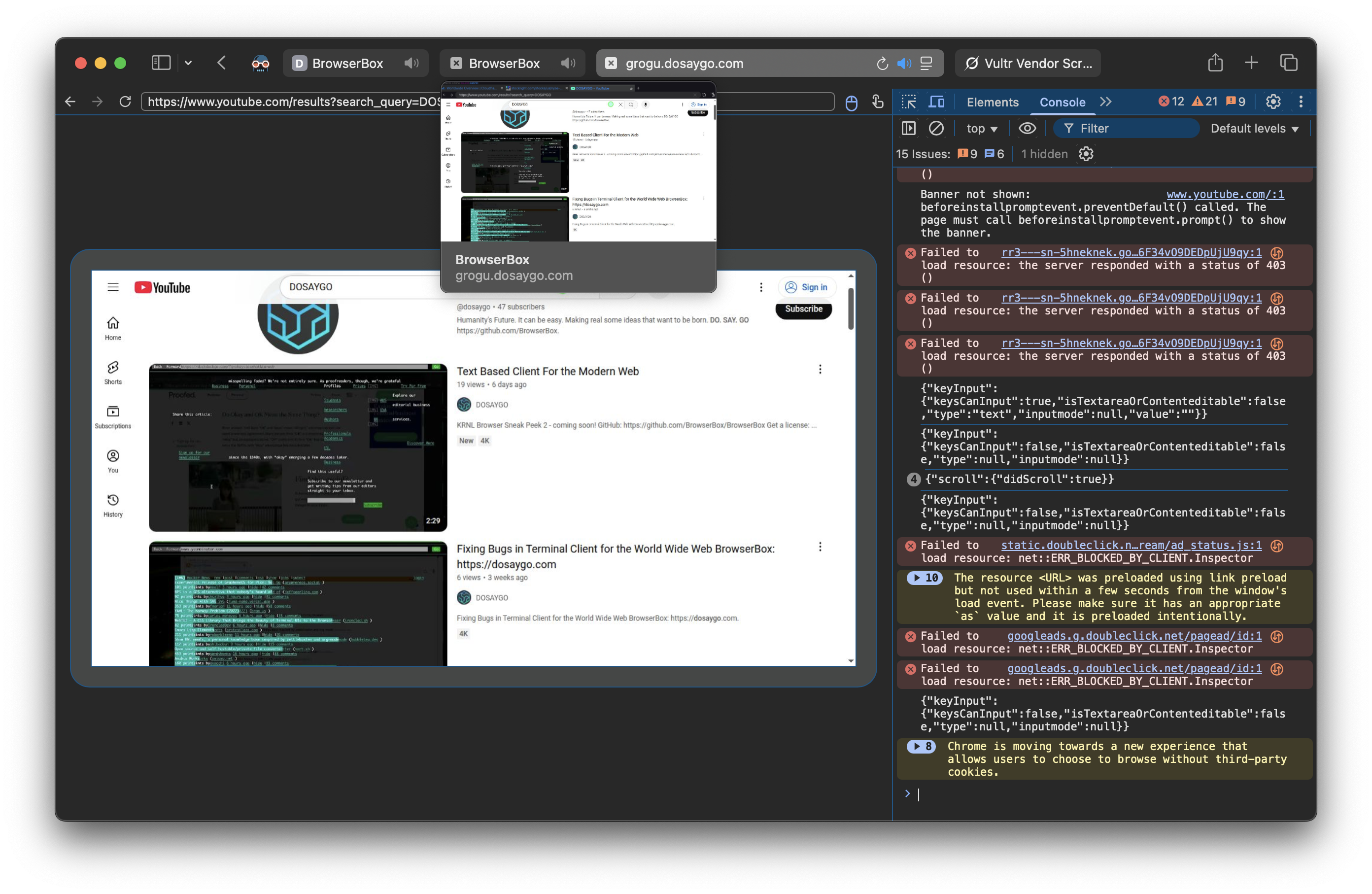
BrowserBox v19.0.3
💚🇺🇸🗽Secure remote browsing anywhere, any way you like it.
BrowserBox — Remote Browser Isolation
A full remote browser. Clientless access. Native performance.
Self-host on Windows, macOS or Linux, or create cloud browser sessions through the API.
Start a 7-Day Paid Evaluation · Buy a Commercial License · Talk to Sales
Website · Live Demo · Documentation · Latest Release
BrowserBox is a remote browser isolation (RBI) platform for secure web access, browser automation, and embedded browsing. It runs a full browser on a remote host and streams the rendered view to your users, with support for 60 FPS streaming. Give employees and contractors access to web applications, investigate untrusted sites, or add a live browser to your product. End users connect from a modern web browser without installing an agent or plugin.
As of v20, BrowserBox's production runtime is written entirely in freelang and compiled to a self-contained native executable. The familiar bbx commands, configuration, policies, and login links carry forward. Read about the freelang architecture.
BrowserBox is commercial software. A valid license is required for all use, including development and evaluation. Compare licensing options or try the hosted demo before planning a deployment.
Table of Contents
- Why BrowserBox?
- Key Benefits
- Who Uses It
- Real-World Use Cases
- Core Features
- What's New in v20 & Freelang
- See It In Action
- Supported Network Topologies
- Platform Compatibility
- Install
- Quick Start
- Documentation
- GitHub Actions
- Cloud API
- Embed BrowserBox
- Advanced Usage
- Flipbook Recording
- License Compliance & Privacy
- FAQ
- Licensing
- Support
- About DOSAYGO
1. Why BrowserBox?
Move web browsing into infrastructure you control. With BrowserBox, remote websites execute on the host while users interact with a streamed view. This separates website execution from the endpoint and gives your team a central place to manage browsing policy, access, and sessions.
Deploy a self-hosted remote browser inside your network for access to internal applications, run isolated sessions for security work, or use the Cloud API when you want on-demand capacity without managing servers. The same browsing experience can also be embedded in your own application with Hyper-Frame.
Evaluate BrowserBox on your infrastructure or discuss an enterprise deployment.
2. Key Benefits
- Reduce endpoint exposure. Run untrusted web content on a remote host, with browser policy enforced in the session.
- Simplify access. Users open a login link in their existing browser; no endpoint agent or browser extension is required.
- Keep browsing responsive. Support for 60 FPS streaming, WebRTC transport, and WebSocket fallback. Actual performance depends on the host, workload, and network.
- Choose where sessions run. Deploy on your own Windows, macOS, or Linux systems, or purchase hosted browser minutes.
- Build browser features into your product. Embed a live session and control navigation, tabs, and capture through the Hyper-Frame API.
- Manage concurrent users. Linux Fleet pools let you run multiple isolated seats on one host, with capacity and health visible in the desktop app.
3. Who Uses It
| Team | What BrowserBox helps you do |
|---|---|
| Security and IT | Isolate browsing activity, investigate suspicious sites, and enforce session policy. |
| Enterprise operations | Give employees, contractors, and vendors browser access to internal web applications. |
| SaaS builders and integrators | Add interactive remote browsers to customer portals, workflows, and support tools. |
| Automation and QA | Automate browser workflows and let a person take over the same session when needed. |
| Healthcare, finance, and government | Apply browsing restrictions, data loss prevention controls, and policy logging within your deployment. |
4. Real-World Use Cases
Enterprise: Secure Remote Browser Gateway
Place BrowserBox inside a protected network and give authorized users access to intranets, admin consoles, and business applications through a remote browser. Users can work from their existing devices while administrators control which sites and browser capabilities the session permits.
Manage clipboard access, uploads, downloads, printing, and developer tools through policy. Navigation allowlists and private-network restrictions let you tailor access to each workflow, while policy decision logs support review. Talk to sales about seat capacity, deployment requirements, and support.
SaaS: An Embedded Browser for Your Product
Use <hyper-frame> to put a live browser inside your application. Build guided onboarding, interactive demos, support sessions, or automation with human handoff. Use your own BrowserBox deployment or create paid cloud sessions through REST, then pass the session's login URL to the embedding component. Explore the embedding API.
Home Lab: An Always-On Jump Browser
Run BrowserBox on a supported home server or virtual machine to reach router consoles, cameras, printers, and other internal web interfaces from one remote session. Choose a private overlay network or an authenticated HTTPS entry point, then use browsing policy to limit what the session can reach. Downloads stay on the host unless you enable a transfer to the client.
5. Core Features
- Clientless remote browser isolation: a full browser streamed to desktop and mobile browsers.
- Native freelang runtime: compiled executables for Windows, macOS, and Linux.
bbxCLI and desktop app: manage sessions, policies, licenses, and connection modes.- Data loss prevention (DLP) controls: manage clipboard, file transfer, printing, navigation, and other browser capabilities.
- Linux Fleet: run a pool of isolated browser seats on one host.
- Hyper-Frame embedding: control tabs, pages, capture, and policy-gated capabilities from your application.
- Cloud browser API: create and end ephemeral sessions using purchased minutes.
- Session recording: save browsing sessions as self-contained flipbook sites.
- Remote audio: supported on macOS and Linux.
- Flexible networking: direct HTTPS, Cloudflare Tunnel, Tor, ZeroTier, and nginx.
- Remote DevTools and document viewing: inspect pages and view supported documents within the remote environment.