 zydak/leetobfuscator
Obfuscates C/C++ through LLVM passes: string encryption, control-flow flattening, MBA rewriting, and anti-analysis to defeat reverse engineering.

██╗     ███████╗███████╗████████╗
██║     ██╔════╝██╔════╝╚══██╔══╝
██║     █████╗  █████╗     ██║
██║     ██╔══╝  ██╔══╝     ██║
███████╗███████╗███████╗   ██║
╚══════╝╚══════╝╚══════╝   ╚═╝

 ██████╗ ██████╗ ███████╗██╗   ██╗███████╗ ██████╗ █████╗ ████████╗ ██████╗ ██████╗
██╔═══██╗██╔══██╗██╔════╝██║   ██║██╔════╝██╔════╝██╔══██╗╚══██╔══╝██╔═══██╗██╔══██╗
██║   ██║██████╔╝█████╗  ██║   ██║███████╗██║     ███████║   ██║   ██║   ██║██████╔╝
██║   ██║██╔══██╗██╔══╝  ██║   ██║╚════██║██║     ██╔══██║   ██║   ██║   ██║██╔══██╗
╚██████╔╝██████╔╝██║     ╚██████╔╝███████║╚██████╗██║  ██║   ██║   ╚██████╔╝██║  ██║
 ╚═════╝ ╚═════╝ ╚═╝      ╚═════╝ ╚══════╝ ╚═════╝╚═╝  ╚═╝   ╚═╝    ╚═════╝ ╚═╝  ╚═╝

A simple obfuscator for C/C++ x64 and x86 code
This is made as an LLVM fork, so you need the actual source to obfuscate. It's not an arbitrary executable obfuscator. It's a modified version of the compiler.
If you want to check out the results, I've made and obfuscated 2 crackmes with this. You can get them in releases alongside the precompiled clang binary.
All of this was compiled with -O3 flag and all screenshots come from IDA Pro 9.4. I also tested it with Binary Ninja and Ghidra, results were either the same or worse.
Encrypts strings at compile time and inserts a decrypt function at every use of the encrypted string. This completely disables the ability to search for any strings in the binary. And every string has its own unique key hardcoded in the decrypt function which makes dumping and decrypting them a lot harder. These decrypt functions will also be inlined. (not inlined below just for showcase)
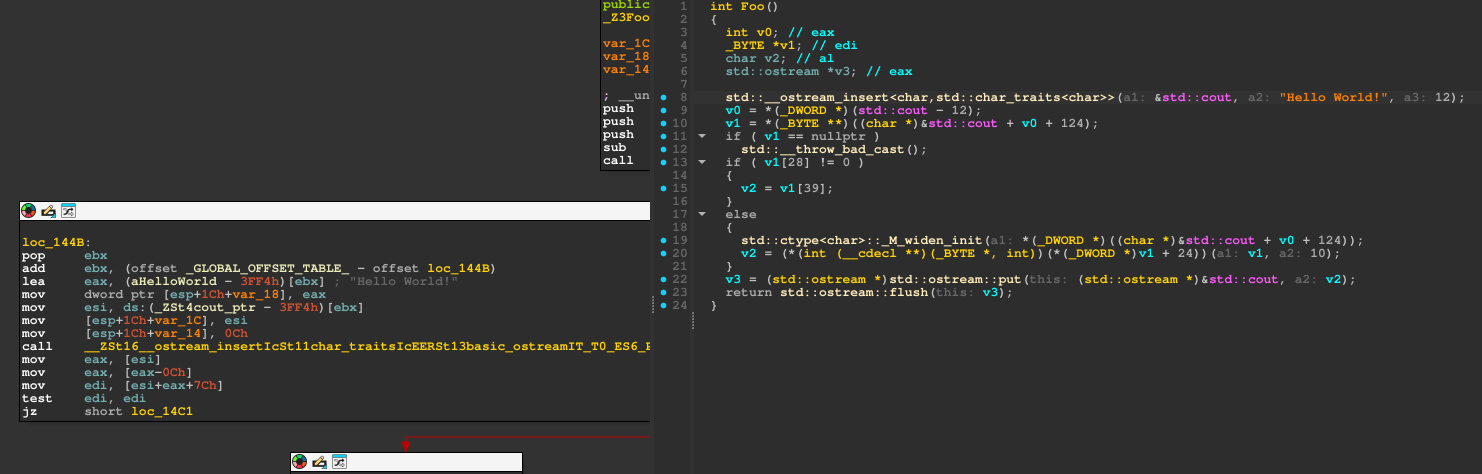 Before the pass |
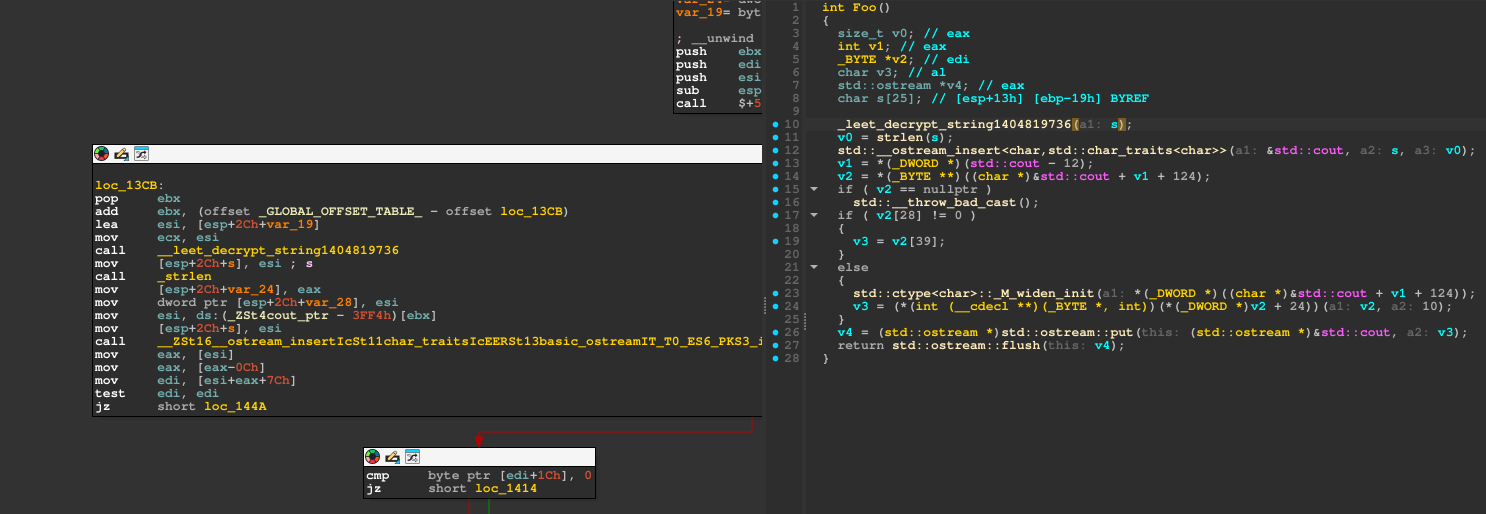 After |
Replaces arithmetic operations with their MBA equivalents. It's basically impossible to see what the original operation did unless you run it through an MBA deobfuscator first. Of course this obfuscation is kinda weak because MBA is the oldest trick in the book, so there are many tools to deal with that, for example CoBRA, it will successfully deobfuscate this into the original expression:
./cobra-cli --mba "((x^y) - (((x^y)&0xFF)&0xA) + 10) * ((x^y) - ((x^y)|0xA) + 10) + ((x^y) - (((x^y)&0xFF)|0xFFFFFFF5) - 11) * (~(x^y) - (~(x^y)|0xA) + 10)" --bitwidth 32

10 * (x ^ y)
That's why I've made the AAMBA pass.
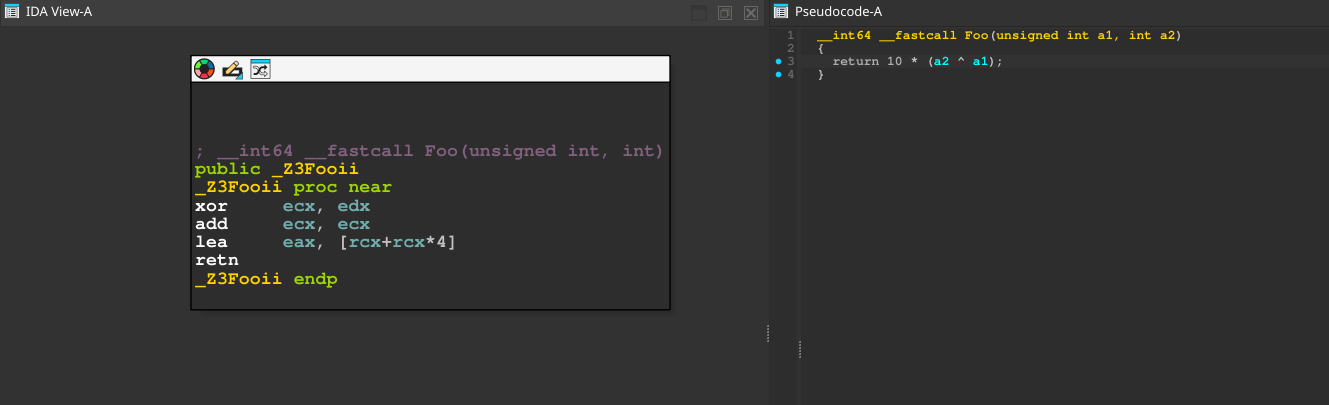 Before the pass |
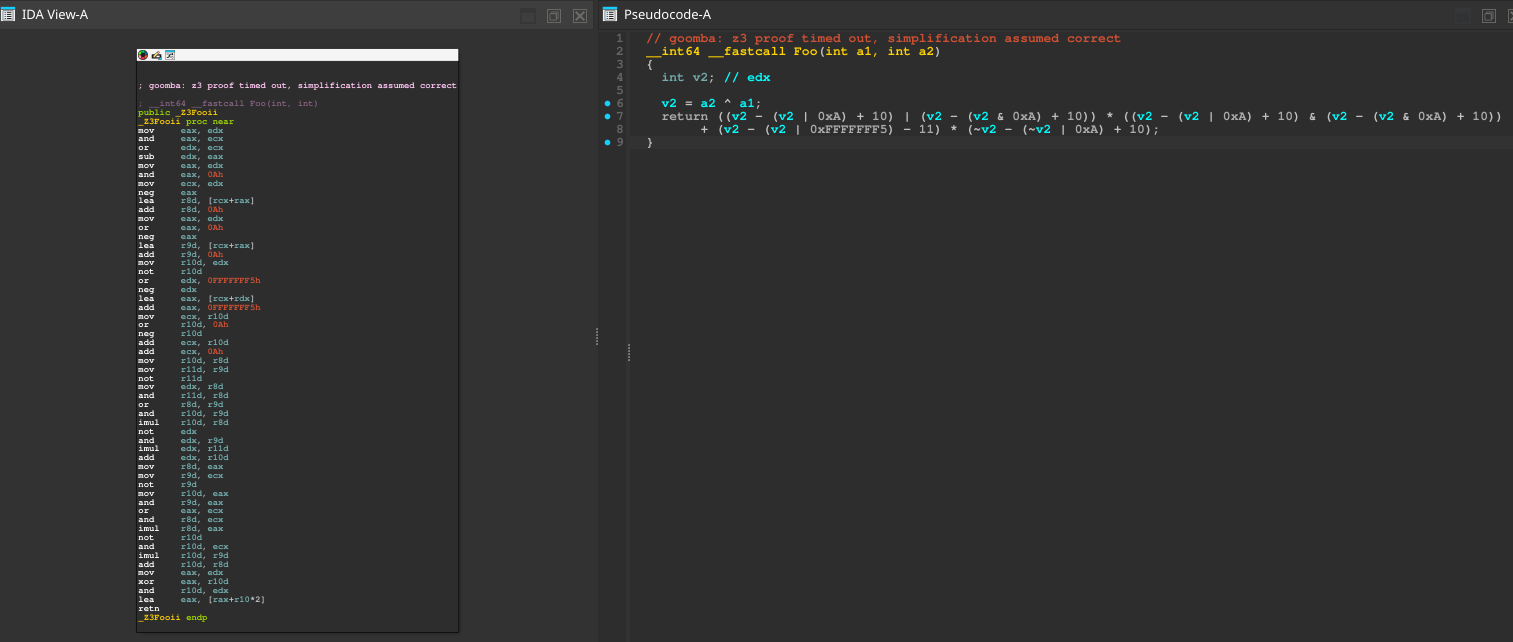 After |
Replaces operands of binary operations with ADC(X, 255) - 255 - CF and SBB(X, 255) + 255 + CF. Of course it always evaluates to X, but it makes the expression dependent on the carry flag. Unless the decompiler tracks the state of CF (which sometimes is impossible) it will get very confused and won't be able to fold these expressions. It pairs very nicely with the previous MBA pass obfuscating the arithmetic even further. As you can see below the decompiler created some additional variables and uses a lot of __PAIR64__ and __CFADD__ calls, so it becomes a lot harder (still not impossible) to paste that into tools like CoBRA, IDA's gooMBA plugin is also no help in simplifying this. Also, IDA's decompiler does track the carry flag to some degree, but combining this with control flow obfuscation makes tracking basically impossible without execution since you do not know what the previous operation was, maybe it set CF to 1, maybe it didn't, so later passes will add up even more to this one.
|
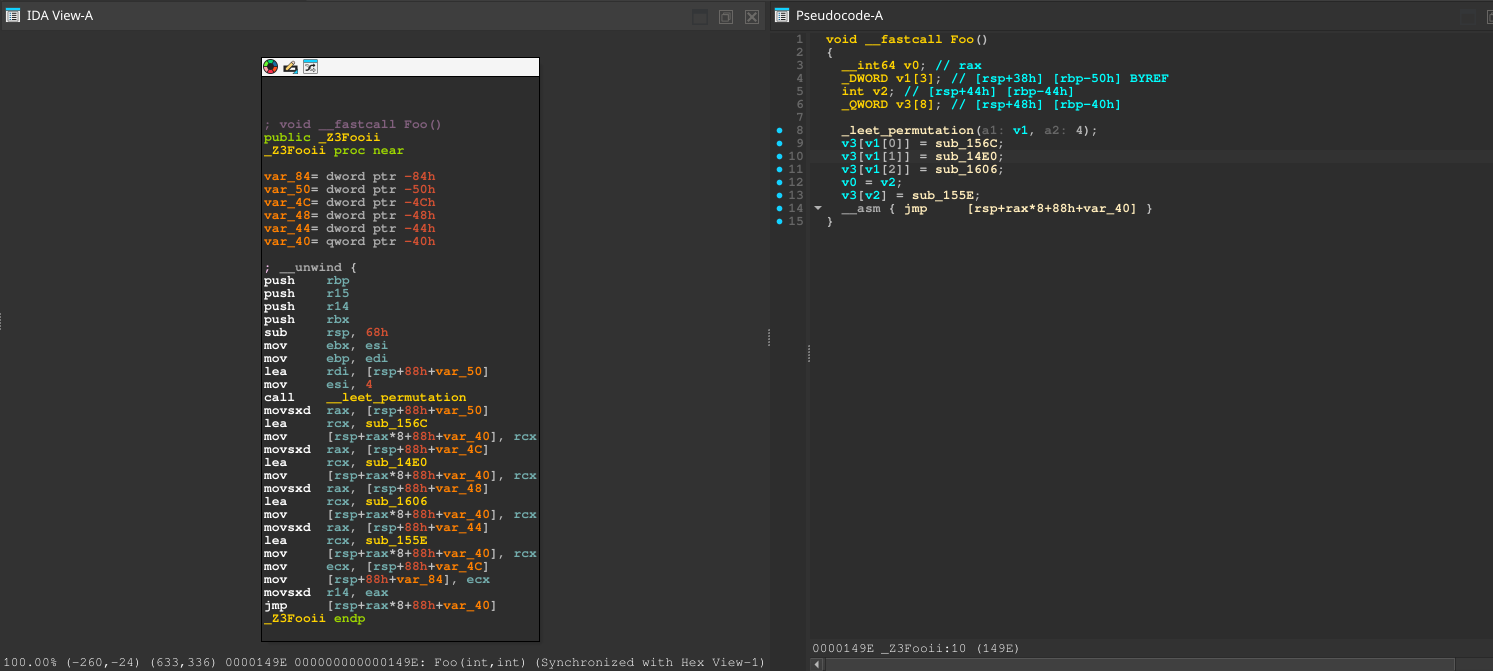
Before the pass |
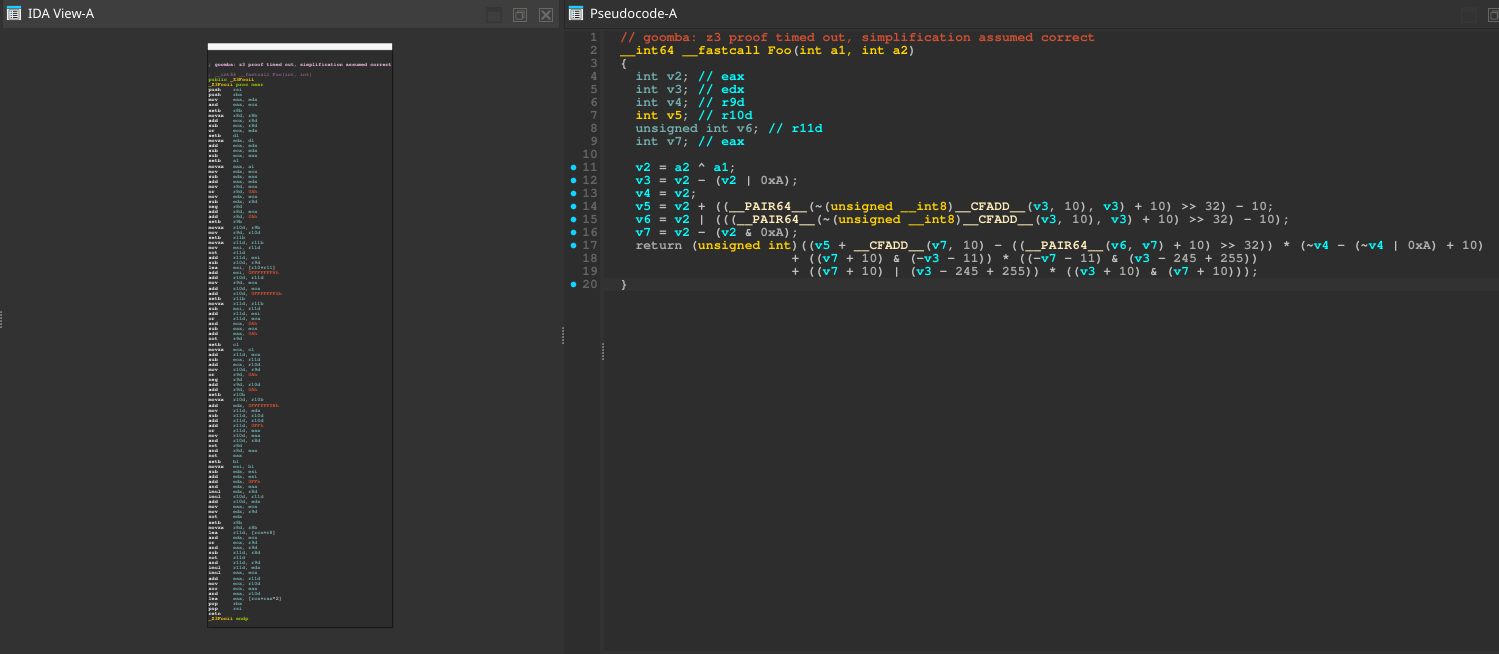 After |
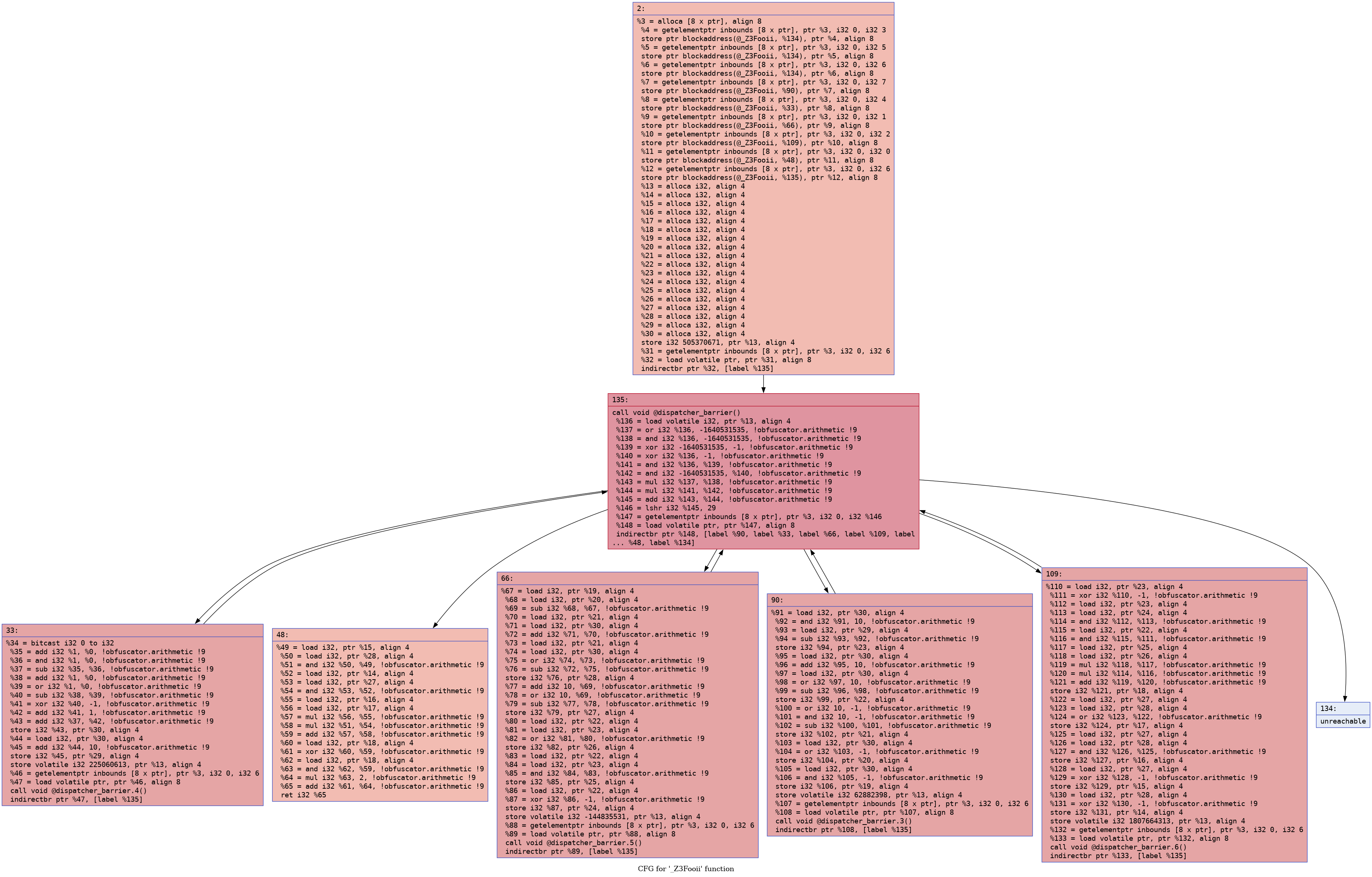
Collects all the blocks inside a function and makes one giant state machine out of them, it creates a jump table at the beginning of the function and places all the block pointers inside it. Then instead of a normal jump at the end of each block everything gets routed through the dispatcher which uses indirect jumps, these are almost impossible to resolve statically without any execution. It also demotes registers to stack, so if you split a block in half, all the variables from the previous block will be on the stack, which means that there will be A LOT of variables in every expression. If you run a single block's operations through CoBRA it won't be able to deobfuscate it much since there will be too many unknown variables.
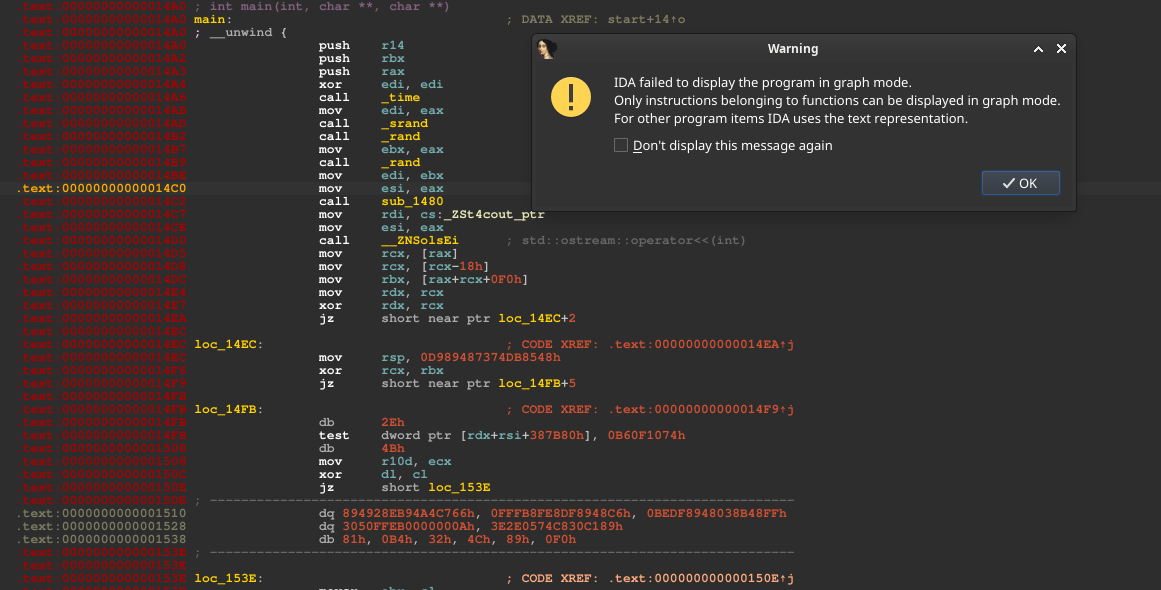
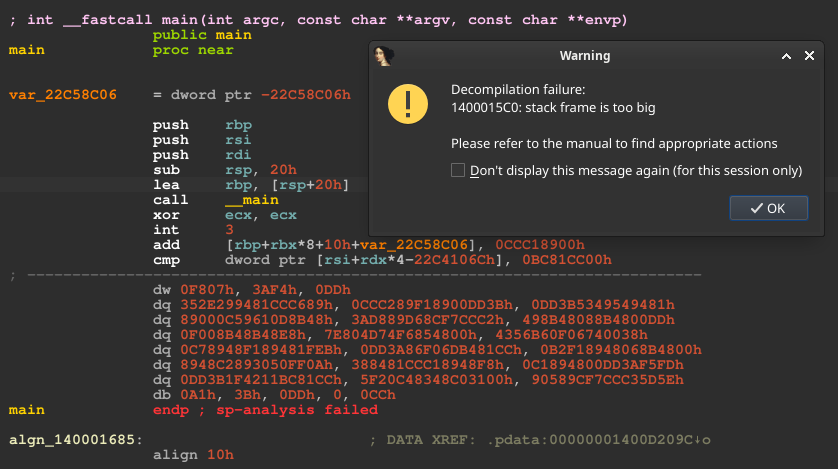
Creates a bunch of bogus blocks containing invalid assembly. This throws disassemblers off immensely because if the disassembler encounters a technically invalid byte that never gets executed, it will still try to make sense of it. So if the byte is incomplete, it will create an instruction from whatever bytes happen to be after it essentially consuming them. That creates a desynch destroying every instruction after that. On Windows binaries IDA will be able to somewhat recover from this, in rare cases it will be able to generate a graph and decompile what it can (tho it will be broken and incomplete), while on Linux binaries it completely breaks the graph view and disables decompilation. Additionaly it will insert RDTSC timer and some other anti debug checks checks, if it detects a debugger you crash.
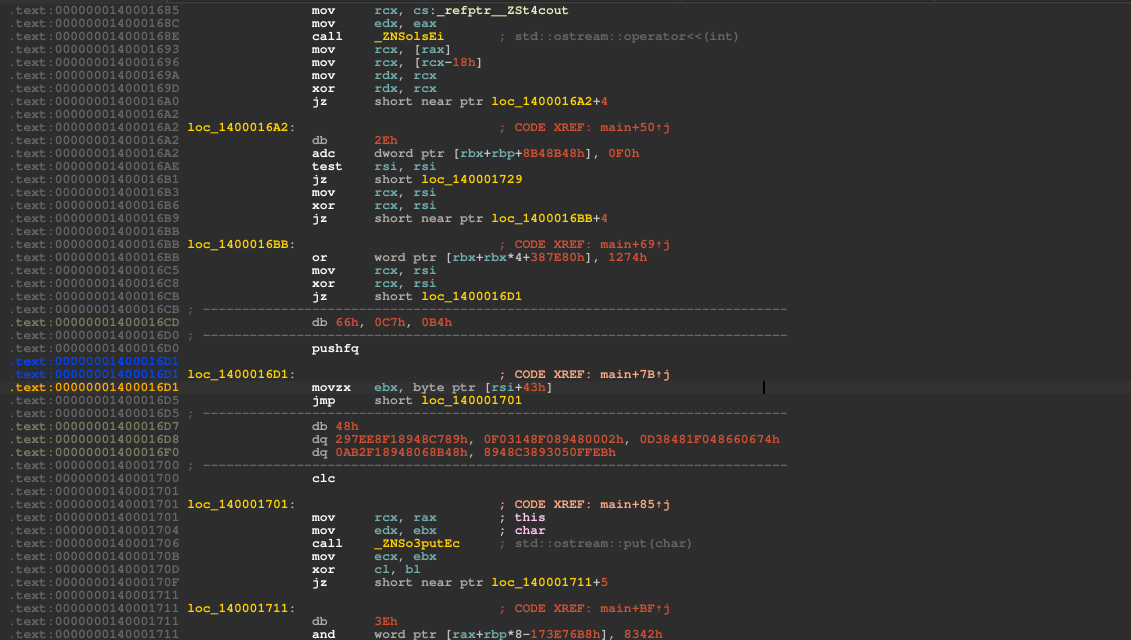 Windows |
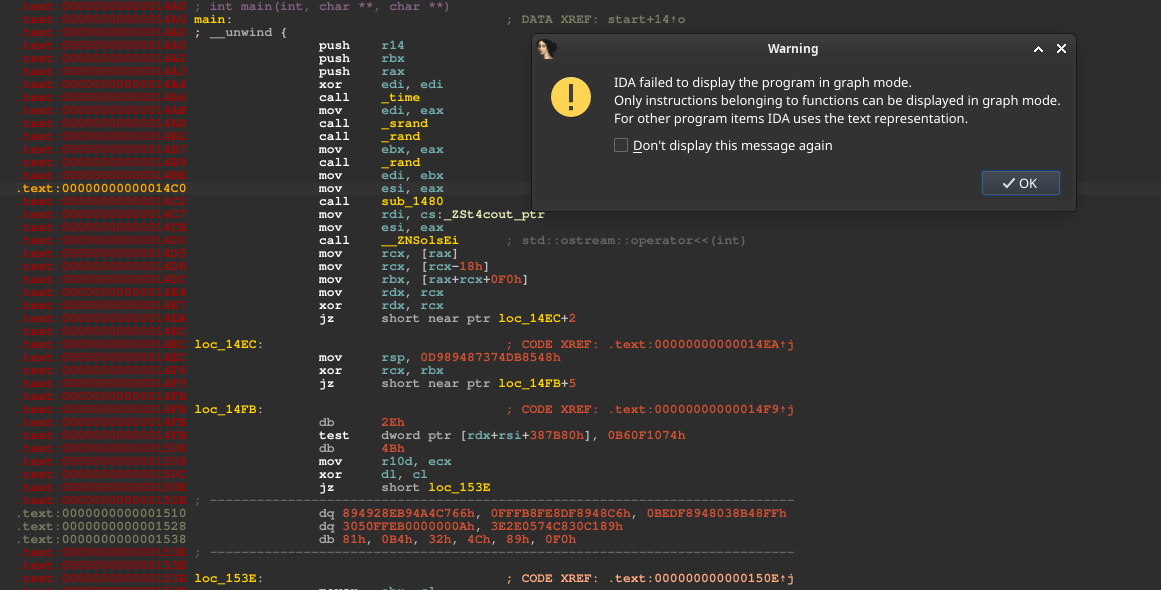 Linux |
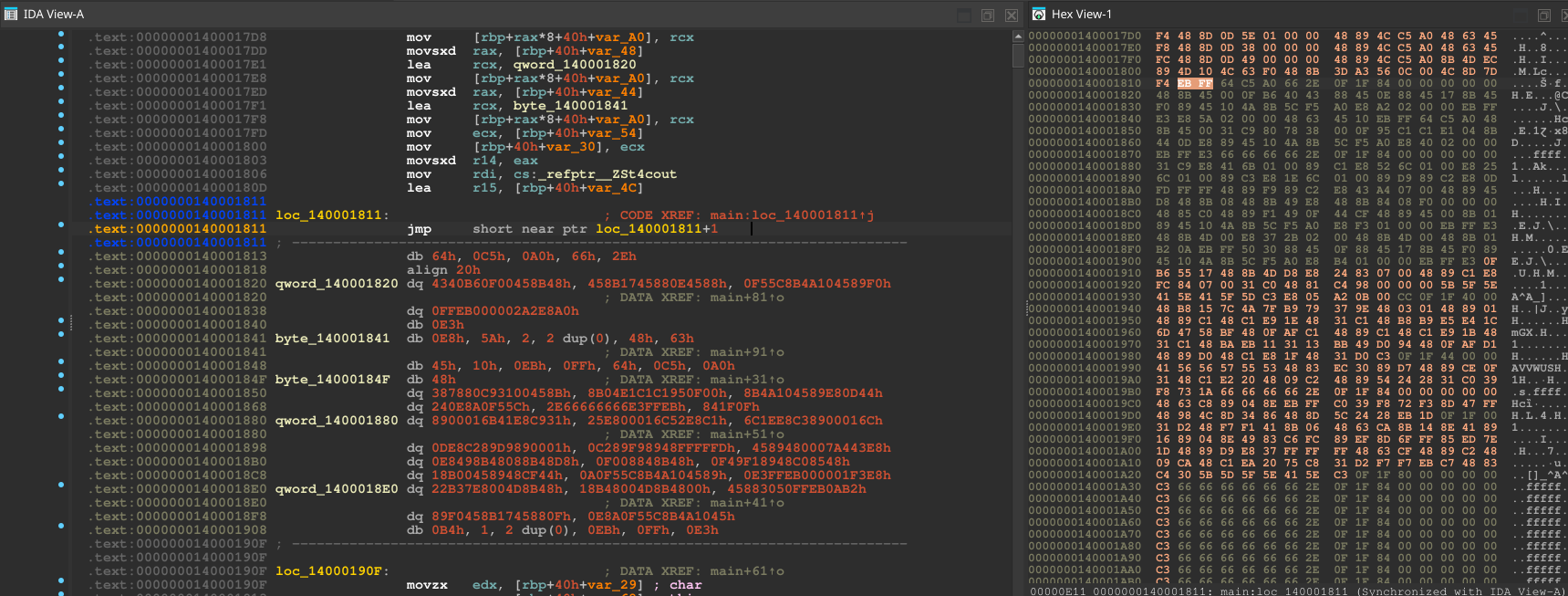
On top of that, if the pass sees any instruction starting with 0xFF, it inserts a single 0xEB byte before it. This will create JMP RIP+1, so control flow is unchanged (RIP simply advances one byte into the original instruction), but disassemblers become desynchronized again.
Instructions beginning with 0xFF are mostly INC/DEC and indirect JMP/CALL. Sadly most of the ordinary calls and jumps are relative (0xE8/0xE9/0xEB) and stay unaffected. But the technique is especially useful with the dispatcher pass since everything there uses indirect jumps. It's not as useful for calls tho, the only calls that are affected by this are the indirect ones, typically virtual calls, calls through function pointers, and some external/library calls.
Splits variables into multiple parts and performs operation on each part individually, adds very nicely to the MBA pass, making simple logic even more convoluted than it already is. In simple words int32 can be split into 4 int8s and if any supported operation (AND, OR, XOR, ADD, SUB, ICMP) is performed on it, it will be performed on the int8s one by one instead of the original int32.
 Before the pass |
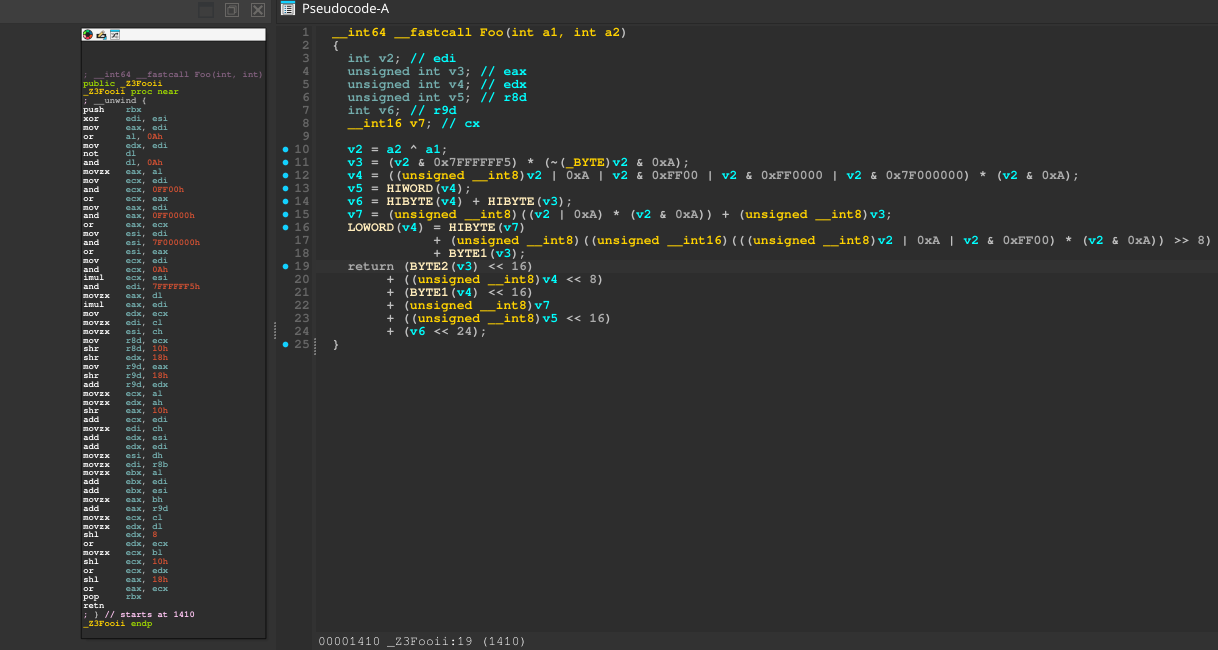 After |
Throws every stack local in a function into one big shared stack buffer to which indices are randomized for each run and computed at runtime. This way decompilers can't alias variables, which makes accesses to the same variable multiple times show up as accessing different values. This plays really nicely with the dispatcher and variable splitting passes. Dispatcher demotes registers to stack, and variable splitting splits them into multiple variables, so there will be a lot of these stack slots.
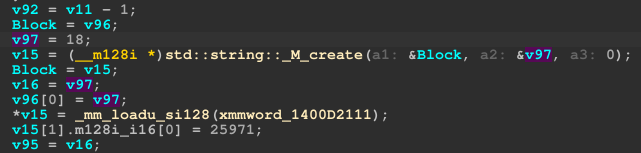 Before the pass |
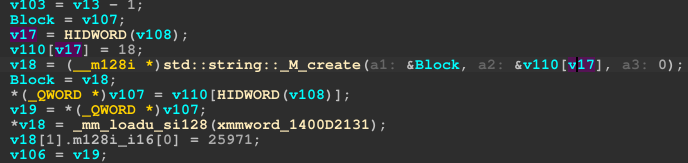 After |
Obfuscates control flow through exceptions. It replaces all calls with int3 traps. When the trap is triggered the control flow goes to the exception handler which adjusts RIP to the actual call. It also inserts invalid bytes right after the trap to desynchronize the disassembler even further.
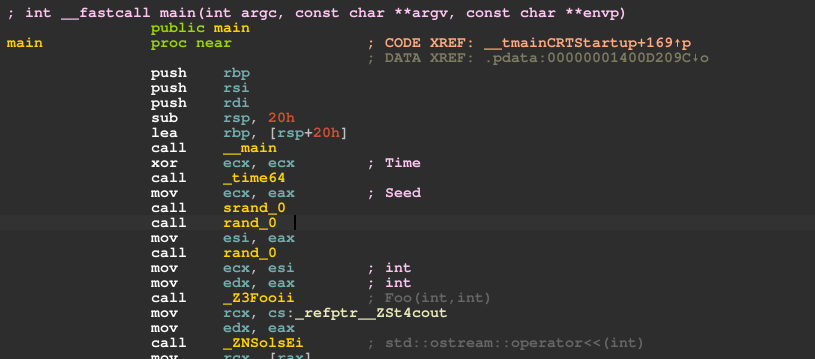 Before the pass |
 After |
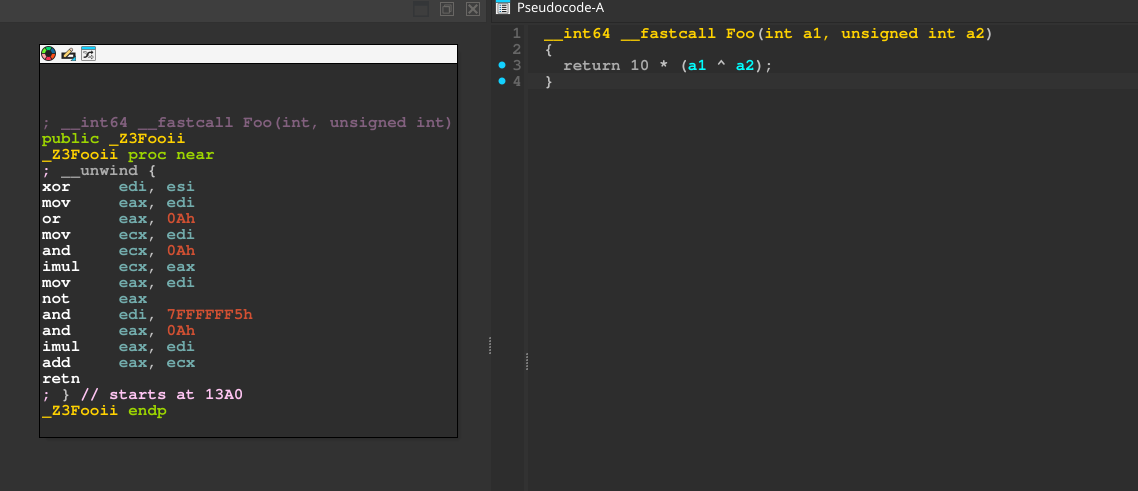
By combining every pass static analysis becomes very hard without some extra tools that would deobfuscate this. Even if you somehow nop all the invalid bytes and you're able to decompile this to some pseudocode or at least get a graph view, you're still left with control flow obfuscation through exceptions and the dispatcher, and even if you break through that, there's a mountain of redundant MBAs, bogus blocks, split stack variables and string encryption obfuscating the actual operations. Here are screenshots of the main entry point of a simple program containing that simple xor Foo function from before in all of the three big boy disassemblers. As you can see they can't make much of it.
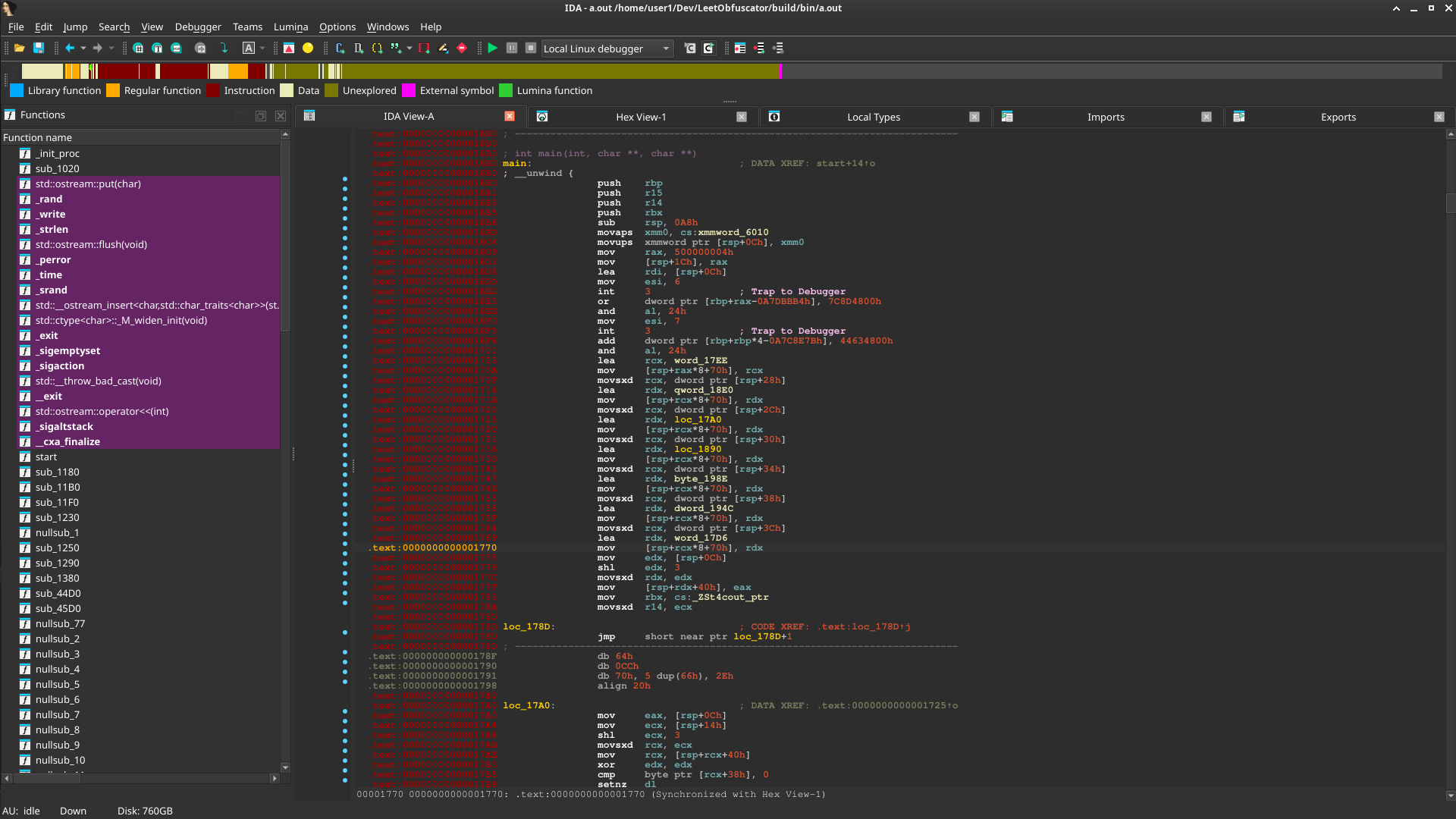
|
I really wanted to include some kind of result of deobfuscators trying to make sense of this, but unfortunately I wasn't able to find any working ones. Every single tool that I was able to find is either very limited to specific usecases (like deobfuscating VMProtect specifically), too old, not maintained and broken (almost every IDA/BN plugin I've tried), or is heavy machinery that requires too much manual guiding and setup through APIs I'm just not familiar with (Angr, Triton, IntelPin). If you know of any deobfuscators for arbitrary binaries that would be able to extract anything at all let me know.
Of course inserting all this bullshit into the binary will slow it down immensely, around 700 times slower on the default settings on average for my tests (of course it will vary a lot per application, so benchmark it urself if you use it):
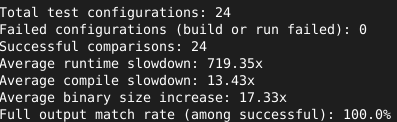
Though it's not as bad as it looks because of 2 things. 1. over 95% of the performance cost here is caused by nanomites, because well, interrupts are just slow. The exception has to leave to the kernel and come back to the app, that takes time. Without nanomites it's down to being only 18x slower:
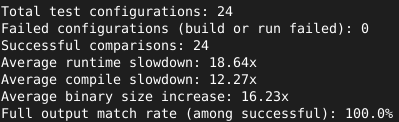
So I highly advise to just mark the functions and calls you want to obfuscate with nanomites manually instead of just setting it to all. Obfuscating every call inside a binary is pointless and costs a lot. And the reason number 2. most of the time you don't really care about the performance of the things you want to hide. This obfuscator has the ability to get selectively enabled and disabled. So you can disable it for the performance critical sections of your code and enable it wherever it's actually needed. Nobody cares whether your license check takes 1ms or 0.001ms, it's still unnoticeable for anyone. The only important thing is to ensure no expensive tranformations land in a hot path.
For the configuration options and the full guide refer to the wiki.
You can also mark all the functions related to the exception handler inside Leet.h with LEET_SKIP macro, that way the exception handler won't get obfuscated by most of the passes which cuts the cost of the nanomites in half (on default settings), but also leaves you with an unobfuscated exception handler which I think is worse than a slight slowdown.
Requirements:
-DLLVM_USE_LINKER=mold from cmake. But it will be faster with mold)git clone https://github.com/Zydak/LeetObfuscator.git --recursive
cd LeetObfuscator
mkdir build
cd build
cmake ../leet-llvm-project/llvm -G Ninja -DCMAKE_C_COMPILER=clang -DCMAKE_CXX_COMPILER=clang++ -DLLVM_USE_LINKER=mold -DLLVM_USE_SPLIT_DWARF=ON -DLLVM_ENABLE_ASSERTIONS=ON -DCMAKE_BUILD_TYPE=RelWithDebInfo -DLLVM_ENABLE_PROJECTS=clang -DLLVM_TARGETS_TO_BUILD=X86 -DCMAKE_EXPORT_COMPILE_COMMANDS=ON
ninja clang
the modified compiler will be inside build/bin/, just use that to compile the source you want to obfuscate.
You also don't have to build it, there's a prebuilt binary in releases, just download and unzip.
Building this project for Windows is currently not supported. But crosscompiling with this project to Windows is. So if you really want to, you can grab the Linux binary and crosscompile the obfuscated app for Windows from Linux or WSL.
For the complete guide on how to use this exactly refer to the wiki.
Example usage:
Copy Leet.h into your project, then inside one .c/.cpp file include it and define LEET_IMPLEMENTATION
do not define this in multiple modules!
#define LEET_IMPLEMENTATION
#include "Leet.h"
then just compile the source with the built compiler:
./build/bin/clang++ ./test.cpp -o test -fno-exceptions
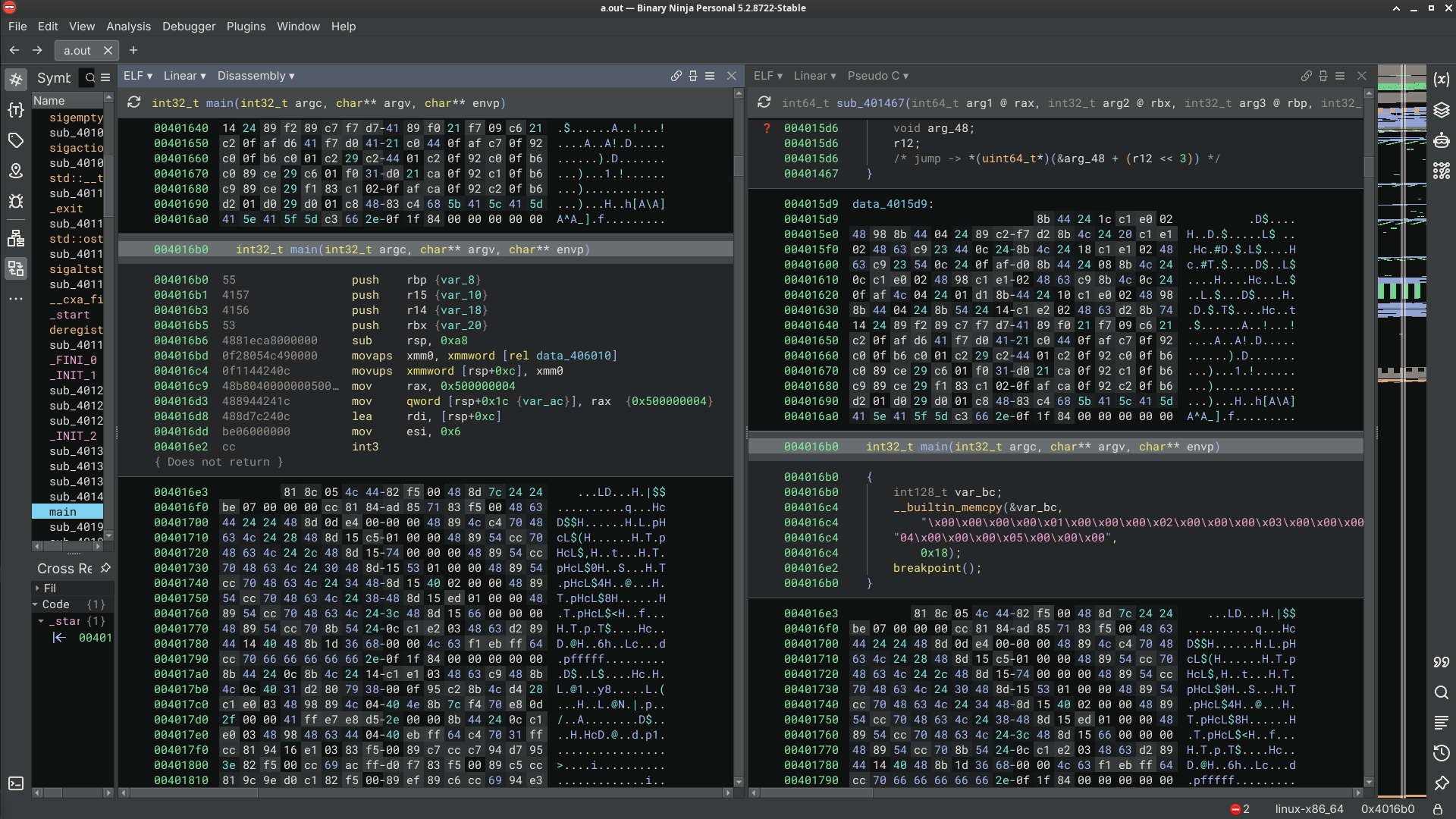 Binary Ninja Personal 5.2 |
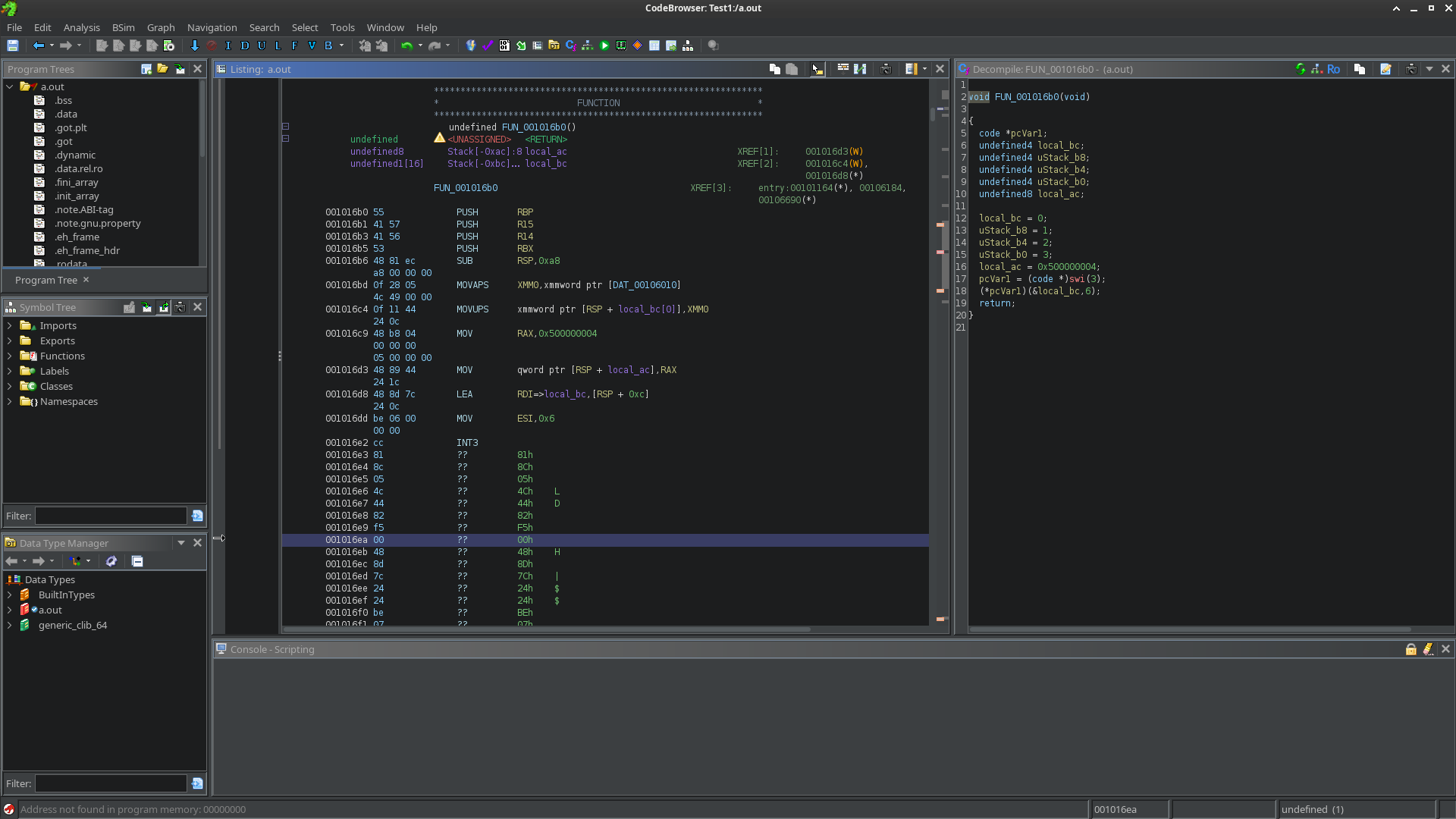 Ghidra 12.1.2 |
