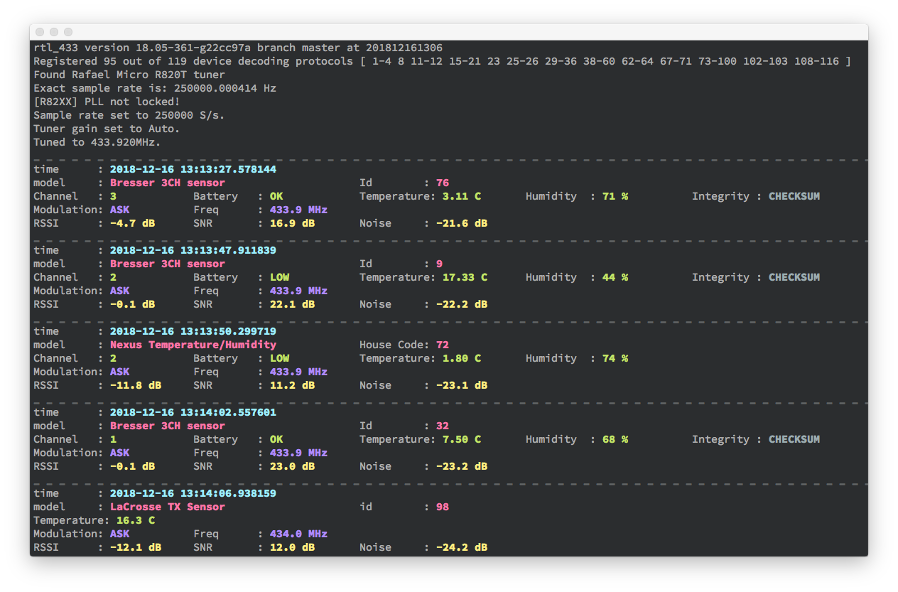
 merbanan/rtl_433
برنامج لفك تشفير الإرسال اللاسلكي من الأجهزة على نطاقات ISM (وغيرها من الترددات)

rtl_433 (على الرغم من الاسم) هو مستقبل بيانات عام، بشكل أساسي لنطاقات 433.92 ميغاهرتز، و868 ميغاهرتز (SRD)، و315 ميغاهرتز، و345 ميغاهرتز، و915 ميغاهرتز ISM.
الكود المصدري الرسمي موجود في مستودع https://github.com/merbanan/rtl_433/.
انظر أيضًا قائمة البرامج التي تعمل مع rtl_433 في الويكي. لمزيد من الوثائق والمشاريع ذات الصلة، لا سيما تلك التي تساعد في تطوير rtl_433، انظر موقع https://triq.org/.
يعمل مع RTL-SDR و/أو SoapySDR. يتم اختبار ودعم دونجل DVB القائم على Realtek RTL2832 (باستخدام RTL-SDR) وLimeSDR (LimeSDR USB وLimeSDR mini عينات هندسية مقدمة بلطف من MyriadRf)، وPlutoSDR، وHackRF One (باستخدام برامج تشغيل SoapySDR)، بالإضافة إلى SoapyRemote.
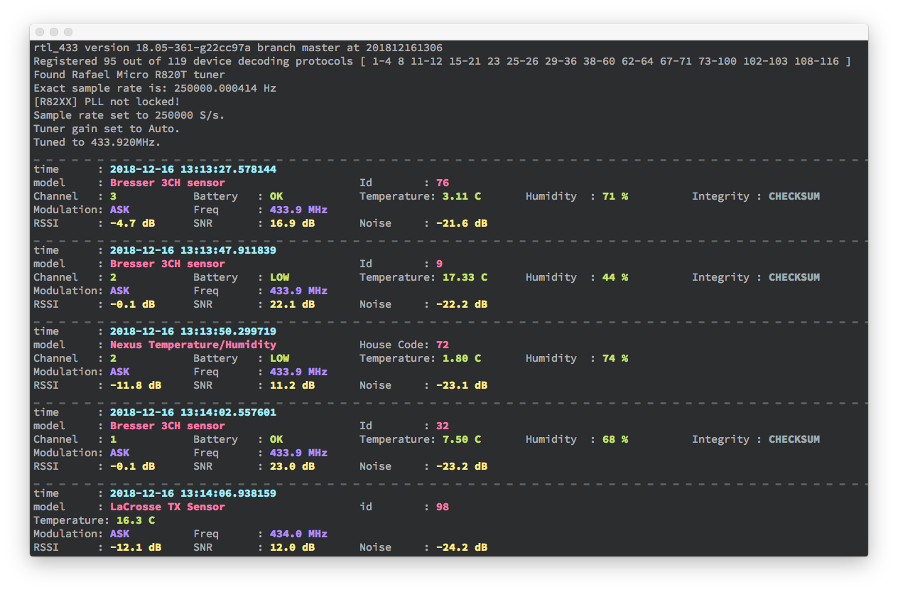
rtl_433 مكتوب بلغة C محمولة (معيار C99) ومن المعروف أنه يُترجم على أنظمة Linux (المدمجة أيضًا)، وFreeBSD، وMacOS، وWindows. يُعد دعم المترجمات وأدوات البناء الأقدم هدفًا رئيسيًا. يسمح استهلاك الموارد المنخفض والاعتماديات القليلة جدًا لـ rtl_433 بالعمل على الأجهزة المدمجة. معظم معماريات المعالجات الشائعة 32-بت و64-بت مثل amd64، وarm64، وarmhf، وi386، وppc64el، وriscv64، وs390x وغيرها مدعومة جيدًا.
انظر BUILDING.md
Linux (Debian، Ubuntu): sudo apt install rtl-433. للتوزيعات الأخرى انظر repology أو pkgs.org.
FreeBSD: pkg install rtl-433.
MacOS: brew install rtl_433.
صور Docker مع rtl_433 متاحة على صفحة github الخاصة بـ hertzg.
انظر CONTRIBUTING.md.
rtl_433 -h```
A "rtl_433.conf" file is searched in "./", XDG_CONFIG_HOME e.g. "$HOME/.config/rtl_433/",
SYSCONFDIR e.g. "/usr/local/etc/rtl_433/", then command line args will be parsed in order.
= General options =
[-V] Output the version string and exit
[-v] Increase verbosity (can be used multiple times).
-v : verbose notice, -vv : verbose info, -vvv : debug, -vvvv : trace.
[-c ] Read config options from a file
= Tuner options =
[-d | : | | rtl_tcp | help]
[-g | help] (default: auto)
[-t ] apply a list of keyword=value settings to the SDR device
e.g. for SoapySDR -t "antenna=A,bandwidth=4.5M,rfnotch_ctrl=false"
for RTL-SDR use "direct_samp[=1]", "offset_tune[=1]", "digital_agc[=1]", "biastee[=1]"
[-f ] Receive frequency(s) (default: 433920000 Hz)
[-H ] Hop interval for polling of multiple frequencies (default: 600 seconds)
[-p <ppm_error>] Correct rtl-sdr tuner frequency offset error (default: 0)
[-s ] Set sample rate (default: 250000 Hz)
[-D quit | restart | pause | manual] Input device run mode options (default: quit).
= Demodulator options =
[-R | help] Enable only the specified device decoding protocol (can be used multiple times)
Specify a negative number to disable a device decoding protocol (can be used multiple times)
[-X | help] Add a general purpose decoder (prepend -R 0 to disable all decoders)
[-Y auto | classic | minmax] FSK pulse detector mode.
[-Y level=] Manual detection level used to determine pulses (-1.0 to -30.0) (0=auto).
[-Y minlevel=] Manual minimum detection level used to determine pulses (-1.0 to -99.0).
[-Y minsnr=] Minimum SNR to determine pulses (1.0 to 99.0).
[-Y autolevel] Set minlevel automatically based on average estimated noise.
[-Y squelch] Skip frames below estimated noise level to reduce cpu load.
[-Y ampest | magest] Choose amplitude or magnitude level estimator.
[-Y filter=] Manual FM low-pass filter cutoff to separate simultaneous transmissions: us (1-9999, e.g. 20), Hz (10000+), or ratio of sample rate (0.0-1.0).
= Analyze/Debug options =
[-A] Pulse Analyzer. Enable pulse analysis and decode attempt.
Disable all decoders with -R 0 if you want analyzer output only.
[-y ] Verify decoding of demodulated test data (e.g. "{25}fb2dd58") with enabled devices
= File I/O options =
[-S none | all | unknown | known] Signal auto save. Creates one file per signal.
Note: Saves raw I/Q samples (uint8 pcm, 2 channel). Preferred mode for generating test files.
[-r | help] Read data from input file instead of a receiver
[-w | help] Save data stream to output file (a '-' dumps samples to stdout)
[-W | help] Save data stream to output file, overwrite existing file
= Data output options =
[-F log | kv | json | csv | mqtt | influx | syslog | trigger | rtl_tcp | http | null | help] Produce decoded output in given format.
Append output to file with : (e.g. -F csv:log.csv), defaults to stdout.
Specify host/port for syslog with e.g. -F syslog:127.0.0.1:1514
[-M time[:] | protocol | level | noise[:] | stats | bits | help] Add various meta data to each output.
[-K FILE | PATH | | =] Add an expanded token or fixed tag to every output line.
[-C native | si | customary] Convert units in decoded output.
[-n ] Specify number of samples to take (each sample is an I/Q pair)
[-T ] Specify number of seconds to run, also 12:34 or 1h23m45s
[-E hop | quit] Hop/Quit after outputting successful event(s)
[-h] Output this usage help and exit
Use -d, -g, -R, -X, -F, -M, -r, -w, or -W without argument for more help
