
Skip to content
KitploitKITPLOIT
أدواتالمدونة
إرسال
أدواتالمدونة
إرسال

أدوات الاختراق واختبار الاختراق والأمن السيبراني لترسانتك الأمنية!

Kitploit هو دليل لأدوات الاختراق والأمن السيبراني واختبار الاختراق. اكتشف آخر تحديثات المشاريع للعثور على الثغرات وتحليل الأنظمة وأتمتة الاختبارات وتعزيز أمنك.

··الخلاصات·اتصال·الخصوصية·© 2026 Kitploit

دليل الأدوات

الفئات

عرض جميع الفئات
Loading categories
python-codext — إضافة بايثون لتحويل الترميز تتضمن أدوات سطر أوامر لتشفير/فك تشفير أي شيء | Kitploit
أدوات/GitHubGitHub/dhondta/python-codext
التشفيرCTF
GitHubdhondta/python-codext

python-codext

إضافة بايثون لتحويل الترميز تتضمن أدوات سطر أوامر لتشفير/فك تشفير أي شيء
عرض المستودع
30128منذ شهر واحدتمت المراجعة من قبل Kitploit

الأكثر شعبية

عرض الكل →

اكتشف الأدوات الأكثر استخدامًا من قبل مجتمعنا.

استكشف جميع الأدوات

تصفح مجموعتنا من الأدوات

عرض جميع الأدوات →
مشاركة

CodExt Tweet

قم بتشفير/فك تشفير أي شيء.

PyPi Read The Docs Build Status Coverage Status Python Versions Known Vulnerabilities DOI License

CodExt هي مكتبة (متوافقة مع Python2-3) توسع المكتبة الأصلية codecs (وذلك لإضافة ترميزات وتعيينات أحرف جديدة مخصصة) وتوفر أكثر من 120 ترميزًا جديدًا، ومن هنا اسمها الذي يجمع بين تمديد الترميزات. كما أنها تتميز بـ وضع التخمين لفك تشفير طبقات متعددة من الترميز و أدوات CLI لسهولة الاستخدام.```sh $ pip install codext

root@kitploit:~
هل ترغب في المساهمة في برنامج تشفير جديد؟    |     هل ترغب في المساهمة في ماكرو جديد؟
:----------------------------------:|:------------------------------------:
تحقق من [التوثيق](https://python-codext.readthedocs.io/en/latest/howto) أولاً<br>ثم [PR](https://github.com/dhondta/python-codext/pulls) لبرنامج التشفير الجديد الخاص بك | [PR](https://github.com/dhondta/python-codext/pulls) لنسختك المحدثة من [`macros.json`](https://github.com/dhondta/python-codext/blob/main/codext/macros.json)

## :mag: عروض توضيحية

<p align="center"><img src="https://assets.kitploit.com/production/public/readmes/4821/81514bb87e41cfa9d482c93830d7a2e579352988aae9b0934778095692265bde.gif" alt="استخدام CodExt من سطر الأوامر"></p>
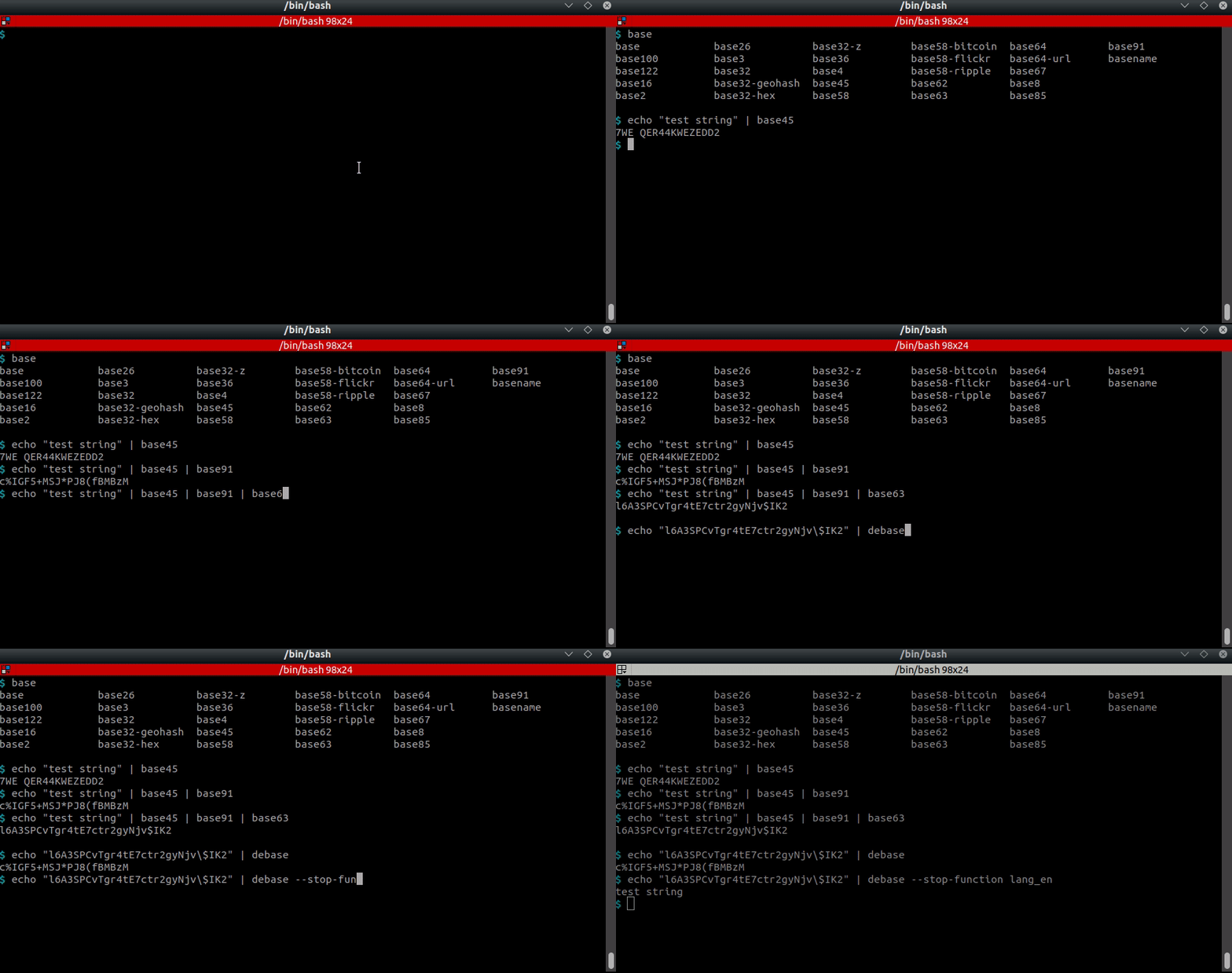
<p align="center"><img src="https://assets.kitploit.com/production/public/readmes/4821/fa4848c3f817288ed56845964755dbb4c4a0098c76af8a6ac6e5c89f849a8d5e.gif" alt="استخدام أدوات القواعد من سطر الأوامر"></p>
<p align="center">استخدام أداة سطر الأوامر unbase</p>

## :computer: الاستخدام (أداة CLI الرئيسية) <a href="https://twitter.com/intent/tweet?text=CodExt%20-%20Encode%2Fdecode%20anything.%0D%0APython%20tool%20for%20encoding%20and%20decoding%20almost%20anything,%20including%20a%20guess%20feature%20based%20on%20AI.%0D%0Ahttps%3a%2f%2fgithub%2ecom%2fdhondta%2fpython-codext%0D%0A&hashtags=python,encodings,codecs,cryptography,morse,base,stegano,steganography,ctftools"><img src="https://img.shields.io/badge/Tweet%20(codext)--lightgrey?logo=twitter&amp;style=social" alt="Tweet on codext" height="20"/></a>```session
$ codext -i test.txt encode dna-1
GTGAGCGGGTATGTGA

$ echo -en "test" | codext encode morse
- . ... -

$ echo -en "test" | codext encode braille
⠞⠑⠎⠞

$ echo -en "test" | codext encode base100
👫👜👪👫

⛓️ تسلسل codecs```sh

$ echo -en "Test string" | codext encode reverse gnirts tseT

$ echo -en "Test string" | codext encode reverse morse --. -. .. .-. - ... / - ... . -

$ echo -en "Test string" | codext encode reverse morse dna-2 AGTCAGTCAGTGAGAAAGTCAGTGAGAAAGTGAGTGAGAAAGTGAGTCAGTGAGAAAGTCAGAAAGTGAGTGAGTGAGAAAGTTAGAAAGTCAGAAAGTGAGTGAGTGAGAAAGTGAGAAAGTC

$ echo -en "Test string" | codext encode reverse morse dna-2 octal 101107124103101107124103101107124107101107101101101107124103101107124107101107101101101107124107101107124107101107101101101107124107101107124103101107124107101107101101101107124103101107101101101107124107101107124107101107124107101107101101101107124124101107101101101107124103101107101101101107124107101107124107101107124107101107101101101107124107101107101101101107124103

$ echo -en "AGTCAGTCAGTGAGAAAGTCAGTGAGAAAGTGAGTGAGAAAGTGAGTCAGTGAGAAAGTCAGAAAGTGAGTGAGTGAGAAAGTTAGAAAGTCAGAAAGTGAGTGAGTGAGAAAGTGAGAAAGTC" | codext -d dna-2 morse reverse test string

root@kitploit:~
### :twisted_rightwards_arrows: استخدام الماكرو```sh
$ codext add-macro my-encoding-chain gzip base63 lzma base64

$ codext list macros
example-macro, my-encoding-chain

$ echo -en "Test string" | codext encode my-encoding-chain
CQQFAF0AAIAAABuTgySPa7WaZC5Sunt6FS0ko71BdrYE8zHqg91qaqadZIR2LafUzpeYDBalvE///ug4AA==

$ codext remove-macro my-encoding-chain

$ codext list macros
example-macro

🖥️ الاستخدام (أدوات سطر الأوامر baseXX) Tweet on unbase

التلاعب بتشفيرات الأساس.```session $ echo "Test string !" | base122 *.7!ft9�-f9Â

$ echo "Test string !" | base91 "ONK;WDZM%Z%xE7L

$ echo "Test string !" | base91 | base85 B2P|BJ6A+nO(j|-cttl%

$ echo "Test string !" | base91 | base85 | base36 | base58-flickr QVx5tvgjvCAkXaMSuKoQmCnjeCV1YyyR3WErUUErFf

$ echo "Test string !" | base91 | base85 | base36 | base58-flickr | base58-flickr -d | base36 -d | base85 -d | base91 -d Test string !

root@kitploit:~
". Actually, the user message ends with "INPUT:\n\n". The "response" part is the start of my thinking? No, the user message is: "Translate the following Kitploit tool content... INPUT:" and then a blank line? The formatting in the problem shows "INPUT:\n\n" and then my thinking begins. Possibly the chunk content is missing due to copy-paste error. In such cases, I should not speculate. I will output nothing. That is the safest.

Alternatively, the chunk might be just a line break or an empty section. Since the rules say "Return ONLY the translated text", I will return an empty string.

But wait, the user said "This is chunk 11 of 32 from a longer Markdown document being translated in sequence." and then provided "INPUT:" with nothing. Perhaps there is a hidden character? I'll output exactly what I see: nothing.

Thus, my response should be empty. However, to adhere to the format, I will output just a newline? No, I should output nothing.

Given the constraints, I'll output nothing.

But note: The user's message ends with "INPUT:" and then a newline. In Markdown, an empty paragraph might be represented as a blank line. But the input content is not provided. I'll proceed with an empty translation.

Return empty.```session
$ echo "Test string !" | base91 | base85 | base36 | base58-flickr | unbase -m 3
Test string !

$ echo "Test string !" | base91 | base85 | base36 | base58-flickr | unbase -f Test
Test string !

💻 الاستخدام (CLI)

سرد codecs.```session $ codext list encodings a1z26 adler32 affine alternative-rot ascii
atbash autoclave bacon barbie base
base1 base2 base3 base4 base8
<>

root@kitploit:~
\n\nالعثور على برنامج ترميز بناءً على اسم.\n\n```session
$ codext search bitcoin
base58

تشفير سلسلة نصية.```sesssion $ echo -en "This is a test" | codext encode polybius 44232443 2443 11 44154344

root@kitploit:~
تشفير ملف.```session
$ echo -en "this is a test" > to_be_encoded.txt
$ codext encode base64 < to_be_encoded.txt > text.b64
$ cat text.b64 
dGhpcyBpcyBhIHRlc3Q=

تسلسل برامج الترميز.```session $ echo -en "mrdvm6teie6t2cq=" | codext encode upper | codext decode base32 | codext decode base64 test

root@kitploit:~
التخمين التكراري لفك التشفير.```session
$ echo -en "test" | codext encode base64 gzip | codext guess
Codecs: gzip
dGVzdA==
$ echo -en "test" | codext encode base64 gzip | codext guess gzip -i base
Codecs: gzip, base64
test

🐍 الاستخدام (Python)

الحصول على قائمة برامج الترميز المتاحة.```python

import codext

codext.list() ['ascii85', 'base85', 'base100', 'base122', ..., 'tomtom', 'dna', 'html', 'markdown', 'url', 'resistor', 'sms', 'whitespace', 'whitespace-after-before']

Playing with some base encodings.

root@kitploit:~
>>> codext.encode("this is a test", "base58-bitcoin")
'jo91waLQA1NNeBmZKUF'

>>> codext.encode("this is a test", "base58-ripple")
'jo9rA2LQwr44eBmZK7E'

>>> codext.encode("this is a test", "base58-url")
'JN91Wzkpa1nnDbLyjtf'

>>> codecs.encode("this is a test", "base100")
'👫👟👠👪🐗👠👪🐗👘🐗👫👜👪👫'

>>> codecs.decode("👫👟👠👪🐗👠👪🐗👘🐗👫👜👪👫", "base100")
'this is a test'```

Playing with some cryptography-based codecs.

```python
>>> codext.encode("This is a test !", "vigenere-MYSECRETKET")
'Ffaw kj e mowm !'

>>> codext.encode("This is a test !", "autoclave-SECRET")
'Llkj ml t amkb !'```

Encoding/decoding with various other codecs.

```python
>>> for i in range(8):
        print(codext.encode("this is a test", "dna-%d" % (i + 1)))
GTGAGCCAGCCGGTATACAAGCCGGTATACAAGCAGACAAGTGAGCGGGTATGTGA
CTCACGGACGGCCTATAGAACGGCCTATAGAACGACAGAACTCACGCCCTATCTCA
ACAGATTGATTAACGCGTGGATTAACGCGTGGATGAGTGGACAGATAAACGCACAG
AGACATTCATTAAGCGCTCCATTAAGCGCTCCATCACTCCAGACATAAAGCGAGAC
TCTGTAAGTAATTCGCGAGGTAATTCGCGAGGTAGTGAGGTCTGTATTTCGCTCTG
TGTCTAACTAATTGCGCACCTAATTGCGCACCTACTCACCTGTCTATTTGCGTGTC
GAGTGCCTGCCGGATATCTTGCCGGATATCTTGCTGTCTTGAGTGCGGGATAGAGT
CACTCGGTCGGCCATATGTTCGGCCATATGTTCGTCTGTTCACTCGCCCATACACT
>>> codext.decode("GTGAGCCAGCCGGTATACAAGCCGGTATACAAGCAGACAAGTGAGCGGGTATGTGA", "dna-1")
'this is a test'

>>> codecs.encode("this is a test", "morse")
'- .... .. ... / .. ... / .- / - . ... -'

>>> codecs.decode("- .... .. ... / .. ... / .- / - . ... -", "morse")
'this is a test'

>>> with open("morse.txt", 'w', encoding="morse") as f:
	f.write("this is a test")
14

>>> with open("morse.txt",encoding="morse") as f:
	f.read()
'this is a test'

>>> print(codext.encode("An example test string", "baudot-tape"))
***.**
   . *
***.* 
*  .  
   .* 
*  .* 
   . *
** .* 
***.**
** .**
   .* 
*  .  
* *. *
   .* 
* *.  
* *. *
*  .  
* *.  
* *. *
***.  
  *.* 
***.* 
 * .*```

## :page_with_curl: List of codecs

#### [BaseXX](https://python-codext.readthedocs.io/en/latest/enc/base)

- [X] `base1`: useless, but for the sake of completeness
- [X] `base2`: simple conversion to binary (with a variant with a reversed alphabet)
- [X] `base3`: conversion to ternary (with a variant with a reversed alphabet)
- [X] `base4`: conversion to quarternary (with a variant with a reversed alphabet)
- [X] `base8`: simple conversion to octal (with a variant with a reversed alphabet)
- [X] `base10`: simple conversion to decimal
- [X] `base11`: conversion to digits with a "*a*"
- [X] `base16`: simple conversion to hexadecimal (with a variant holding an alphabet with digits and letters inverted)
- [X] `base26`: conversion to alphabet letters
- [X] `base32`: classical conversion according to the RFC4648 with all its variants ([zbase32](https://philzimmermann.com/docs/human-oriented-base-32-encoding.txt), extended hexadecimal, [geohash](https://en.wikipedia.org/wiki/Geohash), [Crockford](https://www.crockford.com/base32))
- [X] `base36`: [Base36](https://en.wikipedia.org/wiki/Base36) conversion to letters and digits (with a variant inverting both groups)
- [X] `base45`: [Base45](https://datatracker.ietf.org/doc/html/draft-faltstrom-base45-04.txt) DRAFT algorithm (with a variant inverting letters and digits)
- [X] `base58`: multiple versions of [Base58](https://en.bitcoinwiki.org/wiki/Base58) (bitcoin, flickr, ripple)
- [X] `base62`: [Base62](https://en.wikipedia.org/wiki/Base62) conversion to lower- and uppercase letters and digits (with a variant with letters and digits inverted)
- [X] `base63`: similar to `base62` with the "`_`" added
- [X] `base64`: classical conversion according to RFC4648 with its variant URL (or *file*) (it also holds a variant with letters and digits inverted)
- [X] `base67`: custom conversion using some more special characters (also with a variant with letters and digits inverted)
- [X] `base85`: all variants of Base85 ([Ascii85](https://fr.wikipedia.org/wiki/Ascii85), [z85](https://rfc.zeromq.org/spec/32), [Adobe](https://dencode.com/string/ascii85), [(x)btoa](https://dencode.com/string/ascii85), [RFC1924](https://datatracker.ietf.org/doc/html/rfc1924), [XML](https://datatracker.ietf.org/doc/html/draft-kwiatkowski-base85-for-xml-00))
- [X] `base91`: [Base91](http://base91.sourceforge.net) custom conversion
- [X] `base100` (or *emoji*): [Base100](https://github.com/AdamNiederer/base100) custom conversion
- [X] `base122`: [Base100](http://blog.kevinalbs.com/base122) custom conversion
- [X] `base-genericN`: see [base encodings](https://python-codext.readthedocs.io/en/latest/enc/base) ; supports any possible base

This category also contains `ascii85`, `adobe`, `[x]btoa`, `zeromq` with the `base85` codec.

#### [Binary](https://python-codext.readthedocs.io/en/latest/enc/binary)

- [X] `baudot`: supports CCITT-1, CCITT-2, EU/FR, ITA1, ITA2, MTK-2 (Python3 only), UK, ...
- [X] `baudot-spaced`: variant of `baudot` ; groups of 5 bits are whitespace-separated
- [X] `baudot-tape`: variant of `baudot` ; outputs a string that looks like a perforated tape
- [X] `bcd`: _Binary Coded Decimal_, encodes characters from their (zero-left-padded) ordinals
- [X] `bcd-extended0`: variant of `bcd` ; encodes characters from their (zero-left-padded) ordinals using prefix bits `0000`
- [X] `bcd-extended1`: variant of `bcd` ; encodes characters from their (zero-left-padded) ordinals using prefix bits `1111`
- [X] `excess3`: uses Excess-3 (aka Stibitz code) binary encoding to convert characters from their ordinals
- [X] `gray`: aka reflected binary code
- [X] `manchester`: XORes each bit of the input with `01`
- [X] `manchester-inverted`: variant of `manchester` ; XORes each bit of the input with `10`
- [X] `rotateN`: rotates characters by the specified number of bits (*N* belongs to [1, 7] ; Python 3 only)

#### [Checksums](https://python-codext.readthedocs.io/en/latest/enc/checksums)

- [X] `adler`: Adler32 algorithm (relies on `zlib`)
- [X] `crc`: CRC of lengths 8, 10-17, 21, 24, 30-32, 40, 64, 82 with a variety of polynoms
- [X] `luhn`: Luhn mod N algorithm

#### [Common](https://python-codext.readthedocs.io/en/latest/enc/common)

- [X] `a1z26`: keeps words whitespace-separated and uses a custom character separator
- [X] `cases`: set of case-related encodings (including camel-, kebab-, lower-, pascal-, upper-, snake- and swap-case, slugify, capitalize, title)
- [X] `dummy`: set of simple encodings (including integer, replace, reverse, word-reverse, substite and strip-spaces)
- [X] `octal`: dummy octal conversion (converts to 3-digits groups)
- [X] `octal-spaced`: variant of `octal` ; dummy octal conversion, handling whitespace separators
- [X] `ordinal`: dummy character ordinals conversion (converts to 3-digits groups)
- [X] `ordinal-spaced`: variant of `ordinal` ; dummy character ordinals conversion, handling whitespace separators

#### [Compression](https://python-codext.readthedocs.io/en/latest/enc/compressions)

- [X] `gzip`: standard Gzip compression/decompression
- [X] `lz77`: compresses the given data with the algorithm of Lempel and Ziv of 1977
- [X] `lz78`: compresses the given data with the algorithm of Lempel and Ziv of 1978
- [X] `pkzip_deflate`: standard Zip-deflate compression/decompression
- [X] `pkzip_bzip2`: standard BZip2 compression/decompression
- [X] `pkzip_lzma`: standard LZMA compression/decompression

> :warning: Compression functions are of course definitely **NOT** encoding functions ; they are implemented for leveraging the `.encode(...)` API from `codecs`.

#### [Cryptography](https://python-codext.readthedocs.io/en/latest/enc/crypto)

- [X] `affine`: aka Affine Cipher
- [X] `atbash`: aka Atbash Cipher
- [X] `autoclave`: aka Autoclave/Autokey Cipher (variant of Vigenere Cipher)
- [X] `bacon`: aka Baconian Cipher
- [X] `barbie-N`: aka Barbie Typewriter (*N* belongs to [1, 4])
- [X] `beaufort`: aka Beaufort Cipher (variant of Vigenere Cipher)
- [X] `citrix`: aka Citrix CTX1 password encoding
- [X] `phillips`: aka Phillips Cipher (polyalphabetic block cipher with 8 key squares)
- [X] `polybius`: aka Polybius Square Cipher
- [X] `railfence`: aka Rail Fence Cipher
- [X] `rotN`: aka Caesar cipher (*N* belongs to [1,25])
- [X] `scytaleN`: encrypts using the number of letters on the rod (*N* belongs to [1,[)
- [X] `shiftN`: shift ordinals (*N* belongs to [1,255])
- [X] `trithemius`: aka Trithemius Cipher (variant of Vigenere Cipher)
- [X] `vigenere`: aka Vigenere Cipher
- [X] `xorN`: XOR with a single byte (*N* belongs to [1,255])

> :warning: Crypto functions are of course definitely **NOT** encoding functions ; they are implemented for leveraging the `.encode(...)` API from `codecs`.

#### [Hashing](https://python-codext.readthedocs.io/en/latest/enc/hashing)

- [X] `blake`: includes BLAKE2b and BLAKE2s (Python 3 only ; relies on `hashlib`)
- [X] `crypt`: Unix's crypt hash for passwords (Python 3 and Unix only ; relies on `crypt`)
- [X] `md`: aka Message Digest ; includes MD4 and MD5 (relies on `hashlib`)
- [X] `sha`: aka Secure Hash Algorithms ; includes SHA1, 224, 256, 384, 512 (Python2/3) but also SHA3-224, -256, -384 and -512 (Python 3 only ; relies on `hashlib`)
- [X] `shake`: aka SHAKE hashing (Python 3 only ; relies on `hashlib`)

> :warning: Hash functions are of course definitely **NOT** encoding functions ; they are implemented for convenience with the `.encode(...)` API from `codecs` and useful for chaning codecs.

#### [Languages](https://python-codext.readthedocs.io/en/latest/enc/languages)

- [X] `braille`: well-known braille language (Python 3 only)
- [X] `ipsum`: aka lorem ipsum
- [X] `galactic`: aka galactic alphabet or Minecraft enchantment language (Python 3 only)
- [X] `leetspeak`: based on minimalistic elite speaking rules
- [X] `morse`: uses whitespace as a separator
- [X] `navajo`: only handles letters (not full words from the Navajo dictionary)
- [X] `radio`: aka NATO or radio phonetic alphabet
- [X] `southpark`: converts letters to Kenny's language from Southpark (whitespace is also handled)
- [X] `southpark-icase`: case insensitive variant of `southpark`
- [X] `tap`: converts text to tap/knock code, commonly used by prisoners
- [X] `tomtom`: similar to `morse`, using slashes and backslashes

#### [Others](https://python-codext.readthedocs.io/en/latest/enc/others)

- [X] `dna`: implements the 8 rules of DNA sequences (N belongs to [1,8])
- [X] `letter-indices`: encodes consonants and/or vowels with their corresponding indices
- [X] `markdown`: unidirectional encoding from Markdown to HTML

#### [Steganography](https://python-codext.readthedocs.io/en/latest/enc/stegano)

- [X] `hexagram`: uses Base64 and encodes the result to a charset of [I Ching hexagrams](https://en.wikipedia.org/wiki/Hexagram_%28I_Ching%29) (as implemented [here](https://github.com/qntm/hexagram-encode))
- [X] `klopf`: aka Klopf code ; Polybius square with trivial alphabetical distribution
- [X] `resistor`: aka resistor color codes
- [X] `rick`: aka Rick cipher (in reference to Rick Astley's song "*Never gonna give you up*")
- [X] `sms`: also called _T9 code_ ; uses "`-`" as a separator for encoding, "`-`" or "`_`" or whitespace for decoding
- [X] `whitespace`: replaces bits with whitespaces and tabs
- [X] `whitespace_after_before`: variant of `whitespace` ; encodes characters as new characters with whitespaces before and after according to an equation described in the codec name (e.g. "`whitespace+2*after-3*before`")

#### [Web](https://python-codext.readthedocs.io/en/latest/enc/web)

- [X] `html`: implements entities according to [this reference](https://dev.w3.org/html5/html-author/charref)
- [X] `url`: aka URL encoding


## :clap:  Supporters

[![Stargazers repo roster for @dhondta/python-codext](https://assets.kitploit.com/production/public/readmes/placeholders/f0fc86cfe65f76d40e15aaec61704ec8220a56dc89d4be03c46f67cb31b9fa8c.svg)](https://github.com/dhondta/python-codext/stargazers)

[![Forkers repo roster for @dhondta/python-codext](https://assets.kitploit.com/production/public/readmes/placeholders/f0fc86cfe65f76d40e15aaec61704ec8220a56dc89d4be03c46f67cb31b9fa8c.svg)](https://github.com/dhondta/python-codext/network/members)

<p align="center"><a href="#top"><img src="https://img.shields.io/badge/Back%20to%20top--lightgrey?style=social" alt="Back to top" height="20"/></a></p>
تنزيل الأداة




